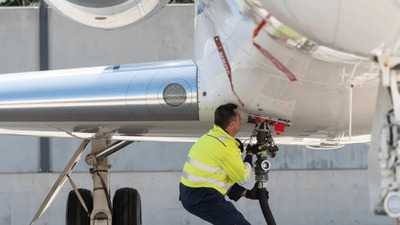
New Delhi: India has permitted the blending of ethanol and other synthetic or man-made hydrocarbons in aviation turbine fuel (ATF), but has not set any immediate mandatory blending targets, according to a government notification.
The move follows amendments to the Aviation Turbine Fuel (Regulation of Marketing) Order, 2001, under the Essential Commodities Act, 1955, which broadened the definition of ATF to include blends with synthetic hydrocarbons.
This is with a view to cutting emissions and reducing reliance on the import of oil. However, no mandatory blending targets have been set so far.
Also Read
Nitin Gadkari pushes for 100 pc ethanol blending amid West Asia oil concernsThe Ministry of Petroleum and Natural Gas (MoPNG), through a gazette notification, amended rules governing the marketing of ATF, broadening the definition of the fuel and aligning enforcement provisions with updated criminal procedures.
Under the amendment, ATF is now defined as a mixture of hydrocarbons conforming to IS 1571 specifications or blends with synthetic hydrocarbons under IS 17081 standards, enabling the inclusion of newer fuel variants.
ATF is primarily produced by refining crude oil. Globally, countries such as the UK and Japan are increasingly mandating blending sustainable aviation fuel (SAF), which is produced by converting renewable feedstocks, such as waste oils and fats, sugar and cereal, municipal solid waste, wood and agricultural residues, or CO2, in ATF to cut emissions.
SAF is also sometimes referred to as synthetic or man-made hydrocarbons.
India is targeting to blend 1 per cent SAF into jet fuel for international flights by 2027, rising to 2 per cent by 2028 and 5 per cent by 2030 in line with the CORSIA mandate.
Also Read
Jet fuel prices double, domestic, international travel to become more expensiveNo targets for fuel used in domestic flights have been set so far.
The Carbon Offsetting and Reduction Scheme for International Aviation (CORSIA) is an International Civil Aviation Organisation (ICAO)-led mandatory global scheme requiring airlines to offset CO2 emissions from international flights exceeding 2020 levels. While voluntary from 2021-2026, it becomes mandatory for most states from 2027 to 2035, aiming for carbon-neutral growth.
The ministry’s notification also updates enforcement provisions to apply search and seizure rules under the Bharatiya Nagarik Suraksha Sanhita, 2023, replacing earlier references.
The amendment, titled the Aviation Turbine Fuel (Regulation of Marketing) Amendment Order, 2026, takes effect upon publication in the Official Gazette.
Get the latest updates in Hyderabad City News, Technology, Entertainment, Sports, Politics and Top Stories on WhatsApp & Telegram by subscribing to our channels. You can also download our app for Android and iOS.
-
Data Scientist: What Education is Required to Become a Data Scientist, and How Do You Start a Career in the Field?

-
Train News: Rules Changed for Disabled Train Passengers; Railways Issues Update Regarding UDID Cards

-
Good News for Government Employees: Now Receive a Massive Payout with 60% DA
-
Stuck Payment? Get an Instant Refund—RBI Changes the Entire Game for Wallet Users and Prepaid Cards
-
CBSE Board's Second Exam Starts May 15: View Full Datesheet Here