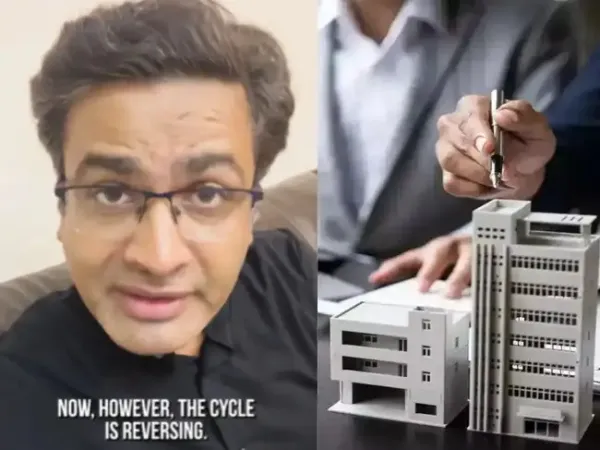
In the real estate market, where luxury homes have become a new fashion in the last few years after Covid period, a property market analyst has predicted that a quiet shift is reshaping the dreams of countless families. New launches of 1BHK apartments in Mumbai dropped sharply by nearly 50 per cent in 2025, falling to just around 9,786 units. This comes after years where the annual average hovered closer to 20,000, according to data tracked by Mumbai Housing Compass and shared by real estate analyst Vishal Bhargava.
Also Read: Hyderabad laid-off techie turns 'ganja engineer' on terrace; 17 plants that could yield 10 kg seized
The ground reality echoes this concern. In core Mumbai, genuine sub-₹1 crore 1BHK choices have become rare, often limited to distant suburbs like Thane, Mira Road, or even further corridors toward Karjat. Some buyers note that what used to be a modest 450 sq ft carpet 1BHK has quietly morphed into marketed 2BHK units in the same tight footprint.
Others lament that even at ₹1 crore plus, a basic 1BHK feels like a cramped cage, tiny kitchens, awkward bathrooms, no proper balcony, and parking headaches forcing vehicles onto already congested roads. Social media reactions poured in thick and fast after the post gained traction. Many shared stories of frustration: “Mumbai is nothing more than a slum for 99 per cent of the citizens,” one user remarked bluntly.
Another highlighted how 2BHKs in places like Bhayandar now start at ₹1.3-1.5 crore, a jump that happened in just the last couple of years. Luxury ads for 4BHK units touching ₹8-9 crore in Borivali drew sarcastic laughs, while some pointed fingers at big developers chasing premium segments under the garb of “luxury.”
A few voices pushed back, arguing that today’s middle class aspires for at least a 2BHK or even 3BHK, viewing 1BHK as entry-level for lower-income groups. Yet the broader sentiment remains sharp, ability to pay has not kept pace with soaring prices, and the ecosystem appears tuned more to high-end buyers. One exchange summed it up well: demand isn’t just willingness; without real purchasing power, it simply doesn’t exist.
Concerns about a builder “cartel” and government levies eating into costs also surfaced, though the core issue remains the supply crunch for everyday homes. This isn’t unique to Mumbai alone, similar murmurs rise from Pune, Hyderabad, and Bengaluru, where inventory of smaller, affordable houses feels scarce beyond government schemes. As the market cools, questions loom: Will prices adjust enough for the middle class to breathe? Or will builders double down on luxury, treating compact homes as an afterthought?
For now, Mumbai’s skyline keeps rising with taller, pricier towers. But for the salaried families, young professionals, and long-time residents who keep the city running, the message from the numbers is clear, the ladder to owning even a small roof overhead has grown steeper. Whether the slowdown forces a reset remains to be seen, but the conversation has clearly begun.
Also Read: Hyderabad laid-off techie turns 'ganja engineer' on terrace; 17 plants that could yield 10 kg seized
Builders shifted focus to bigger homes
He highlighted that post-Covid, builders had turned their focus away from 1BHK houses in Mumbai to bigger size houses. He said this happened due to post-pandemic gains in stock markets and startup success stories created a wave of buyers eager for bigger spaces — 2BHK, 3BHK, even 4BHK homes. These larger units were also beneficial for builder due to better margins, while 1BHK projects often squeeze profits thin. The result? The average price tag for a fresh apartment in Mumbai has climbed to about ₹3 crore, pushing compact, budget-friendly options further out of reach for many in the city’s core areas, Bhargava said.‘Market may circle back to the middle class’
Bhargava pointed out how buyer preferences flipped after COVID, with demand tilting heavily toward spacious homes. Developers happily followed suit, sidelining the smaller formats that once formed the backbone of middle-class housing. Now, as sales momentum slows and affordability worries mount heading into 2026, he believes the market may circle back to reality: “Mumbai has forgotten the middle-class... As the market slows down further, Mumbai will once again remember the middle-class.”The ground reality echoes this concern. In core Mumbai, genuine sub-₹1 crore 1BHK choices have become rare, often limited to distant suburbs like Thane, Mira Road, or even further corridors toward Karjat. Some buyers note that what used to be a modest 450 sq ft carpet 1BHK has quietly morphed into marketed 2BHK units in the same tight footprint.
Others lament that even at ₹1 crore plus, a basic 1BHK feels like a cramped cage, tiny kitchens, awkward bathrooms, no proper balcony, and parking headaches forcing vehicles onto already congested roads. Social media reactions poured in thick and fast after the post gained traction. Many shared stories of frustration: “Mumbai is nothing more than a slum for 99 per cent of the citizens,” one user remarked bluntly.
Another highlighted how 2BHKs in places like Bhayandar now start at ₹1.3-1.5 crore, a jump that happened in just the last couple of years. Luxury ads for 4BHK units touching ₹8-9 crore in Borivali drew sarcastic laughs, while some pointed fingers at big developers chasing premium segments under the garb of “luxury.”
A few voices pushed back, arguing that today’s middle class aspires for at least a 2BHK or even 3BHK, viewing 1BHK as entry-level for lower-income groups. Yet the broader sentiment remains sharp, ability to pay has not kept pace with soaring prices, and the ecosystem appears tuned more to high-end buyers. One exchange summed it up well: demand isn’t just willingness; without real purchasing power, it simply doesn’t exist.
Concerns about a builder “cartel” and government levies eating into costs also surfaced, though the core issue remains the supply crunch for everyday homes. This isn’t unique to Mumbai alone, similar murmurs rise from Pune, Hyderabad, and Bengaluru, where inventory of smaller, affordable houses feels scarce beyond government schemes. As the market cools, questions loom: Will prices adjust enough for the middle class to breathe? Or will builders double down on luxury, treating compact homes as an afterthought?
For now, Mumbai’s skyline keeps rising with taller, pricier towers. But for the salaried families, young professionals, and long-time residents who keep the city running, the message from the numbers is clear, the ladder to owning even a small roof overhead has grown steeper. Whether the slowdown forces a reset remains to be seen, but the conversation has clearly begun.