
Workers most concerned about AI-driven job displacement are those in roles where Anthropic has observed Claude doing the most work, according to a new survey study by the AI startup published on Wednesday, April 22.
The survey, based on responses from over 81,000 Claude users, found that about one-fifth of respondents expressed concern about economic displacement, with workers in highly exposed roles such as software engineers more worried about losing their jobs to AI than, for instance, elementary school teachers.
This finding is consistent with the fact that Claude usage skews toward coding tasksAnthropic said. The survey study is focused on understanding the economic impact of AI by looking primarily at “what work Claude is being asked to do, and in which jobs Claude is doing the largest share of tasks.”
Notably, it provides early evidence that observed exposure is cor with economic concern around AI. It is a combined analysis of responses from 81,000 Claude users as well as Anthropic’s internal understanding of Claude traffic.
Anthropic researchers said they used Claude-powered classifiers to infer respondents’ attributes and the sentiments behind their responses. Job loss concerns were also measured by prompting Claude to identify and interpret respondents’ statements on their roles being at risk of AI-led displacement.
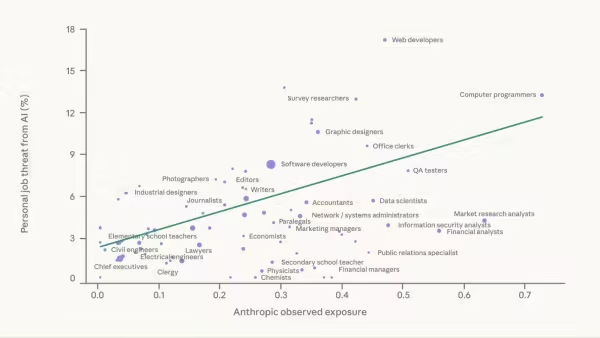 Personal job threat and observed exposure. (Image: Anthropic)
The company further announced the launch of a monthly Economic Index Survey that will look to capture a new corpus of qualitative data about how AI is affecting jobs, productivity, and unemployment.
“Collecting these data monthly will enable measurement of not just what people experience and expect, but how quickly their views shift as AI capabilities evolve. Combined with Claude usage data in a privacy-preserving way, these first-hand accounts can surface change before it shows up in aggregate labor market data,” Anthropic said.
Story continues below this ad
Other key findings of the survey
Anthropic said it used AI-powered classifiers to infer respondents’ career stages from their statements. It found that early-career respondents were much more likely to express concern about job displacement than senior workers.
As a measure of productivity gains from AI, Claude was used to rate respondents’ answers on a scale of 1 to 7, with 1 being ‘less productive’ and so on. The mean productivity rating of the survey sample was 5.1, corresponding to ‘substantially more productive’, as per the survey. Over three per cent of respondents reported negative or neutral impacts, and 42 per cent did not give a clear indication on productivity.
However, these findings came with a disclaimer: “Our respondents were, of course, active Claude users who were willing to take a survey. This could make them more likely to report productivity benefits than the average user.”
Workers at both ends of the pay scale, those in high-paying jobs such as software developers and lowest-paid workers such as customer service representatives, reported the largest productivity gains from AI, as per the survey. In contrast, scientists and lawyers reported the ‘mildest’ productivity improvements following AI adoption.
Story continues below this ad
While most of the respondents said that AI usage benefits themselves, 10 per cent of them responded that greater AI use benefits employers and clients by enabling them to ask for and get more work out of employees. Furthermore, only 60 per cent of early-career workers indicated that they personally benefited from AI, compared to 80 per cent of senior professionals.
When asked if AI use helped workers expand the scope of their roles, speed up work, improve quality, or cut down on costs, a majority of them (48 per cent of respondents) identified scope as the most common productivity- effect of AI whereas 40 per cent of users emphasised speed as the key enhancement due to AI tools.