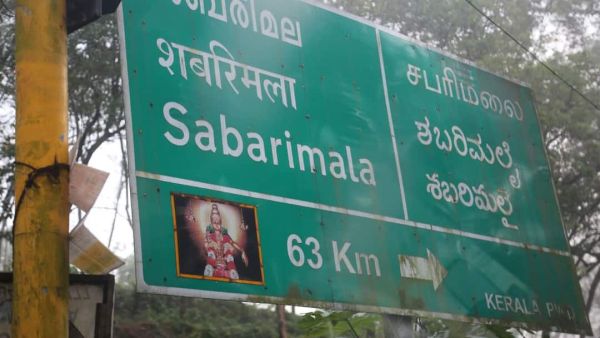
The case concerning the entry of young women into the Sabarimala temple has taken a complex turn in the Supreme Court. The debate now centres on balancing the right to religious freedom with women’s fundamental rights.
During the proceedings, arguments have been presented not only by Hindu organisations but also by Muslim, Dawoodi Bohra, Parsi and Jain groups, as the court’s eventual ruling is expected to have wider implications across religions.
‘WhatsApp University’ Remark In Court
The Supreme Court on Thursday referred to the commonly used phrase “WhatsApp University,” often used for misinformation circulating on social media.
On the eighth day of the hearing before a nine-judge bench, senior advocate Neeraj Kishan Kaul, appearing for a Dawoodi Bohra organisation, cited an article by MP Shashi Tharoor on religious freedom.
Responding to this, Chief Justice Surya Kant said, “The court respects the views of authors, but it is better that arguments are based on law.”
Justice B V Nagarathna added in a lighter vein, “Knowledge should be respected, provided it does not come from WhatsApp University.”
Debate On Women’s Entry Into Mosques
Appearing for a Muslim organisation, senior advocate M R Shamshad addressed the issue of women’s entry into mosques.
He argued that in Islam, it is not mandatory for women to offer prayers in mosques, as they receive equal spiritual merit by praying at home.
Justice Ahsanuddin Amanullah asked him to explain the reasoning behind such a position in Hadith, observing, “You should also explain the reason given in Hadith for this. That reason is that someone should be at home to take care of children.”
Is A Mosque Essential For Prayer?
Shamshad further argued that while there are demands to allow women into mosques, the Supreme Court itself had held in the ‘Ismail Faruqui’ case that a mosque is not essential for offering namaz.
Justice Nagarathna responded, “But saying that is like saying a temple is not essential in Hinduism.”
Shamshad agreed, stating, “Exactly, that has been our argument, but unfortunately the Ismail Faruqui judgment has become the basis for several other Supreme Court rulings.”
Jain Group’s Argument On Religious Practices
Senior advocate Krishnan Venugopal, representing a plea filed under the name ‘Geetarth Ganga’ on the instructions of Jain Acharya Yugbhushansuri Ji, argued that the right to religious freedom is subject to health, morality and public order.
He said courts or the government can intervene if these are violated, but criticised the Supreme Court’s doctrine of protecting only “essential religious practices.”
He added that determining whether a practice is essential should not be the court’s role.
Venugopal also pointed out that several natural sites, including ‘Sammed Shikharji’, are revered due to their association with Jain Tirthankaras. While the government has the authority to acquire land, he argued it should refrain from acquiring such sacred sites.
-
Sanju Samson, Akeal Hosein power CSK to massive 103-run win over MI in IPL
-
Wall Street Pauses As Iran Tensions Persist, Earnings Stir AI Concerns

-
10-Year-old rescues endangered Mexican Axolotl from Welsh river

-
Common egg myths every home cook should know

-
'Princess Diaries 3' is 'coming': Garry Marshall's daughter Kathleen Marshall shares update