What are some of the most innovative political campaigns you have come across? From John F. Kennedy’s mastery of television during the 1960s debates to today’s social media wars filled with songs and skits, political campaigns have long relied on creativity to cut through the noise.
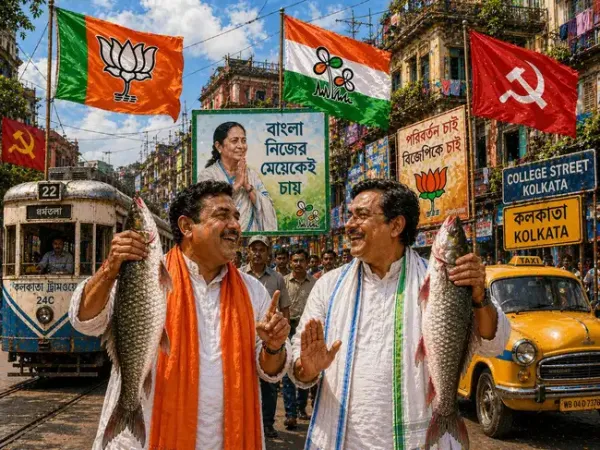
In West Bengal this time, there’s another innovative political campaign taking shape largely between Mamata Banerjee’s Trinamool Congress and Narendra Modi-led Bharatiya Janata Party. While slogans, songs, and even theatrics are now familiar, the campaigns this time involve fish, a staple deeply embedded in Bengal’s food culture.
Click here to track developments on 2026 state elections
Sharadwat Mukhopadhyay, BJP’s candidate from Bidhannagar in Kolkata, took to the campaign trail holding a large fish. On Bengali New Year’s Day, another BJP candidate Koustav Bagchi also did the same, while TMC candidate and former Bengal minister Aroop Biswas too carried a fish during his campaign.
Home Minister Amit Shah and former minister Smriti Irani have also joined the debate that BJP is not against Bengal’s love for fish and meat. BJP MP Anurag Thakur was also seen eating fish and rice before the first phase of West Bengal polls.
This is perhaps a signal aimed at reassuring voters that a BJP government in West Bengal would not seek to curb non-vegetarian food habits.
In a state where food is tightly woven into cultural identity, the gesture reflects BJP’s attempt to counter a persistent political narrative that has sought to portray the party as culturally restrictive. The imagery, rooted in Bengal’s ‘maach-bhaat’ (fish and rice) culture, signals a broader shift in messaging to better align with regional sentiments.
Yet beyond the campaign optics, fish and meat in West Bengal represent far more than a political talking point. Beneath the noise of slogans and symbolism lies a vast, deeply entrenched economic ecosystem, one that cuts across livelihoods, consumption patterns and exports. The real story is unfolding in markets, supply chains and balance sheets, where Bengal’s non-vegetarian economy continues to operate as a powerful growth engine.
“Business and politics should not be mixed here. The prospect of growing domestic sales and exports for fish and meat is quite good. This will provide better livelihood to a large number of people,” said Ajitava Raychaudhuri, former professor and head, Department of Economics, Jadavpur University.
Also Read: West Bengal Elections: The real numbers test for Mamata Banerjee’s command & BJP’s pitch
West Bengal’s non-vegetarian economy is a major business story hiding in plain sight. It fuels value creation at multiple levels, from restaurants, quick-service formats, cloud kitchens, fisheries, poultry, cold-chain logistics, exports, to thousands of direct and indirect jobs, said Debaditya Chaudhury - Managing Director of Chowman, Oudh 1590, Chapter 2 & Chaudhury & Company.
“Bengal is not “non-veg” in a superficial sense. It is non-veg because ecology made it natural, history made it richer, and culture made it permanent,” said Indrajit Lahiri, author and food vlogger.
Lahiri, who is popularly known as Foodka on social media, said Bengal’s connection with fish and meat is shaped first by its geography and then by its culture. As a river-rich region filled with ponds and wetlands, fish has long been an easy and everyday source of protein, gradually becoming a habit and part of identity rather than just food. He added that meat has followed a slightly different path, gaining importance through Bengal's, and particularly Kolkata’s, history of migration, trade and cultural exchange. Over time, dishes such as mutton, chicken, kebabs and biryani became an integral part of the region’s urban food culture.
Ajitava Raychaudhuri said that fish production is an important livelihood in West Bengal. In 2011–12, it contributed 3.3% to the state’s GSDP, but this fell to 2.1% in 2022–23, according to the latest available data from All India Fish Statistics and the RBI. The same data shows that in 2019–20, about 3.25% of the state’s population were fishermen, one of the highest shares in India. In 2020–21, marine products made up 5.46% of West Bengal’s total exports.
Fish consumption per head in West Bengal in 2022–23 ranked eighth in India, indicating scope for further growth. Marine products exports, especially shrimps, have good prospects if processing is improved, Raychaudhuri said.
Bengal’s fish and meat economy stretches across multiple layers, aquaculture, wholesale trade, cold chain, retail, delivery, cloud kitchens, QSR formats, legacy restaurants, packaged food and exports.
“When you look at prawns, freshwater fish, hilsa, processing, and export potential, you realize this is not a side story. It is a real industry,” Foodka, or Lahiri, said.
Meat production also is an important business in this part although its contribution to bovine meat export is still not significant. However, poultry meat exports rose to $610,000 in 2023–24 from negligible levels in 2022–23, indicating rising prospects in the segment, Raychaudhuri said.
According to Indian government’s Basic Animal Husbandry Statistics 2025, West Bengal accounts for about 12.46% of the country’s meat output, making it the largest producing state. This underlines the strong demand and sizeable market for meat-based products. Uttar Pradesh is second with 12.2%, followed by Maharashtra at 11.57%.
West Bengal remains the second-largest fish producer with annual output of about 2 million tonnes in 2025–26, according to the State Fishery Officers’ Association. The state leads in inland fish production and is among the top suppliers of fish seed, accounting for more than 16% of the country’s total output. The sector supports the livelihoods of nearly 3.2 million people and has an estimated potential of around 3.4 million tonnes, indicating further headroom for growth.
India’s Department of Fisheries data shows West Bengal has a 158 km coastline and 2,526 km of rivers and canals.
India’s seafood exports have climbed to ₹62,408.45 crore in 2024–25 from ₹43,720.98 crore in 2020–21, an increase of about 42.7%, according to government data. West Bengal has mirrored this trend, with exports rising to ₹4,321.1 crore from ₹3,595.1 crore. However, the state continues to trail leading exporters such as Andhra Pradesh (₹21,246 crore) and Maharashtra (₹7,343.4 crore).
The export gap points to infrastructure constraints, particularly around ports and processing, which could shape the next phase of growth.
While direct listed exposure to Bengal’s non-vegetarian consumption is limited, companies across poultry, quick-service restaurants and fisheries exports stand to benefit indirectly as organised consumption rises.
Cold-chain gaps, high logistics costs and price volatility in feed and fuel continue to weigh on margins.
Unlike many North and West Indian markets, where vegetarian demand rises during festivals, West Bengal sees sustained consumption of fish and meat, making it relatively more resilient as a non-vegetarian demand market.
A 2025 festive report from Swiggy highlights the scale of demand in Kolkata during Durga Puja. Orders on Ashtami rose 11.26% year-on-year, with more than 60 orders per minute recorded between September 28 and 30, peaking at 197 orders in a single minute. Biryani dominated consumption, with over 9,000 mutton and chicken orders placed in three days. High-value spending was also evident, with one order worth ₹18,000. This underlines strong demand even when many are out pandal-hopping.
“In Bengal, non-vegetarian food is not a category, it is culture, memory, and daily life. Fish and meat are deeply embedded into both everyday meals and celebratory occasions, from a simple weekday lunch to festive gatherings during Durga Puja and family milestones. This cultural centrality naturally translates into the restaurant economy as well,” Chowman and Oudh’s Chaudhury said.
He said West Bengal stands out as one of the country’s strongest non-vegetarian markets, with nearly 80% of demand skewed towards meat-based dishes in his restaurants. The preference also drives repeat orders, family dining and festive spikes.
An estimated 98–99% of the population consumes non-vegetarian food, with nearly 18.9% of household expenditure going towards fish and meat, among the highest in India, he said. This positions non-vegetarian food as central not just to culture, but to the state’s wider economy, spanning restaurants, supply chains, fisheries, meat distribution and employment.
Consumption patterns also vary across cities, with Kolkata showing an 80:20 non-veg to veg split, compared with 60:40 in Delhi, 70:30 in Bengaluru and 75:25 in Mumbai, according to Chaudhury.
From a restaurant perspective, non-vegetarian dishes lift both average order values and repeat consumption. Fish specialities, chicken dishes and seafood bowls contribute meaningfully to margins, making Bengal one of the most dependable food business markets in the country.
What’s changing now is the narrative around food, Lahiri said. Earlier, heritage simply existed; now it can be shaped and branded. What was once routine is now seen as identity, experience and business, opening up opportunities for tourism, food ventures and stronger regional brands.
“Bengal’s non-vegetarian heritage is moving from cultural continuity to economic structure. And that shift matters. Because behind every plate of fish or meat in Bengal, there is not just taste, there is livelihood, logistics, memory, and market,” Lahiri said.
In West Bengal this time, there’s another innovative political campaign taking shape largely between Mamata Banerjee’s Trinamool Congress and Narendra Modi-led Bharatiya Janata Party. While slogans, songs, and even theatrics are now familiar, the campaigns this time involve fish, a staple deeply embedded in Bengal’s food culture.
Click here to track developments on 2026 state elections
Sharadwat Mukhopadhyay, BJP’s candidate from Bidhannagar in Kolkata, took to the campaign trail holding a large fish. On Bengali New Year’s Day, another BJP candidate Koustav Bagchi also did the same, while TMC candidate and former Bengal minister Aroop Biswas too carried a fish during his campaign.
Home Minister Amit Shah and former minister Smriti Irani have also joined the debate that BJP is not against Bengal’s love for fish and meat. BJP MP Anurag Thakur was also seen eating fish and rice before the first phase of West Bengal polls.
This is perhaps a signal aimed at reassuring voters that a BJP government in West Bengal would not seek to curb non-vegetarian food habits.
Fish, Bengali culture & the deeper money message
In a state where food is tightly woven into cultural identity, the gesture reflects BJP’s attempt to counter a persistent political narrative that has sought to portray the party as culturally restrictive. The imagery, rooted in Bengal’s ‘maach-bhaat’ (fish and rice) culture, signals a broader shift in messaging to better align with regional sentiments.
Yet beyond the campaign optics, fish and meat in West Bengal represent far more than a political talking point. Beneath the noise of slogans and symbolism lies a vast, deeply entrenched economic ecosystem, one that cuts across livelihoods, consumption patterns and exports. The real story is unfolding in markets, supply chains and balance sheets, where Bengal’s non-vegetarian economy continues to operate as a powerful growth engine.
“Business and politics should not be mixed here. The prospect of growing domestic sales and exports for fish and meat is quite good. This will provide better livelihood to a large number of people,” said Ajitava Raychaudhuri, former professor and head, Department of Economics, Jadavpur University.
Also Read: West Bengal Elections: The real numbers test for Mamata Banerjee’s command & BJP’s pitch
West Bengal’s non-vegetarian economy is a major business story hiding in plain sight. It fuels value creation at multiple levels, from restaurants, quick-service formats, cloud kitchens, fisheries, poultry, cold-chain logistics, exports, to thousands of direct and indirect jobs, said Debaditya Chaudhury - Managing Director of Chowman, Oudh 1590, Chapter 2 & Chaudhury & Company.
“Bengal is not “non-veg” in a superficial sense. It is non-veg because ecology made it natural, history made it richer, and culture made it permanent,” said Indrajit Lahiri, author and food vlogger.
Lahiri, who is popularly known as Foodka on social media, said Bengal’s connection with fish and meat is shaped first by its geography and then by its culture. As a river-rich region filled with ponds and wetlands, fish has long been an easy and everyday source of protein, gradually becoming a habit and part of identity rather than just food. He added that meat has followed a slightly different path, gaining importance through Bengal's, and particularly Kolkata’s, history of migration, trade and cultural exchange. Over time, dishes such as mutton, chicken, kebabs and biryani became an integral part of the region’s urban food culture.
Fish, meat & business in West Bengal
Ajitava Raychaudhuri said that fish production is an important livelihood in West Bengal. In 2011–12, it contributed 3.3% to the state’s GSDP, but this fell to 2.1% in 2022–23, according to the latest available data from All India Fish Statistics and the RBI. The same data shows that in 2019–20, about 3.25% of the state’s population were fishermen, one of the highest shares in India. In 2020–21, marine products made up 5.46% of West Bengal’s total exports.
Fish consumption per head in West Bengal in 2022–23 ranked eighth in India, indicating scope for further growth. Marine products exports, especially shrimps, have good prospects if processing is improved, Raychaudhuri said.
Bengal’s fish and meat economy stretches across multiple layers, aquaculture, wholesale trade, cold chain, retail, delivery, cloud kitchens, QSR formats, legacy restaurants, packaged food and exports.
“When you look at prawns, freshwater fish, hilsa, processing, and export potential, you realize this is not a side story. It is a real industry,” Foodka, or Lahiri, said.
Meat production also is an important business in this part although its contribution to bovine meat export is still not significant. However, poultry meat exports rose to $610,000 in 2023–24 from negligible levels in 2022–23, indicating rising prospects in the segment, Raychaudhuri said.
According to Indian government’s Basic Animal Husbandry Statistics 2025, West Bengal accounts for about 12.46% of the country’s meat output, making it the largest producing state. This underlines the strong demand and sizeable market for meat-based products. Uttar Pradesh is second with 12.2%, followed by Maharashtra at 11.57%.
West Bengal remains the second-largest fish producer with annual output of about 2 million tonnes in 2025–26, according to the State Fishery Officers’ Association. The state leads in inland fish production and is among the top suppliers of fish seed, accounting for more than 16% of the country’s total output. The sector supports the livelihoods of nearly 3.2 million people and has an estimated potential of around 3.4 million tonnes, indicating further headroom for growth.
India’s Department of Fisheries data shows West Bengal has a 158 km coastline and 2,526 km of rivers and canals.
Exports, scale and the next growth frontier
India’s seafood exports have climbed to ₹62,408.45 crore in 2024–25 from ₹43,720.98 crore in 2020–21, an increase of about 42.7%, according to government data. West Bengal has mirrored this trend, with exports rising to ₹4,321.1 crore from ₹3,595.1 crore. However, the state continues to trail leading exporters such as Andhra Pradesh (₹21,246 crore) and Maharashtra (₹7,343.4 crore).
The export gap points to infrastructure constraints, particularly around ports and processing, which could shape the next phase of growth.
While direct listed exposure to Bengal’s non-vegetarian consumption is limited, companies across poultry, quick-service restaurants and fisheries exports stand to benefit indirectly as organised consumption rises.
Cold-chain gaps, high logistics costs and price volatility in feed and fuel continue to weigh on margins.
Restaurants ride Bengal’s non-veg appetite
Unlike many North and West Indian markets, where vegetarian demand rises during festivals, West Bengal sees sustained consumption of fish and meat, making it relatively more resilient as a non-vegetarian demand market.
A 2025 festive report from Swiggy highlights the scale of demand in Kolkata during Durga Puja. Orders on Ashtami rose 11.26% year-on-year, with more than 60 orders per minute recorded between September 28 and 30, peaking at 197 orders in a single minute. Biryani dominated consumption, with over 9,000 mutton and chicken orders placed in three days. High-value spending was also evident, with one order worth ₹18,000. This underlines strong demand even when many are out pandal-hopping.
“In Bengal, non-vegetarian food is not a category, it is culture, memory, and daily life. Fish and meat are deeply embedded into both everyday meals and celebratory occasions, from a simple weekday lunch to festive gatherings during Durga Puja and family milestones. This cultural centrality naturally translates into the restaurant economy as well,” Chowman and Oudh’s Chaudhury said.
He said West Bengal stands out as one of the country’s strongest non-vegetarian markets, with nearly 80% of demand skewed towards meat-based dishes in his restaurants. The preference also drives repeat orders, family dining and festive spikes.
An estimated 98–99% of the population consumes non-vegetarian food, with nearly 18.9% of household expenditure going towards fish and meat, among the highest in India, he said. This positions non-vegetarian food as central not just to culture, but to the state’s wider economy, spanning restaurants, supply chains, fisheries, meat distribution and employment.
Consumption patterns also vary across cities, with Kolkata showing an 80:20 non-veg to veg split, compared with 60:40 in Delhi, 70:30 in Bengaluru and 75:25 in Mumbai, according to Chaudhury.
From a restaurant perspective, non-vegetarian dishes lift both average order values and repeat consumption. Fish specialities, chicken dishes and seafood bowls contribute meaningfully to margins, making Bengal one of the most dependable food business markets in the country.
What’s changing now is the narrative around food, Lahiri said. Earlier, heritage simply existed; now it can be shaped and branded. What was once routine is now seen as identity, experience and business, opening up opportunities for tourism, food ventures and stronger regional brands.
“Bengal’s non-vegetarian heritage is moving from cultural continuity to economic structure. And that shift matters. Because behind every plate of fish or meat in Bengal, there is not just taste, there is livelihood, logistics, memory, and market,” Lahiri said.