
Listen to this article in summarized format
Loading...
××
Subscribe to

Unlock AI Briefing and Premium Content
New Year Offer 24 Hours Left
Subscribe NowAlready a member? Sign In
What's Included
- Exclusive Stories
- Daily ePaper Access
- Smart Market Tools
- Curated Investment Ideas
- Ad-lite Experience
Subscription

Space has a way of making even the biggest human achievements feel small. A recent viral reel has reignited that feeling, claiming that a spacecraft launched nearly half a century ago is about to hit a milestone so vast it’s hard to comprehend. The idea sounds almost unreal, sparking both fascination and doubt online. But is it exaggerated storytelling, or is there real science behind it? The answer lies somewhere between awe-inspiring fact and misunderstood scale.
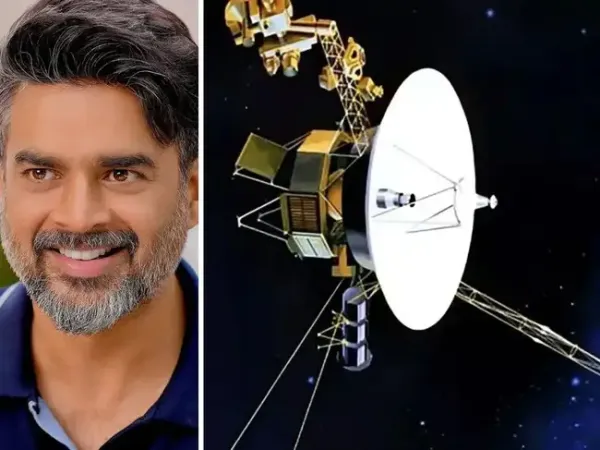
Actor R Madhavan recently shared a reel that quickly caught attention for its dramatic explanation of Voyager 1 and its journey through space. The video suggested that by November 2026, the spacecraft could reach a distance equivalent to one light day from Earth, a concept that left many viewers both amazed and sceptical.
The reel attempted to break down what a “light day” means. It also highlighted how even at extraordinary speeds, human-made objects take decades to cover what light crosses in just one day. It also pointed out a striking communication delay. Signals sent from Earth travel at the speed of light, meaning it can take nearly a full day to reach Voyager 1, and another full day for a response to return. Any interaction with the spacecraft effectively unfolds over nearly 48 hours.
Netizens are divided
The internet, however, was divided. Some users questioned whether a machine built in the 1970s could realistically survive for so long in space without collisions or major failures. Others found the idea difficult to grasp, describing it as both chilling and incomprehensible. A few dismissed the claim entirely, doubting the feasibility of such long-term operation in extreme conditions.
Fact or fiction?
To separate fact from fiction, it helps to look at what NASA officially states.
Voyager 1 was launched in 1977 with the primary mission of studying Jupiter and Saturn. After completing its planetary flybys, it continued its journey outward. In August 2012, it became the first human-made object to enter interstellar space, moving beyond the heliosphere, the region influenced by the Sun.
Decades later, it is still operational. The spacecraft continues to send data back to Earth through NASA’s Deep Space Network. Four of its scientific instruments remain active, including those studying cosmic rays, charged particles, magnetic fields and plasma waves. As of August 21, 2024, Voyager 1 was about 164.7 astronomical units away from Earth, making it the most distant human-made object ever. It is travelling at roughly 38,000 miles per hour relative to the Sun.
Actor R Madhavan recently shared a reel that quickly caught attention for its dramatic explanation of Voyager 1 and its journey through space. The video suggested that by November 2026, the spacecraft could reach a distance equivalent to one light day from Earth, a concept that left many viewers both amazed and sceptical.
The reel attempted to break down what a “light day” means. It also highlighted how even at extraordinary speeds, human-made objects take decades to cover what light crosses in just one day. It also pointed out a striking communication delay. Signals sent from Earth travel at the speed of light, meaning it can take nearly a full day to reach Voyager 1, and another full day for a response to return. Any interaction with the spacecraft effectively unfolds over nearly 48 hours.
Netizens are divided
The internet, however, was divided. Some users questioned whether a machine built in the 1970s could realistically survive for so long in space without collisions or major failures. Others found the idea difficult to grasp, describing it as both chilling and incomprehensible. A few dismissed the claim entirely, doubting the feasibility of such long-term operation in extreme conditions.Fact or fiction?
To separate fact from fiction, it helps to look at what NASA officially states.Voyager 1 was launched in 1977 with the primary mission of studying Jupiter and Saturn. After completing its planetary flybys, it continued its journey outward. In August 2012, it became the first human-made object to enter interstellar space, moving beyond the heliosphere, the region influenced by the Sun.
Decades later, it is still operational. The spacecraft continues to send data back to Earth through NASA’s Deep Space Network. Four of its scientific instruments remain active, including those studying cosmic rays, charged particles, magnetic fields and plasma waves. As of August 21, 2024, Voyager 1 was about 164.7 astronomical units away from Earth, making it the most distant human-made object ever. It is travelling at roughly 38,000 miles per hour relative to the Sun.