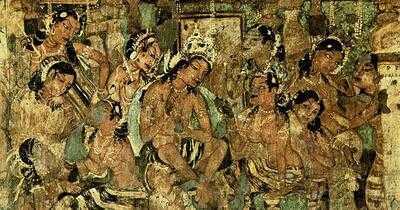
After John Smith’s accidental rediscovery of the Ajanta caves while on that game-changing tiger hunt, news spread fast among not just the colonial Europeans in India, but across the seas in Britain as well. This was a startling find!
Scholars researching Eastern history, languages and cultures, from institutions like the Bombay Literary Society and the Asiatic Society of Bengal, spoke and wrote about the caves in detail. They also alerted the British East India Company, which controlled most parts of India at the time, about the delicate condition of the murals. Funds were needed urgently to safeguard them before they were destroyed – not just by nature, but also by vandals and treasure hunters who didn’t hesitate to gouge out sections of the panels to sell them in the West.
Curiously, the first attempts at restoring the murals were not to preserve the art, but to preserve memories of it for a time when the originals would fade away. Skilled artists were paid to create copies of the paintings. Some of them chose to show the murals as they were, decaying, while others created “perfect” copies.
The many attemptsMajor Robert Gill, a soldier and painter from the Madras Army, laboured from 1844 for nearly 20...
Read more
-
TCS case: No evidence of 'conversion conspiracy', says APCR report
-
I'm A Celebrity's Adam Thomas dealt huge blow before final as winner 'exposed'

-
Dog trainer mum-of-three shares 7 reasons raising a puppy is harder than a baby

-
Driving License Application Made Easier: No More RTO Visits

-
Fertiliser supply strong, stable and above requirement across India: Govt