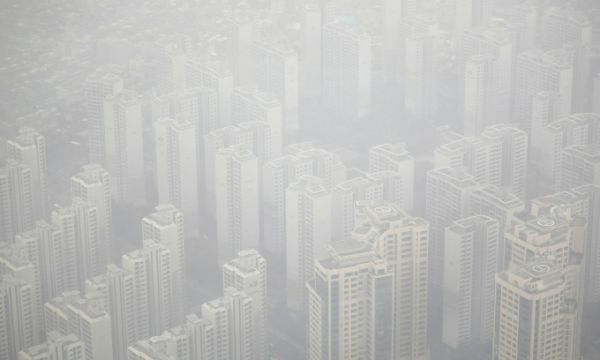
South Korean authorities warned of possible “yellow dust rain” this week as air quality held at “bad” levels nationwide, with dust from deserts in China and Mongolia continuing to linger days after first blanketing the peninsula.
The Korea Meteorological Administration said residual dust carried by strong winds remained in place, though no further inflow was expected, The Korea Herald reported. Fine dust concentrations are forecast to stay elevated throughout the day, with the highest levels in Incheon and on Jeju Island.
Yellow dust, known locally as hwangsa, is a recurring spring phenomenon in which fine soil particles from the Gobi and other East Asian deserts are carried east by prevailing winds. Seoul averaged 10.6 yellow dust days a year between 2020 and 2024, up from 8.9 across the 1991-2020 reference period, according to KMA records.
This week’s episode began April 19, when dust from southern Mongolia and northern China was pulled into the Korean Peninsula on northwesterly winds generated by a low-pressure system to the north and a high-pressure system to the southwest, the National Institute of Environmental Research’s Air Quality Forecasting Center said.
PM10 concentrations, airborne particles 10 micrometers or smaller, surged past 150 micrograms per cubic meter in most regions on April 20, triggering “very bad” ratings, the highest grade in South Korea’s four-tier forecast.
|
Apartment complexes are seen shrouded by fine dust during a polluted day in Seoul, March 6, 2019. Photo by Reuters |
Authorities flagged the possibility of “yellow dust rain,” in which rainfall mixes with suspended dust particles, and advised the public to avoid direct exposure. Older adults and individuals with respiratory conditions were urged to wear protective masks outdoors.
Skies began to clear from April 24, with temperatures gradually rising later in the week and largely clear conditions expected through the weekend, accompanied by wide day-night temperature swings.
Dry conditions persisted inland despite the cloud cover. Dry weather advisories remained in place for Gangwon Province and northern North Gyeongsang Province, where strong winds are increasing wildfire risk. Gusts of up to 55 kph, or 70 kph in mountainous areas, are expected along Gangwon’s east coast and in its mountains.
-
Gemini Tarot Horoscope Today, April 25, 2026: Patience is needed in certain matters, trust the process

-
Scorpio Tarot Horoscope Today, April 25, 2026: Differences with spouse may increase, proceed with patience

-
Libra Daily Horoscope Today (Sept 23 - Oct 22), April 25, 2026: Happiness in Relationships and Reunion with a Loved One

-
Pisces Daily Horoscope Today (Feb 19 - Mar 20), April 25, 2026: Relationships Will Be Sweet, Will Go on a Trip with Relatives

-
Taurus Daily Horoscope Today (Apr 20 - May 20), April 25, 2026: Good health and consistent routine ahead