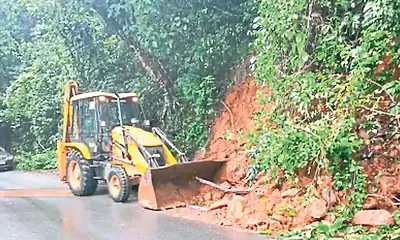
Karkala: The Western Ghats, considered older than the Himalayas and one of the world’s eight most sensitive biodiversity hotspots, are witnessing increasing environmental stress. Recognised as a UNESCO World Heritage Site in 2012, the region includes 39 protected areas. However, unscientific development projects and inaction by conservation bodies have led to a rise in landslides across the green belt.
Forest regions such as Agumbe, Kudremukh and Kodachadri, located along the border of Udupi and Dakshina Kannada districts, have been witnessing landslides every monsoon, raising concerns over potential large-scale disasters.
Ghats under threat
Around 60 per cent of Karnataka’s total forest area lies within the Western Ghats, which play a key role in regulating monsoon patterns. Recent landslides in Hulikal Ghat are seen as an example of a growing problem. The intensity of soil erosion and landslides has been increasing year after year across districts such as Dakshina Kannada, Udupi, Shivamogga, Chikkamagaluru and Kodagu.
Past disasters in Wayanad and Kodagu had highlighted the risks, but preventive measures remain limited.
Task force inactive
The Western Ghats Conservation Task Force, set up in 2008 to protect the region, is reportedly inactive. Initially formed with environmental experts, the body has not been active for nearly a decade.
Despite the chairman being given cabinet-rank status, no major policy decisions have been introduced for conservation. The task force has not conducted consultations in districts like Udupi or Dakshina Kannada. It has also remained silent on issues such as river diversion projects, the Yettinahole project, resort construction and forest encroachment.
Frequent landslides in Agumbe and Mala
During the previous monsoon, repeated landslides were reported in Agumbe and Mala regions. Geological studies have indicated that the soil layers in these areas are highly fragile and could pose serious risks in the future. Reports have been submitted to the government, but concerns remain over the lack of response from authorities.
Call for scientific monitoring
Experts have stated that departments such as Mines and Geology should not be limited to issuing permits for sand and stone mining. They should also study land structure and assess risks from unscientific projects.
Environmental scientist T V Ramachandra’s report on Western Ghats conservation has been highlighted as an important document that requires attention. Retired geologist Dr Uday Shankar from MIT Manipal emphasised the need for scientific evaluation and timely warnings.
Reasons behind rising concern
- Over 1,400 landslide incidents reported since 2010
- Large-scale deforestation and unscientific highway construction
- Excessive intervention in natural slope regions
- Illegal quarrying activities in ecologically sensitive zones
- River diversion projects without adequate environmental assessment
-
From Chhena Poda To Rasgulla, 8 Indian Desserts That Are Made With Cheese

-
Can sexual enhancement drugs kill?

-
Real-like bank check of Rs 69,000 made by AI goes viral, increased concern over digital scams

-
Now RCB is in trouble, will Flower replace Shepherd for Jacob Bethel?

-
Lucknow is struggling with continuous defeats and KKR is excited about its first win: Tomorrow will be a do or die match.