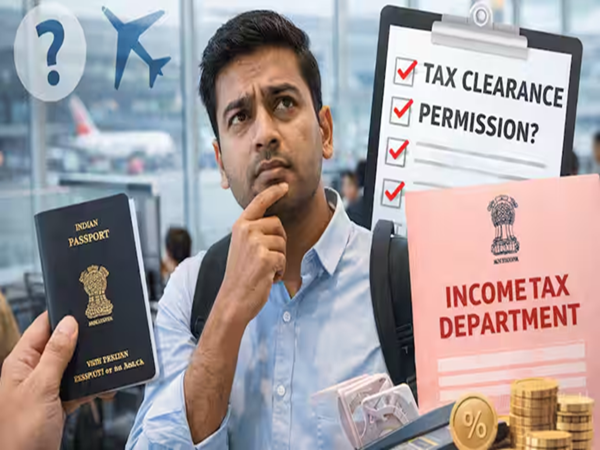
Recently, there has been considerable discussion regarding international travel, specifically the notion that it has now become mandatory for every individual to obtain an Income-Tax Clearance Certificate (ITCC) before traveling abroad. This apprehension has intensified, particularly following the introduction of the new Forms 157 and 159, fueling fears that one's travel plans might be stalled due to a lack of tax clearance.
However, if one examines the law closely, these fears are, to a large extent, unfounded. The Income-Tax Act, 2025, contains no provision making the ITCC mandatory for every single traveler. In reality, this requirement applies only under specific circumstances.
International Travel and Tax Clearance: Myth vs. Reality
Often, when the government notifies new forms, the public perceives it as the imposition of a new burden. The same scenario has unfolded here. The introduction of Forms 157 and 159 does not signify a change in the underlying rules; rather, it merely represents a restructuring of the existing procedure into a new documentary format.
How Did the Confusion Arise?
Two new forms have been introduced pursuant to Rule 228(4) of the Income Tax Rules, 2026. Form 157 serves as the application submitted to obtain clearance, while Form 159 is the actual certificate issued by the Department. As soon as discussions regarding these forms began, people assumed that every individual would now be required to fill them out. However, under the law, legal obligations are determined not by 'forms,' but by the 'Act' itself—the statute enacted by the legislature. And the Act is quite explicit on this matter.
What Does Section 420 Say?
Section 420 of the new Income Tax Act, 2025, is essentially a re-enactment of Section 230(1A) of the erstwhile Income Tax Act of 1961. This outlines a verification process at two distinct levels:
**General Information:** As per Section 420(3), any individual residing in India who is traveling abroad is required to provide only their PAN (Permanent Account Number), the purpose of their travel, and the duration of their stay outside the country. This serves merely as a notification; no specific 'clearance' or certificate is required for this purpose.
**Requirement for a Certificate:** Under Sections 420(4) and 420(5), a certificate may be demanded only if Income Tax authorities have reason to believe that a specific individual's departure from the country could be detrimental to government revenue (tax collections). Even in such instances, strict safeguards are in place: no officer can demand a certificate from you arbitrarily. The officer must record the reasons for such a demand in writing and obtain prior approval from their superior (either the Principal Chief Commissioner or the Chief Commissioner).
**Who *Really* Needs This Certificate?**
The CBDT's (Central Board of Direct Taxes) earlier instructions (Instruction No. 1/2004)—which remain in force to this day—clarify that a certificate shall be demanded in only two specific scenarios:
**Serious Financial Irregularities:** If an individual is implicated in major economic crimes or scams, and their continued presence in India is deemed essential for investigative purposes, and the Department anticipates that a substantial tax liability is likely to arise against them.
**Substantial Tax Arrears:** If an individual has outstanding direct tax arrears exceeding ₹10 lakh, provided that no court or competent authority has issued a stay order (injunction) against the recovery of such dues.
Barring these two specific situations, no ordinary traveler, student, tourist, or businessperson requires this certificate.
**Why Do the Old Instructions Remain Effective Today?**
Section 536 of the new Act contains a specific provision known as the 'Repeal and Savings' clause. It states that all circulars and instructions issued under the old law shall remain in force unless they are contrary to the new law. Since the 2004 directive aligns perfectly with the new Act, the hands of Income Tax officials are tied. They cannot compel any ordinary citizen to fill out Form 157 without a valid reason.
Disclaimer: This content has been sourced and edited from Zee Business. While we have made modifications for clarity and presentation, the original content belongs to its respective authors and website. We do not claim ownership of the content.
-
What is happening on 3rd May in Hyderabad’s Kokapet?

-
Three held for possessing drugs in Hyderabad, hash oil worth Rs 1 lakh seized

-
Man arrested with 3.83 kg ganja in Hyderabad’s Kondapur

-
Built in Hyderabad, Skyroot’s Vikram-1 readies for orbit

-
UP: Minors stripped, beaten, thrown into canal to die over ‘restaurant debt’