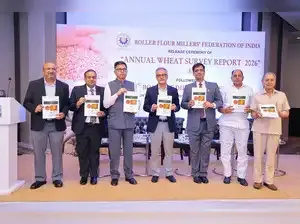
Navneet Chitlangia, President, Roller Flour Millers’ Federation of India (RFMFI), on Friday, called for greater policy stability and stronger industry-government coordination while addressing the release of the Wheat Crop Survey Report for Rabi 2025–26 by Agriwatch. The event was attended by Sanjeev Chopra, Secretary, Department of Food & Public Distribution.
Chitlangia described the past year as highly volatile, marked by sharp price swings and financial strain across the value chain, farmers, traders, and processors, alongside rising input, logistics, and packaging costs driven by global geopolitical tensions. With intense competition in the milling sector limiting price pass-through, margins have come under pressure.
He outlined key industry asks:
The report pegs wheat production for Rabi 2025–26 at 1,106.5 lakh metric tonnes (LMT), up from 1,096.3 LMT last year. Sown area rose to 348.34 lakh hectares (345.96 lakh ha), with average yield at 3,176 kg/ha (3,169 kg/ha). Production gains were led by Madhya Pradesh, Rajasthan, and Haryana, offsetting declines in Uttar Pradesh, Punjab, Bihar, and West Bengal.
Weather disruptions in late March–early April—including unseasonal rain and hail—affected crops in parts of Punjab and West Bengal most severely, with moderate impact in Haryana, Bihar, and Rajasthan. Key affected districts included Fazilka, Amritsar, Bathinda, and Moga (Punjab), and Dakshin Dinajpur, Maldah, Uttar Dinajpur, Birbhum, and Murshidabad (West Bengal), along with select districts in Uttar Pradesh, Haryana, Bihar, and Madhya Pradesh.
Chitlangia described the past year as highly volatile, marked by sharp price swings and financial strain across the value chain, farmers, traders, and processors, alongside rising input, logistics, and packaging costs driven by global geopolitical tensions. With intense competition in the milling sector limiting price pass-through, margins have come under pressure.
He outlined key industry asks:
- Stock transparency: Regular release of cumulative national wheat stock data from the Wheat Stock Portal to support informed decisions and reduce market distortions.
- Predictable OMSS policy: Clear pricing, quantities, and schedules through stakeholder consultation to avoid ad-hoc interventions.
- Export flexibility: Open licenses for all wheat products, including bran, without restrictive conditions.
- Export promotion: Freight support and incentives for value-added wheat exports to boost capacity utilization and employment.
- Liquidity support: An ECLGS-type scheme to ease financial stress amid tight margins and global uncertainty.
The report pegs wheat production for Rabi 2025–26 at 1,106.5 lakh metric tonnes (LMT), up from 1,096.3 LMT last year. Sown area rose to 348.34 lakh hectares (345.96 lakh ha), with average yield at 3,176 kg/ha (3,169 kg/ha). Production gains were led by Madhya Pradesh, Rajasthan, and Haryana, offsetting declines in Uttar Pradesh, Punjab, Bihar, and West Bengal.
Weather disruptions in late March–early April—including unseasonal rain and hail—affected crops in parts of Punjab and West Bengal most severely, with moderate impact in Haryana, Bihar, and Rajasthan. Key affected districts included Fazilka, Amritsar, Bathinda, and Moga (Punjab), and Dakshin Dinajpur, Maldah, Uttar Dinajpur, Birbhum, and Murshidabad (West Bengal), along with select districts in Uttar Pradesh, Haryana, Bihar, and Madhya Pradesh.