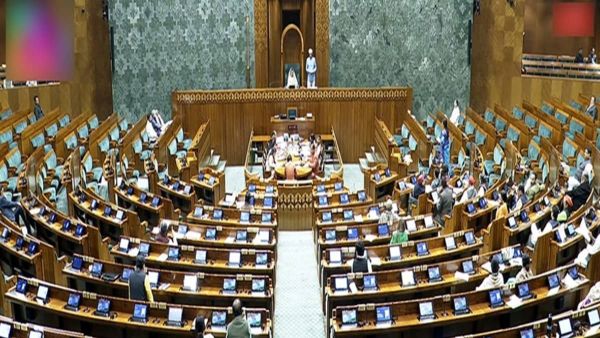
New Delhi: For months, the Rajya Sabha has been the one chamber where the Narendra Modi government could not take legislative passage for granted. Despite a majority in the Lok Sabha, the Upper House remained a numbers puzzle, where the Opposition’s INDI bloc, backed by a crucial 10-member AAP contingent, could stall, delay, or force amendments to contentious bills. Eventually, the wall of resistance cracked wide open in a single stroke, after 7 Aam Aadmi Party MPs crossed the floor to join the Bharatiya Janata Party (BJP), claiming the two-thirds threshold needed for a clean merger under the anti-defection law.
The AAP MPs' move, spearheaded by Raghav Chadha and Sandeep Pathak, has done more than shrink Arvind Kejriwal’s parliamentary footprint, but it has handed the BJP-led NDA something it has chased for over a decade, an outright majority in the Upper House.
The immediate arithmetic is intense, with the AAP’s 7 on board, the NDA’s tally jumps to 128 in a House of 243, crossing the 122-mark for a simple majority and ending the Opposition’s de facto veto on ordinary legislation. What does this mean for bills stuck in the pipeline, for constitutional amendments, and for the balance of power going into 2027?
In this explainer, we will break down the new Rajya Sabha arithmetic, the legal route the defectors took, and why ‘total control’ still stops short of the two-thirds super-majority the government needs for its biggest reforms.
Rajya Sabha’s Political Formation
The political formation of the Rajya Sabha was redrawn on Friday after 7 Aam Aadmi Party MPs walked out of Arvind Kejriwal’s camp and crossed over to the BJP, delivering a massive blow to the Opposition and handing the ruling National Democratic Alliance (NDA) a decisive edge in the Upper House.
AAP’s breakaway group claimed to have met the two-thirds threshold required under the anti-defection law for a merger without inviting disqualification. After their switch, the BJP’s long chase for outright control of the House appears to have ended after more than a decade of coalition arithmetic and floor management.
For the AAP, the exodus does more than dent its parliamentary footprint. It strips the party of its most recognisable faces in the Upper House and leaves Kejriwal with a rump of just 3 members, crippling the party’s ability to influence national legislation from the Rajya Sabha.
NDA Crosses Majority Mark
Before Friday’s rebellion, the BJP held around 106 seats in the Rajya Sabha, while the NDA bloc stood at around 121, just one short of the 122 needed for a simple majority in a House with an effective strength of 243. The induction of the so-called ‘AAP Seven’ changes that equation overnight.
The seven defectors, Raghav Chadha, Sandeep Pathak, Swati Maliwal, Harbhajan Singh, Ashok Mittal, Vikram Sahney, and Rajendra Gupta, take the BJP’s own tally to 113. Importantly, the NDA’s combined strength now rises to 128, placing it comfortably above the halfway mark. For the first time since the days of single-party Congress dominance, the ruling coalition can push ordinary legislation through without leaning on neutral regional outfits or issue-based support.
The change in political demography in the Rajya Sabha registered a watershed moment in the Narendra Modi government’s third term. The bills that previously faced delay, dilution or referral to select committees due to the Opposition bloc can now expect a far smoother passage, giving the government legislative velocity comparable to its Lok Sabha dominance.
Two-Thirds Majority Still Out Of Reach
Here, it is pertinent to mention that despite the breakthrough, the NDA remains short of the ‘Holy Grail’ in the Parliament, the two-thirds majority needed to carry constitutional amendments. In a full House of 245, that super-majority stands at 164. Even after absorbing the AAP defectors, the alliance is 36 votes adrift of that figure.
As per analysts, the present situation means in practice that while the government can now enact ordinary laws with ease, sweeping structural reforms will still require negotiation. The proposals, such as ‘One Nation, One Election’, a fresh delimitation exercise, or any attempt to amend the basic features of the Constitution, would need support from non-aligned parties, or the BJP would have to wait for future biennial Rajya Sabha elections to close the gap.
The parliamentary observers noted that the two-thirds mark has eluded every government since 1984. The current numbers bring the NDA closer than it has ever been, but the final stretch remains a task of persuasion rather than pure arithmetic.
Opposition Veto Dismantled
After the 7 Rajya Sabha MPs switch, the immediate casualty of realignment is the Opposition INDI Alliance’s ability to stall legislation in the Upper House. Until now, AAP’s 10-member group was a key pillar of the Opposition’s floor strategy and with 7 gone, only 3 AAP MPs remain loyal to Kejriwal, leaving the bloc without the numbers to demand divisions, force adjournments, or send bills to select committees.
In effect, the Opposition’s informal veto has collapsed. For the government, the path is now clear to pursue high-priority items that qualify as ordinary legislation. That list included politically sensitive measures such as a Uniform Civil Code (UCC), further amendments to the Income Tax Act 2025, and other reform bills that had been held up by Rajya Sabha gridlock.
The senior BJP strategists explained the development as “total control” of the legislative agenda, while Opposition leaders conceded that their negotiating leverage had been severely eroded. The change also alters the dynamics of pre-legislative consultation, with the government less compelled to accommodate dissenting views to secure passage.
-
Pat Cummins Returns to IPL: Sunrisers Hyderabad Triumph Over Rajasthan Royals

-
Controversy Surrounds Sheriff Chris Nanos Amid Nancy Guthrie Investigation

-
Tragic Park Attack: Family's Nightmare Unfolds in San Antonio

-
Donald Trump Hospital Rumors Debunked Ahead of White House Correspondents' Dinner

-
John Lewis introduces new £13.25 rule in UK shops - launched on April 1