Good deeds rarely go unpunished. And so it is with solid plans that quickly reveal their structural weaknesses. Astana, the baffling capital of Kazakhstan, would soon rattle us to our core. Admittedly, it had already done so the previous day. A veritable snowstorm had pushed us forward.
Yet, it blinded most sites, preventing us from properly experiencing them. Trying to find the entrance to Baiterek monument proved nigh impossible, the view from its 105-metre observation tower offering little more than a whiteout.
Waking the next morning in our sprawling room at The Veil, our futuristically designed hotel, the city revealed itself anew. The sky was a sharp cobalt blue, communicating the opposite of what Astana had suggested the day before. Rather than demanding shelter, the city now beckoned to be explored.
Our plan was to visit what remained of Expo 2017, the world exhibition the city hosted around the theme of global energy. Kazakhstan used the event to position itself as a player in debates around sustainability and technological innovation. More than 100 countries and international organisations participated.
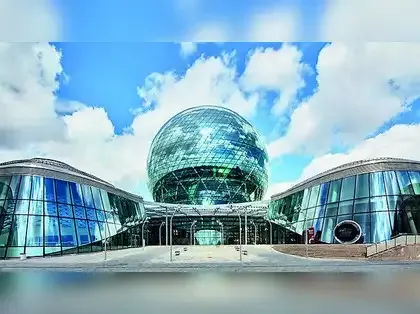
At its centre stood the striking spherical pavilion known as Nur Alem, now functioning as a museum dedicated to energy and science. The name draws from Kazakh and Turkic roots: 'nur' meaning light or radiance, and 'alem' meaning world or universe. It is, of course, purely coincidental that Kazakhstan's long-time president, Nursultan Nazarbayev, shares this linguistic element.
When Nazarbayev resigned in 2019, the capital was promptly renamed Nur-Sultan, only to revert to Astana a few years later amid public dissatisfaction with inequality and entrenched elite power.
Driving towards Nur Alem, its glittering, almost festive shape announced itself from afar, sunlight cascading off its surface like a disco ball beckoning us onto a dance floor. Our driver, who had earlier cast a doubtful glance at our clothing via his rearview screen, informed us in gruff, Kazakh-inflected English that we would have to walk the final 300 m - the area around the museum was car-free. The distance seemed oddly precise. But the sun was out, and so were many Kazakhs, all moving in the same direction.
There is something inherently alluring about former expo sites once the crowds have dissipated and the buildings are left to negotiate their afterlives. In Shanghai, little remains beyond the striking red crown of the former China Pavilion. In Lisbon, the legacy of Expo 98 lingers more diffusely in the redeveloped waterfront district of Parque das Nacoes.
Infinitely more evocative is Daejeon, South Korea. There, the legacy of Expo 93 endures with a curious intensity - conceived at a moment when South Korea was emerging as a newly industrialised, technologically ambitious state. Many of its pavilions still stand. Visiting them today comes close to stepping into a time machine: a future imagined in the past, shaped by very different expectations of what lay ahead.
Nur Alem, by contrast, still seems to gesture toward an actual future. A perfect glass sphere, roughly 80 m in diameter, it ranks among the largest of its kind in the world. Its curved panels catch and refract light, while inside, a vertical sequence of exhibition spaces traces different energy systems in a carefully staged ascent.
We never made it to the entrance. Having stepped out of the taxi and begun the walk, we quickly realised that while we were dressed for a European winter, we were no match for a Kazakh one. A digital screen informed us it was -24°C. Another sign--promising hot coffee - urged us inside. As much as Kazakhstan positioned itself as a place grappling with global warming and sustainable futures, all we wanted in that moment was something far more immediate: heat and escape from a landscape that had seemed pristine only moments before.
Yet, it blinded most sites, preventing us from properly experiencing them. Trying to find the entrance to Baiterek monument proved nigh impossible, the view from its 105-metre observation tower offering little more than a whiteout.
Waking the next morning in our sprawling room at The Veil, our futuristically designed hotel, the city revealed itself anew. The sky was a sharp cobalt blue, communicating the opposite of what Astana had suggested the day before. Rather than demanding shelter, the city now beckoned to be explored.
Our plan was to visit what remained of Expo 2017, the world exhibition the city hosted around the theme of global energy. Kazakhstan used the event to position itself as a player in debates around sustainability and technological innovation. More than 100 countries and international organisations participated.
At its centre stood the striking spherical pavilion known as Nur Alem, now functioning as a museum dedicated to energy and science. The name draws from Kazakh and Turkic roots: 'nur' meaning light or radiance, and 'alem' meaning world or universe. It is, of course, purely coincidental that Kazakhstan's long-time president, Nursultan Nazarbayev, shares this linguistic element.
When Nazarbayev resigned in 2019, the capital was promptly renamed Nur-Sultan, only to revert to Astana a few years later amid public dissatisfaction with inequality and entrenched elite power.
Driving towards Nur Alem, its glittering, almost festive shape announced itself from afar, sunlight cascading off its surface like a disco ball beckoning us onto a dance floor. Our driver, who had earlier cast a doubtful glance at our clothing via his rearview screen, informed us in gruff, Kazakh-inflected English that we would have to walk the final 300 m - the area around the museum was car-free. The distance seemed oddly precise. But the sun was out, and so were many Kazakhs, all moving in the same direction.
There is something inherently alluring about former expo sites once the crowds have dissipated and the buildings are left to negotiate their afterlives. In Shanghai, little remains beyond the striking red crown of the former China Pavilion. In Lisbon, the legacy of Expo 98 lingers more diffusely in the redeveloped waterfront district of Parque das Nacoes.
Infinitely more evocative is Daejeon, South Korea. There, the legacy of Expo 93 endures with a curious intensity - conceived at a moment when South Korea was emerging as a newly industrialised, technologically ambitious state. Many of its pavilions still stand. Visiting them today comes close to stepping into a time machine: a future imagined in the past, shaped by very different expectations of what lay ahead.
Nur Alem, by contrast, still seems to gesture toward an actual future. A perfect glass sphere, roughly 80 m in diameter, it ranks among the largest of its kind in the world. Its curved panels catch and refract light, while inside, a vertical sequence of exhibition spaces traces different energy systems in a carefully staged ascent.
We never made it to the entrance. Having stepped out of the taxi and begun the walk, we quickly realised that while we were dressed for a European winter, we were no match for a Kazakh one. A digital screen informed us it was -24°C. Another sign--promising hot coffee - urged us inside. As much as Kazakhstan positioned itself as a place grappling with global warming and sustainable futures, all we wanted in that moment was something far more immediate: heat and escape from a landscape that had seemed pristine only moments before.
(Disclaimer: The opinions expressed in this column are that of the writer. The facts and opinions expressed here do not reflect the views of www.economictimes.com.)

Michiel Baas
The writer is author of Muscular India: Masculinity, Mobility & the New Middle Class