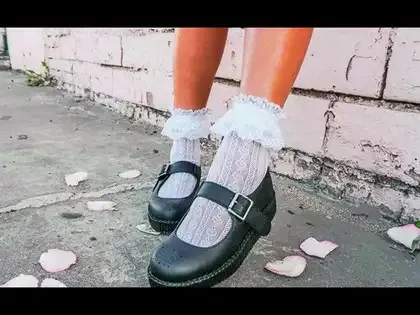
Dear Mary,
Muah-muah! And no, this fashion greeting is not a misspelling of Miu Miu.
Mary, you don't know me. But I have known you since my days as a schoolgirl in the 70s. In fact, I knew you intimately even before I knew your name. You were the one secure constant as I walked to class, footsteps slow but purposeful. And again on the way back, when I skipped more lightly.
Like all true love stories, I forgot you for a while. Until the 1990s, when I saw you again in fashion magazines, reimagined by designers, styled into something flirtatious, even risque. I recognised you instantly, though you appeared in shades and insinuations I did not associate with you. For me, you had always been function, security, and plain, dependable black.
I know, of course, that you are not real. You began as a comic-strip girl in early 1900s America, one of those accidents where a character turned into commodity, as her creator sold his figures for advertising, and a shoe took on a life of its own.
Charles Dickens never sold rights to his character Miss Havisham, or all white lace might have been known as Miss Havisham lace. But in the 1990s, you entered more complicated territory. Paired, rather unfortunately, with Lolita, you became part of a stylised innocence that now reads differently, even uncomfortably, in a world that has learned to question such aesthetics.
And then, this spring-summer, I saw you again. Changed again but unmistakable. You were right there in the front rows of stores. My hands reached out as I saw you surrounded by heavy-duty laces that exhausted me just looking at them, while you remained yourself: straps, simple, assured. Only now you've evolved -velcro, cushioning, a sportswear ease.
I slipped my feet in tentatively and strapped up. And there we were - soul to sole, reunited.
Comfort has been rebranding itself post-pandemic. What began as a drift - from athleisure to coord sets to what we now call 'office sneakers' - has crossed its final threshold in that formalwear no longer wishes to look formal. And you, Mary Jane, sit right at the pull of this shift where comfort is no longer casual, but engineered.
New iterations of familiar corporate power dressing are deemed less about labels and more about judgment, less about display and more about ease. Which, Mary Jane, I am delighted to note , is the fashion police describing the very essence of you!
Mary, it means our tribe, fashionable but clever, and low key kewl - performance sneakers, bright, cushioned, engineered for movement, paired with unisex pajama-kurtas ('coord sets') - has entered formal offices not as rebellion, or ruralism, but as competence, quiet luxury and right judgment.
Which brings me, Mary, to a small local matter. I am tempted to write to Delhi's Gymkhana Club with its colonial hangover and carefully enforced dress codes for 'gentlemen and ladies,' to suggest that the 2026 version of you may, in fact, be ideal for ballroom dancing on Thursday nights. You would certainly soften the impact of missteps on a crowded floor. More importantly, they might consider rewriting their codes before they begin to resemble costumes of a past authority.
Because power no longer signals itself through leather and stiffness. It signals itself through technology--through support, stability, optimisation. Comfort has entered every room and rearranged the hierarchy.
Dress codes, particularly in legacy institutions, were built on discomfort as proof of seriousness: hard soles, stiff uppers, the rigid separation of leisure and formality. But now 'Casual Friday' is dissolved into every day. The question is no longer what is appropriate, but whether 'appropriate' survives at all. It has taken this long because mindsets change slowly. Until suddenly, they don't serve us. Wardrobes, after all, are about the survival of the fittest items.
And through it all, you persist, always adapting, never announcing, simply arriving where needed, updated. Hello again, Mary Jane. I love you.
Yours,
A 2026 Mary Jane fan
Muah-muah! And no, this fashion greeting is not a misspelling of Miu Miu.
Mary, you don't know me. But I have known you since my days as a schoolgirl in the 70s. In fact, I knew you intimately even before I knew your name. You were the one secure constant as I walked to class, footsteps slow but purposeful. And again on the way back, when I skipped more lightly.
Like all true love stories, I forgot you for a while. Until the 1990s, when I saw you again in fashion magazines, reimagined by designers, styled into something flirtatious, even risque. I recognised you instantly, though you appeared in shades and insinuations I did not associate with you. For me, you had always been function, security, and plain, dependable black.
I know, of course, that you are not real. You began as a comic-strip girl in early 1900s America, one of those accidents where a character turned into commodity, as her creator sold his figures for advertising, and a shoe took on a life of its own.
Charles Dickens never sold rights to his character Miss Havisham, or all white lace might have been known as Miss Havisham lace. But in the 1990s, you entered more complicated territory. Paired, rather unfortunately, with Lolita, you became part of a stylised innocence that now reads differently, even uncomfortably, in a world that has learned to question such aesthetics.
And then, this spring-summer, I saw you again. Changed again but unmistakable. You were right there in the front rows of stores. My hands reached out as I saw you surrounded by heavy-duty laces that exhausted me just looking at them, while you remained yourself: straps, simple, assured. Only now you've evolved -velcro, cushioning, a sportswear ease.
I slipped my feet in tentatively and strapped up. And there we were - soul to sole, reunited.
Comfort has been rebranding itself post-pandemic. What began as a drift - from athleisure to coord sets to what we now call 'office sneakers' - has crossed its final threshold in that formalwear no longer wishes to look formal. And you, Mary Jane, sit right at the pull of this shift where comfort is no longer casual, but engineered.
New iterations of familiar corporate power dressing are deemed less about labels and more about judgment, less about display and more about ease. Which, Mary Jane, I am delighted to note , is the fashion police describing the very essence of you!
Mary, it means our tribe, fashionable but clever, and low key kewl - performance sneakers, bright, cushioned, engineered for movement, paired with unisex pajama-kurtas ('coord sets') - has entered formal offices not as rebellion, or ruralism, but as competence, quiet luxury and right judgment.
Which brings me, Mary, to a small local matter. I am tempted to write to Delhi's Gymkhana Club with its colonial hangover and carefully enforced dress codes for 'gentlemen and ladies,' to suggest that the 2026 version of you may, in fact, be ideal for ballroom dancing on Thursday nights. You would certainly soften the impact of missteps on a crowded floor. More importantly, they might consider rewriting their codes before they begin to resemble costumes of a past authority.
Because power no longer signals itself through leather and stiffness. It signals itself through technology--through support, stability, optimisation. Comfort has entered every room and rearranged the hierarchy.
Dress codes, particularly in legacy institutions, were built on discomfort as proof of seriousness: hard soles, stiff uppers, the rigid separation of leisure and formality. But now 'Casual Friday' is dissolved into every day. The question is no longer what is appropriate, but whether 'appropriate' survives at all. It has taken this long because mindsets change slowly. Until suddenly, they don't serve us. Wardrobes, after all, are about the survival of the fittest items.
And through it all, you persist, always adapting, never announcing, simply arriving where needed, updated. Hello again, Mary Jane. I love you.
Yours,
A 2026 Mary Jane fan
(Disclaimer: The opinions expressed in this column are that of the writer. The facts and opinions expressed here do not reflect the views of www.economictimes.com.)


Kanika Gahlaut
Journalist, author and artist