In Dom Moraes’s poetry collection Serendip (1990), one poem is addressed to his friend Peter Levi. He recalls their idyllic days at Oxford, after which Levi went on to lead his English life, while Moraes returned to India, feeling forever unmoored: “Then you went home, all of you went home/ To high tea, Gentleman’s Relish, maturity/ At the end you all knew where you came from/ All of you have homes Peter, not me.”
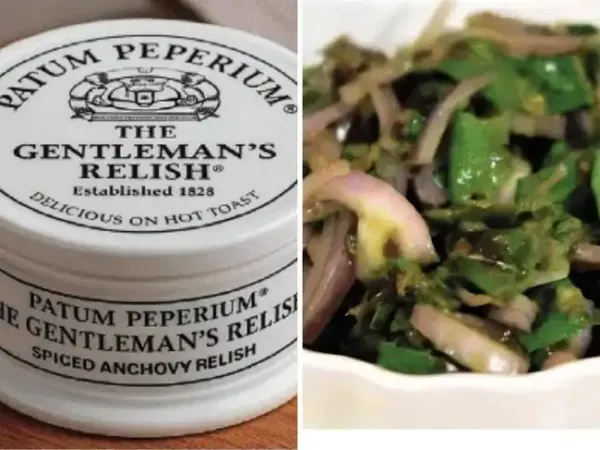
Gentleman’s Relish, which Moraes uses as a symbol of England, is a savoury paste made from anchovies, butter and spices. It is intensely salty and fishy, which is why it is only used in small amounts, scraped from its distinctive white pot and very thinly spread on toast. It was created in 1828 by John Osborn who, to make it sound more prestigious, called it ‘ patum peperium ’, a fake-Latin name that means spicy paste. Both names are used, like a food aristocrat, with a title as well as a family name.
Anchovy pastes weren’t new, even in 1828. British food was famously free of spices and even herbs like garlic, but anchovies were long used as a secret flavour-booster. “Preserved anchovies — whether salted, packed in oil or marinated — have some of the highest levels of umami known in the plant and animal kingdoms,” explains Christopher Beckman in A Twist in the Tale, his charmingly obsessive book about these small fish. Making a paste or liquid made it easier for cooks to add it to dishes.
Fermenting small fish for umami, the savoury fifth taste, is done across the world. The Romans adored garum , a strong-smelling condiment similar to Thailand’s nam pla , Vietnam’s nuoc mam and the Philippines’s bagoong . Rushina Munshaw-Ghildiyal’s splendid new book Chutney lists several items from the Northeast that use fermented fish, like Manipur’s morok atekpa metpa or Meghalaya’s tungtap . Tim MackintoshSmith wrote of eating fissikh , a fermented fish so beloved in Egypt that it is eaten despite several food-poisoning cases every year: “Slowly, my nausea passed, but I still felt as though I’d swallowed a pot of Gentleman’s Relish in one go.”
The early 19th century saw a boom in bottled condiments like Lea & Perrins Worcestershire and Harvey’s sauces, many with anchovies originally included in their top-secret recipes. India was a good market for them, as is shown by the Bombay Times & Journal of Commerce (later, The Times of India ) which, in January 1839, was carrying ads for anchovy and herring pastes, imported by the firm of Blackwell, Cursetjee & Co. Colonel Kenney-Herbert’s Culinary Jotting for Madras includes many recipes that require a spoonful of anchovy sauce and anchovy toast as an easy snack.
The class-obsessed British could be snobbish about branded sauces. Richmal Crompton’s William books feature the fearsome Violet Elizabeth Bott, a girl whose nouveau-riche parents made their money with Bott’s Sauce, making the middle-class families in the books subtly look down on them. It’s easy to see why Osborn did his best to make Gentleman’s Relish appear as an upperclass delicacy. “Will we be found guilty of social climbing if we ask for The Gentleman’s Relish?” asked a journalist in a Daily Telegraph article from 1992 about how brands channel class anxieties.
This may have succeeded too well. In today’s UK, where hereditary peers are being removed from the House of Lords and populism rules, Gentleman’s Relish seems out of place. The Spectator , a conservative magazine also founded in 1828, sorrowfully announced recently that the current owners of the brand had stopped production. This led to the usual outpouring of nostalgia that greets the death of old brands, with The Spectator pledging to ne gotiate renewed production, while also procuring the last stocks for selective distribution. Given their common birth dates though, one has to wonder, cynically, if it’s all a carefully calibrated co-marketing campaign between a brand and magazine dedicated to maintaining an idea of English exclusivity.
Gentleman’s Relish, which Moraes uses as a symbol of England, is a savoury paste made from anchovies, butter and spices. It is intensely salty and fishy, which is why it is only used in small amounts, scraped from its distinctive white pot and very thinly spread on toast. It was created in 1828 by John Osborn who, to make it sound more prestigious, called it ‘ patum peperium ’, a fake-Latin name that means spicy paste. Both names are used, like a food aristocrat, with a title as well as a family name.
Anchovy pastes weren’t new, even in 1828. British food was famously free of spices and even herbs like garlic, but anchovies were long used as a secret flavour-booster. “Preserved anchovies — whether salted, packed in oil or marinated — have some of the highest levels of umami known in the plant and animal kingdoms,” explains Christopher Beckman in A Twist in the Tale, his charmingly obsessive book about these small fish. Making a paste or liquid made it easier for cooks to add it to dishes.
Gentleman’s Relish, which Moraes uses as a symbol of England, is a savoury paste made from anchovies, butter and spices.
Fermenting small fish for umami, the savoury fifth taste, is done across the world. The Romans adored garum , a strong-smelling condiment similar to Thailand’s nam pla , Vietnam’s nuoc mam and the Philippines’s bagoong . Rushina Munshaw-Ghildiyal’s splendid new book Chutney lists several items from the Northeast that use fermented fish, like Manipur’s morok atekpa metpa or Meghalaya’s tungtap . Tim MackintoshSmith wrote of eating fissikh , a fermented fish so beloved in Egypt that it is eaten despite several food-poisoning cases every year: “Slowly, my nausea passed, but I still felt as though I’d swallowed a pot of Gentleman’s Relish in one go.”
The early 19th century saw a boom in bottled condiments like Lea & Perrins Worcestershire and Harvey’s sauces, many with anchovies originally included in their top-secret recipes. India was a good market for them, as is shown by the Bombay Times & Journal of Commerce (later, The Times of India ) which, in January 1839, was carrying ads for anchovy and herring pastes, imported by the firm of Blackwell, Cursetjee & Co. Colonel Kenney-Herbert’s Culinary Jotting for Madras includes many recipes that require a spoonful of anchovy sauce and anchovy toast as an easy snack.
The class-obsessed British could be snobbish about branded sauces. Richmal Crompton’s William books feature the fearsome Violet Elizabeth Bott, a girl whose nouveau-riche parents made their money with Bott’s Sauce, making the middle-class families in the books subtly look down on them. It’s easy to see why Osborn did his best to make Gentleman’s Relish appear as an upperclass delicacy. “Will we be found guilty of social climbing if we ask for The Gentleman’s Relish?” asked a journalist in a Daily Telegraph article from 1992 about how brands channel class anxieties.
This may have succeeded too well. In today’s UK, where hereditary peers are being removed from the House of Lords and populism rules, Gentleman’s Relish seems out of place. The Spectator , a conservative magazine also founded in 1828, sorrowfully announced recently that the current owners of the brand had stopped production. This led to the usual outpouring of nostalgia that greets the death of old brands, with The Spectator pledging to ne gotiate renewed production, while also procuring the last stocks for selective distribution. Given their common birth dates though, one has to wonder, cynically, if it’s all a carefully calibrated co-marketing campaign between a brand and magazine dedicated to maintaining an idea of English exclusivity.