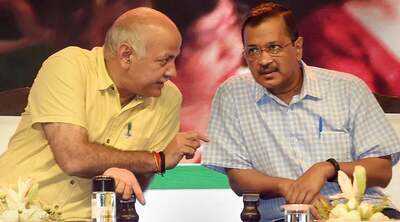
A political and legal standoff has intensified in the ongoing Delhi excise policy case, with senior Aam Aadmi Party leaders Arvind Kejriwal and Manish Sisodia refusing to participate in proceedings before Justice Swarana Kanta Sharma of the Delhi High Court.
On Tuesday, Sisodia wrote to the judge stating that he would not pursue his matter in the excise case in her court and would not appoint legal representation. His remarks echoed a similar stance taken by Kejriwal a day earlier, when the Delhi chief minister said he would neither appear in person nor engage a lawyer for his case before the same bench.
In his letter, Sisodia made sharp comments, saying he did not expect justice and that there was “no path left except Satyagraha”, signalling a shift towards symbolic protest. He also made a pointed reference to Tushar Mehta, suggesting that the future of the judge’s children lay in the hands of the senior law officer.
The confrontation follows the rejection of a joint plea filed by Kejriwal, Sisodia and other accused seeking the recusal of Justice Sharma from hearing excise policy-related matters. In a detailed order delivered on 20 April, the judge dismissed the request, describing it as a strategic attempt and asserting that recusal cannot be based on perceptions or external pressure.
The excise policy case centres on allegations of corruption, including claims of policy manipulation and kickbacks linked to Delhi’s now-scrapped 2021–22 liquor policy. Investigations by central agencies have focused on several AAP leaders and intermediaries.
Justice Sharma has been hearing multiple petitions and bail applications connected to the case and has, in several instances, ruled in favour of the prosecution. The defence had argued that repeated adverse rulings created a reasonable apprehension of bias, a claim the court firmly rejected.
Following the court’s decision, both Kejriwal and Sisodia have chosen to disengage from proceedings before her bench, framing their move as a matter of principle rather than legal strategy. The AAP has portrayed the developments as evidence of political targeting and has questioned whether a fair trial is possible under the current circumstances.
However, legal observers and sections of the bar have raised concerns over the implications of such non-cooperation. Refusing to appear in court or appoint counsel could be seen as undermining judicial authority, with some warning that continued defiance may invite contempt proceedings if it disrupts the judicial process.
The episode marks a significant escalation in the dispute between the AAP leadership and the judiciary, blending legal contest with political messaging. As the excise policy case continues to unfold, the refusal of two of its most prominent accused to participate in court proceedings adds a new and uncertain dimension to an already high-profile matter.
With PTI inputs
-
Sahamati secures Rs 50 crore in funding from large banks, AMCs, stockbrokers and fintechs

-
Peak XV fully exits Mobikwik in Rs 130 crore block deal

-
Budget airlines first to cut flights as jet fuel prices soar

-
Thai AirAsia to reduce seat capacity by about 30% as jet fuel prices bite

-
Quote of the Day by Jimmy Kimmel: ‘I don't really need to be dirty to…’