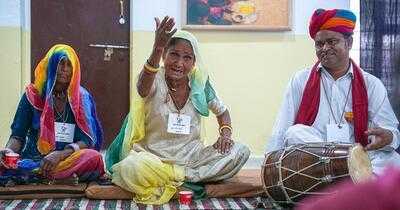
Dariya Bai has a crushing response for anyone who tells her that women Manganiyars should not sing in public: “Bhad mein jaao.” The aggravation is not unwarranted. She is one of just three women in her community of roughly 1,000 performers to have stepped onto public concert platforms. Her defiance is a rare crack in a social structure that has otherwise remained as immutable as the landscape it inhabits.
Set deep in the arid expanses of rural western Rajasthan, the Muslim families of Manganiyars and Langas form a singularly talented lineage of hereditary musicians with a vast repertoire of folk music governed by a raga and tala system all their own. Since 1976, thanks largely to the efforts of legendary folk archivist Komal Kothari and his Jodhpur-based institution, Rupayan Sansthan, many of these musicians have become frequent invitees to world music festivals not just in India but also across the globe.
Yet, for all their metropolitan and international exposure, the communities remain culturally and socially anchored to their home turf. They may hold dozens of passport books, but home is still a remote, tight-knit village where resources and facilities are scant. In this world, social mores are unyielding and orthodox gender structures are stubbornly...
Read more
-
Attention Pensioners! Receive Your Medical Allowance Hassle-Free; Government Changes Payment Method
-
NEET UG 2026: Important Advisory from NTA—Update Biometric Details Before the Exam

-
5 Government Jobs Available for 10th Pass Candidates: Find Out Where to Apply
-
Aadhaar ID Support Arrives in Google Wallet; Verification Set to Become Even Easier

-
How Much Salary Does a Junior Hindi Translator Earn? Find Out Here