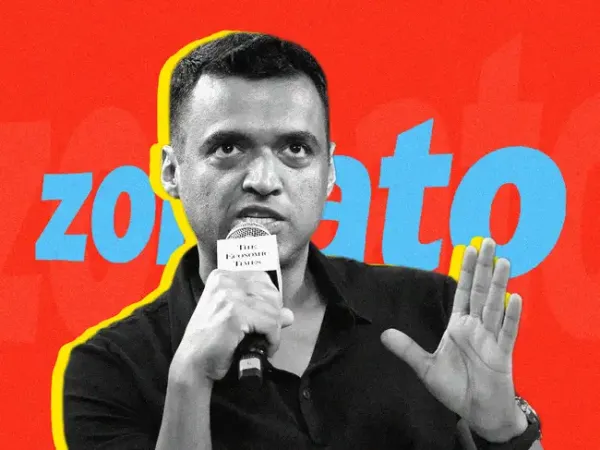
Eternal founder Deepinder Goyal dispelled fears that artificial intelligence (AI) chat interfaces could displace food delivery and quick commerce apps, while making the case that the technology will help widen the company's moat by bringing more Indians on its platforms.
In a letter to shareholders, Goyal drew a comparison with Google's decade-long attempt to pull transactional behaviour into its own ecosystem for booking flights, hotels, shopping and food ordering.
"They had the largest demand surface on earth, billions of searches a day, and the strongest distribution advantage in the history of the world. And yet Booking.com is still here. Expedia is still here. Amazon is still here. The vertical apps that consumers had built habits around didn't get displaced," he wrote.
"General-purpose interfaces are good for general-purpose queries. They are poor interfaces for complex, high-frequency, habitual transactions," he said, noting that customers who order on Zomato four times a week or restock groceries on Blinkit every other day will not change those habits and switch to a chat window.
He also pointed to brand recall as a structural defence. When someone is hungry, they think Zomato. When they need groceries in minutes, they think Blinkit. He argued that such a mental real estate will not be dislodged easily, and is the main reason why the company runs separate apps focussed on building distinct super brands rather than collating all of it into a single super app.
However, Goyal did not swipe away the threat entirely. "Agentic commerce is similar to, and also different from, Google's attempt at owning transactions. At this point, we believe there is nothing to panic about," he said.
But how does AI help Eternal? Goyal said the company is the largest deployers of AI in demand prediction, route optimisation, supply-chain management, customer experience, fraud detection and catalogue quality control.
Smelling an opportunity in the technology for more than just cutting costs for Eternal, Goyal said conversational interfaces could significantly lower the barrier to participation for older users, non-native language speakers, first-time online buyers, and consumers in tier-II and -III cities who struggle with conventional app flows.
"AI lets us serve people and businesses that were previously too hard, too small, too fragmented, or too operationally expensive to serve well," Goyal wrote. "Our moat remains the physical world. AI makes that moat wider by allowing more of India to participate in it."
In a letter to shareholders, Goyal drew a comparison with Google's decade-long attempt to pull transactional behaviour into its own ecosystem for booking flights, hotels, shopping and food ordering.
"They had the largest demand surface on earth, billions of searches a day, and the strongest distribution advantage in the history of the world. And yet Booking.com is still here. Expedia is still here. Amazon is still here. The vertical apps that consumers had built habits around didn't get displaced," he wrote.
"General-purpose interfaces are good for general-purpose queries. They are poor interfaces for complex, high-frequency, habitual transactions," he said, noting that customers who order on Zomato four times a week or restock groceries on Blinkit every other day will not change those habits and switch to a chat window.
He also pointed to brand recall as a structural defence. When someone is hungry, they think Zomato. When they need groceries in minutes, they think Blinkit. He argued that such a mental real estate will not be dislodged easily, and is the main reason why the company runs separate apps focussed on building distinct super brands rather than collating all of it into a single super app.
However, Goyal did not swipe away the threat entirely. "Agentic commerce is similar to, and also different from, Google's attempt at owning transactions. At this point, we believe there is nothing to panic about," he said.
But how does AI help Eternal? Goyal said the company is the largest deployers of AI in demand prediction, route optimisation, supply-chain management, customer experience, fraud detection and catalogue quality control.
Smelling an opportunity in the technology for more than just cutting costs for Eternal, Goyal said conversational interfaces could significantly lower the barrier to participation for older users, non-native language speakers, first-time online buyers, and consumers in tier-II and -III cities who struggle with conventional app flows.
"AI lets us serve people and businesses that were previously too hard, too small, too fragmented, or too operationally expensive to serve well," Goyal wrote. "Our moat remains the physical world. AI makes that moat wider by allowing more of India to participate in it."