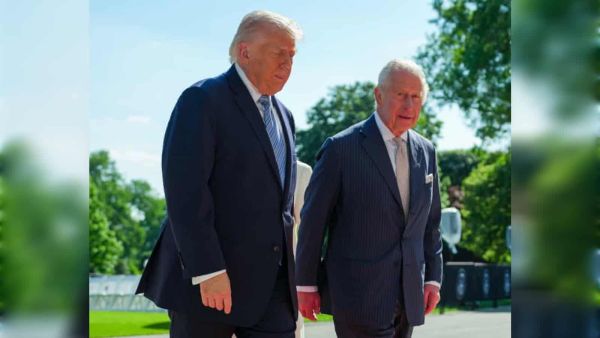
US President Donald Trump said on Wednesday, April 29, that King Charles III agrees Iran cannot obtain a nuclear bomb, making the remarks during the British monarch’s state visit to the United States, according to Reuters.
The developments come on the 61st day of the US-Israeli war on Iran and the 22nd day of the ceasefire, as diplomatic efforts continue alongside mounting economic pressure and regional instability.
Latest updates here
US Marines board vessel in Arabian Sea
US Marines boarded a commercial ship in the Arabian Sea on Tuesday, April 28, over suspicions it was attempting to breach the American blockade of Iranian ports, the US military said.

Central Command said the M/V Blue Star III was released after a search confirmed it would not call at any Iranian port.
The command added that 39 vessels had so far been redirected to ensure compliance with the blockade.
War costs two million jobs in Iran
The Wall Street Journal (WSJ), citing preliminary estimates from an Iranian Labour Ministry official, reported that the war directly cost about one million people their jobs, with another one million affected indirectly.
Iran military says war footing continues
Iran Army spokesperson Amir Akraminia said the country remains on a war footing and military targets and equipment plans have been updated, state broadcaster IRIB reported.
He added that the Strait of Hormuz is under joint control, with the western sector managed by the IRGC and the eastern side by the regular army.
Iran prepares revised proposal
CNN, quoting informed sources, said Iran is expected to submit a revised proposal to mediators in Pakistan within days after consulting senior leadership.
Reuters, citing US officials and a source familiar with the matter, reported that American intelligence agencies are assessing how Tehran may respond if Trump declares a unilateral victory in the conflict.
The Wall Street Journal (WSJ) reported that Trump has instructed aides to prepare for a long-term blockade aimed at tightening pressure on Iranian ports, shipping routes and oil exports.
The newspaper said Washington believes restrictions linked to the Strait of Hormuz are putting severe strain on Iran’s economy and making crude storage increasingly difficult.
The report added that Trump remains unwilling to drop his demand that Iran suspend uranium enrichment for at least 20 years.
US expands pressure campaign
US Treasury Secretary Scott Bessent said sanctions had been imposed on 35 Iranian entities and individuals accused of operating within Tehran’s shadow banking system.
He said the network serves as a financial lifeline for Iran’s armed forces and enables activities that fuel violence across the Middle East.
Bessent added that US measures had deprived Iran of tens of billions of dollars in revenue, while inflation had risen sharply and the national currency had weakened.
He also said Kharg Island, Iran’s main oil export terminal, was nearing maximum storage capacity, which could force production cuts.
Iran complains to UN
Iran’s ambassador to the United Nations, Amir Saeed Iravani, sent a letter to Secretary-General Antonio Guterres rejecting what he described as American maritime piracy against Iranian vessels.
He said the US would bear responsibility for the consequences of detaining Iranian ships and called on the UN Security Council to secure the immediate release of vessels, cargoes and seized assets.
In a separate statement, Iravani urged the council to compel Israel to fully comply with the Lebanon ceasefire, halt attacks and withdraw its forces.
Gulf states reject Hormuz threats
Leaders of Gulf nations rejected what they described as Iran’s illegal actions to threaten shipping, close the Strait of Hormuz or charge fees for safe passage.
The statement followed a Gulf Cooperation Council (GCC) summit in Saudi Arabia chaired by Crown Prince Mohammed bin Salman and attended by leaders from Qatar, Bahrain, Kuwait and the United Arab Emirates (UAE)
The bloc called for restoring full freedom of navigation, expanding military coordination, launching joint infrastructure projects and creating a ballistic missile early warning system.
Bahrain calls for dialogue
Bahrain Foreign Minister Abdullatif bin Rashid Al-Zayani said the international community should move beyond crisis management and seek lasting solutions through constructive dialogue.
He said this should include Iranian compliance with principles of good neighbourliness, respect for sovereignty, freedom of navigation and international law, while also halting its nuclear, missile and drone programmes.
Lebanon condemns Israeli strike
Lebanese President Joseph Aoun and Prime Minister Nawaf Salam condemned an Israeli strike that killed civil defence workers in the south.
Salam said the attack in Majdal Zoun, which targeted personnel carrying out humanitarian duties, constituted a new war crime and a flagrant violation of international humanitarian law.
He said the Lebanese government would intensify efforts in international forums to pressure Israel into ending repeated ceasefire violations.
Lebanon’s Health Ministry said at least five people were killed, including three paramedics trapped beneath rubble after an earlier strike.
Israel escalates operations
Israel intensified air strikes and artillery shelling in southern Lebanon despite the temporary ceasefire.
Israeli Defence Minister Yisrael Katz said the military had been instructed to destroy what he described as terrorist infrastructure in the security zone up to the yellow line.
-
Get to Know the New Labor Law Rules: Here Is the Government's Stance on Overtime and Weekly Offs..

-
No PAN Card? You Won't Be Able to Purchase These Items—Familiarize Yourself with This Income Tax Rule..

-
Aadhaar Card Support Arrives on Google Wallet; Instant Identification Now Possible via Phone..

-
Indian Companies Under Hackers' Crosshairs; Government Agency Issues Alert..

-
Government Takes Major Action Against 'Digital Arrest' Scams; Strict Measures to be Imposed on SIM Cards and WhatsApp..