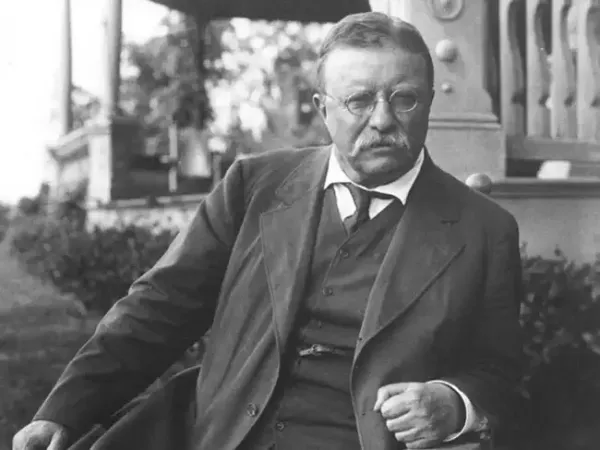
Theodore Roosevelt, the 26th President of the United States.
Do you ever feel like life keeps throwing the same problems at you, like missed chances, repeated mistakes, or stress that somehow circles back again and again? Many people blame bad luck, difficult people, or poor timing. But what if the real reason sits much closer than we think?
Sometimes, the hardest truth is that we are standing in our own way. Quoted by brainyquote, today’s quote of the day by Theodore Roosevelt is on self-awareness, responsibility, and personal growth, and it offers a sharp reminder that the first step to solving problems often begins with looking inward.
Quote of the Day by Theodore Roosevelt: "If you could kick the person in the pants responsible for most of your trouble, you wouldn't sit for a month."
Also Read: Quote of the Day by Wisława Szymborska: ‘When I pronounce the word future, the first syllable already belongs to...’ Nobel laureate explains how quickly life becomes the past
It is easy to blame work pressure, relationships, society, or circumstances for our struggles. While external problems are real, Roosevelt’s words challenge us to ask a deeper question: are we also contributing to our own troubles?
This quote matters because it pushes honesty. Growth begins when people stop avoiding responsibility and start accepting their own role in failure, delay, or frustration. Whether it is career setbacks, poor decisions, or emotional stress, self-reflection often becomes the real solution.
Roosevelt’s quote highlights personal accountability. It suggests that many of our biggest struggles come not from others, but from our own habits, procrastination, fear, poor choices, or refusal to act.
For example, someone may complain about not getting promoted but avoid improving skills. Another may blame stress on others while ignoring unhealthy routines. The quote reminds us that change begins when we stop pointing outward and start looking inward.
It does not mean blaming yourself for everything. Instead, it means recognizing where your own actions can improve the situation. Honest self-awareness is often uncomfortable, but it is also powerful.
In real life, the people who grow the most are often the ones willing to admit mistakes and fix them. Roosevelt’s words are not harsh; they are practical. Responsibility can feel heavy, but it also gives control back to us.
Also Read: Quote of the Day by Alexandre Dumas: ‘There is neither happiness nor misery in the world; there is only the comparison of one state with another, nothing more…’
More notable quotes from the former US president quoted in the outlet are,
Theodore Roosevelt was the 26th President of the United States and one of the most energetic leaders in American history. He became president at just 42 years old, making him the youngest person ever to hold the office at that time.
Before becoming president, he served in many important roles, including New York State Assemblyman, Police Commissioner of New York City, Assistant Secretary of the Navy, Governor of New York, Vice President, and Colonel of the Rough Riders. His leadership style was bold, direct, and action-driven.
Roosevelt was also much more than a politician. He was a historian, naturalist, explorer, writer, and conservationist. He helped found major institutions, led scientific expeditions across Africa and South America, and wrote more than 35 books.
His passion for knowledge, nature, and public service made him a larger-than-life figure. Even outside politics, he remained a symbol of courage, discipline, and intellectual strength.
Also Read: Quote of the Day by Roy T. Bennett: ‘Don't be pushed around by the fears in your mind. Be led by the dreams in your heart’ - a lesson in overcoming anxiety
Roosevelt transformed the American presidency by making it the center of national leadership. He challenged powerful monopolies, supported consumer protections, and pushed reforms that shaped modern business regulation.
As per the Theodore Roosevelt Association, laws such as the Pure Food and Drug Act (1906) and the Federal Meat Inspection Act helped protect ordinary citizens and laid the foundation for stronger federal oversight. His leadership redefined what a president could do.
He also expanded America’s global influence. Roosevelt helped mediate the Russo-Japanese War and won the Nobel Peace Prize. He supported the Panama Canal project and strengthened U.S. naval power, helping position the country as a major world force.
Perhaps his greatest legacy was conservation. He protected nearly 230 million acres of public land, creating national forests, parks, monuments, and wildlife reserves. His face on Mount Rushmore remains a symbol of his lasting impact on leadership, reform, and the protection of nature.
Sometimes, the hardest truth is that we are standing in our own way. Quoted by brainyquote, today’s quote of the day by Theodore Roosevelt is on self-awareness, responsibility, and personal growth, and it offers a sharp reminder that the first step to solving problems often begins with looking inward.
Quote of the Day by Theodore Roosevelt: "If you could kick the person in the pants responsible for most of your trouble, you wouldn't sit for a month."
Also Read: Quote of the Day by Wisława Szymborska: ‘When I pronounce the word future, the first syllable already belongs to...’ Nobel laureate explains how quickly life becomes the past
Why Theodore Roosevelt’s quote on self-responsibility matters today
It is easy to blame work pressure, relationships, society, or circumstances for our struggles. While external problems are real, Roosevelt’s words challenge us to ask a deeper question: are we also contributing to our own troubles?
This quote matters because it pushes honesty. Growth begins when people stop avoiding responsibility and start accepting their own role in failure, delay, or frustration. Whether it is career setbacks, poor decisions, or emotional stress, self-reflection often becomes the real solution.
What Theodore Roosevelt’s quote means in real life
Roosevelt’s quote highlights personal accountability. It suggests that many of our biggest struggles come not from others, but from our own habits, procrastination, fear, poor choices, or refusal to act.
For example, someone may complain about not getting promoted but avoid improving skills. Another may blame stress on others while ignoring unhealthy routines. The quote reminds us that change begins when we stop pointing outward and start looking inward.
It does not mean blaming yourself for everything. Instead, it means recognizing where your own actions can improve the situation. Honest self-awareness is often uncomfortable, but it is also powerful.
In real life, the people who grow the most are often the ones willing to admit mistakes and fix them. Roosevelt’s words are not harsh; they are practical. Responsibility can feel heavy, but it also gives control back to us.
Also Read: Quote of the Day by Alexandre Dumas: ‘There is neither happiness nor misery in the world; there is only the comparison of one state with another, nothing more…’
Theodore Roosevelt’s quotes
More notable quotes from the former US president quoted in the outlet are,
- “The only man who never makes a mistake is the man who never does anything.”
- “In any moment of decision, the best thing you can do is the right thing, the next best thing is the wrong thing, and the worst thing you can do is nothing.”
- “No man is above the law and no man is below it: nor do we ask any man's permission when we ask him to obey it.”
- “Do what you can, with what you have, where you are.”
- “If you could kick the person in the pants responsible for most of your trouble, you wouldn't sit for a month.”
- “Far better is it to dare mighty things, to win glorious triumphs, even though checkered by failure... than to rank with those poor spirits who neither enjoy nor suffer much, because they live in a gray twilight that knows not victory nor defeat.”
Who was Theodore Roosevelt?
Theodore Roosevelt was the 26th President of the United States and one of the most energetic leaders in American history. He became president at just 42 years old, making him the youngest person ever to hold the office at that time.
Before becoming president, he served in many important roles, including New York State Assemblyman, Police Commissioner of New York City, Assistant Secretary of the Navy, Governor of New York, Vice President, and Colonel of the Rough Riders. His leadership style was bold, direct, and action-driven.
Roosevelt was also much more than a politician. He was a historian, naturalist, explorer, writer, and conservationist. He helped found major institutions, led scientific expeditions across Africa and South America, and wrote more than 35 books.
His passion for knowledge, nature, and public service made him a larger-than-life figure. Even outside politics, he remained a symbol of courage, discipline, and intellectual strength.
Also Read: Quote of the Day by Roy T. Bennett: ‘Don't be pushed around by the fears in your mind. Be led by the dreams in your heart’ - a lesson in overcoming anxiety
Theodore Roosevelt’s legacy
Roosevelt transformed the American presidency by making it the center of national leadership. He challenged powerful monopolies, supported consumer protections, and pushed reforms that shaped modern business regulation.
As per the Theodore Roosevelt Association, laws such as the Pure Food and Drug Act (1906) and the Federal Meat Inspection Act helped protect ordinary citizens and laid the foundation for stronger federal oversight. His leadership redefined what a president could do.
He also expanded America’s global influence. Roosevelt helped mediate the Russo-Japanese War and won the Nobel Peace Prize. He supported the Panama Canal project and strengthened U.S. naval power, helping position the country as a major world force.
Perhaps his greatest legacy was conservation. He protected nearly 230 million acres of public land, creating national forests, parks, monuments, and wildlife reserves. His face on Mount Rushmore remains a symbol of his lasting impact on leadership, reform, and the protection of nature.