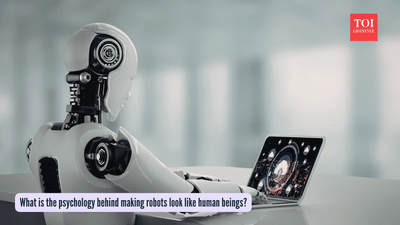
For decades, engineers have sculpted robots much like our own physical form, creating machines with faces, limbs, and expressive eyes. While a task-oriented machine, a vacuum cleaner or a factory arm functions perfectly well without a face or a human shape.
Have you ever thought why these machines are made to look like human beings?
Let’s break down why!
Why are robots designed to look like human beings?
When we create machines that look like us, we tap into deep-seated psychological instincts. According to a conducted by researchers at the University of Genova and the Italian Institute of Technology, our brains process these machines differently; while non- humanoid robots are often understood as simple objects, humanoid robots are often categorised as “human-like” or “social agents”.
 This change happens because our brains are hardwired to look for social attributes, such as eye contact, which usually signal a response for bonding.
by scientists at Tampere University in Finland has found that eye contact with robots ignites a similar psychophysiological connection in people as it does with other humans.
Giving robots human like appearance makes them more approachable
The idea to give robots "human" features is often a way to make them more approachable. A conducted at the IRCCS Centro Neurolesi Bonino Pulejo in Messina, Italy, revealed that robots programmed for “emotional intelligence” can effectively evoke empathy in people, “especially when they exhibit anthropomorphic traits”.
By designing them this way, we essentially trick our own brains into filling in the blanks, assuming these machines understand and share our intentions or feelings based on our lived experience with other people.
The ELIZA effectThis phenomenon is often linked to the “ELIZA effect.” Named after a 1960s chat program created by MIT professor Joseph Weizenbaum (1923–2008) at the MIT Artificial Intelligence Laboratory, the term describes how easily users can be fooled into believing a machine is truly interacting with them.
Because a humanoid robot triggers natural human tendencies, such as maintaining gaze or responding to facial expressions, we naturally project human qualities onto it.
This design has its advantages and disadvantages
Humanoid robots are often easier for us to trust, cooperate with, or instruct, particularly in roles involving care or customer service. However, this intuitive connection comes with difficulties.
According to the Australian Cobotics Centre, we may naturally begin to project human-like emotions, intentions, or even moral expectations onto these machines.
The IEEE’s Global Initiative on Ethics of Autonomous Systems has rightly warned that designing robots to look like humans can create confusion regarding trust, accountability, and the nature of their autonomy.
On the contrary, we tolerate errors from a simple mechanical arm, but the same error from a robot with a face can be unsettling. This discomfort is often linked to the “uncanny valley,” a term coined by roboticist Masahiro Mori in 1970. It refers to the unease people experience when a robot or character appears almost human, but not quite.
This phenomenon tends to blur the lines between a simple tool and a companion, leaving us to navigate the complex boundary between a machine and a being.
-
IPL 2026: Vaibhav Suryavanshi’s point will be made with the help of Jasprit Bumrah! Abhishek Sharma will not be able to do this even if he wants to.

-
Arjun Tendulkar: Bidding will be held on Arjun Tendulkar on May 2, base price Rs 5 lakh

-
West Bengal Election: Was BJP’s vote stopped by taping EVM? Big election ruckus in Falta. Evm Tape Controversy In Falta Sparks Political Storm Election Commission Orders Repoll

-
Dhongi Baba used to have fun with 100 women, send their husbands out and… – News Himachali News Himachali

-
Explainer: These are the new instructions of RBI regarding identification of bad loans, what will be their impact on banks?