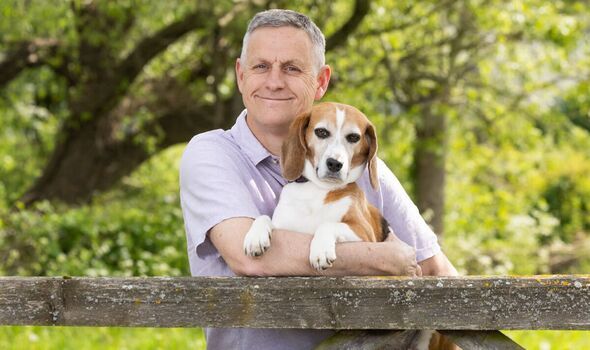
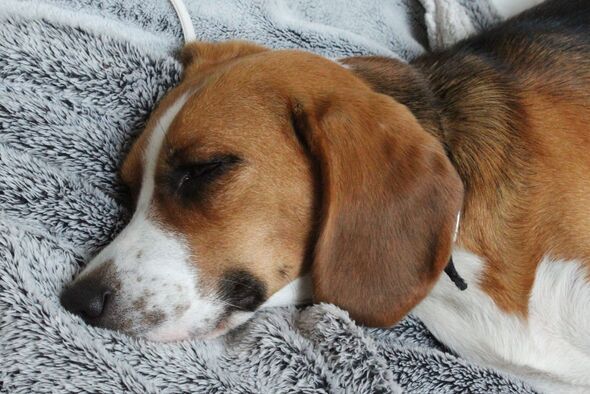
She was bred for experiments, not to be loved. But somehow, love found Lola the beagle anyway. The sweet-natured pooch is one of millions of animals in the UK used every year to test new drugs in laboratories - but today she is the reason owner Iain Green, 55, comes home smiling. The affectionate hound's favourite thing to do is to sit on the windowsill with her adoring owner so they can watch the world go by together. It's a far cry from her days spent at a laboratory in Ireland, where she was born and bred simply to be used in research.
Although Lola was only in the facility for six months, it was enough to give her scars to last a lifetime. "It's been a long and challenging journey for Lola and us," says Iain, Director of Animal Aid, who adopted her. "Even after nine years with us, she still carries the mental scars of her early life."It took approximately a year for the terrified dog to fully trust her new owner and his family, and the worried canine has only just built up enough confidence to engage in play after nearly a decade.
Born into a sterile kennel environment, Lola was denied the usual freedom, love, play and social interactions which most puppies get. When strangers and friends innocently ask her for her paw, she gives it dutifully, not for rewards or praise but because she was trained to do this as a puppy so it was easier for laboratory workers to inject her with substances or to take blood from her. At six months of age, Lola escaped the cruel life she had been born into when the breeding facility she was based in closed down. Her life was spared after local animal campaigners successfully convinced workers to release the dogs rather than kill them.
By Kirsty Gallagher, television presenter
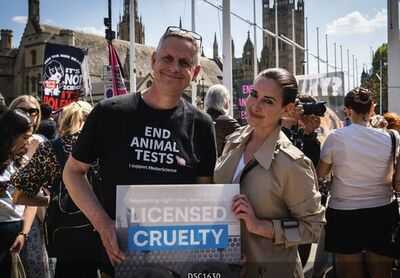
"Standing at the Camp Beagle rally on Monday, looking at all those passionate faces, I'm reminded of why we cannot stay silent. I'm here to speak for the animals who don't have a voice, and to use my platform to raise awareness, especially for the dogs like Lola.
Lola's story is one of the rare, beautiful ones; she was bred for a life of testing but was lucky enough to find a loving home and family with Iain. But for every Lola, there are thousands of other dogs, and millions of animals, who never get to feel the grass under their paws or the warmth of a family. They are treated as equipment, as tools - not living, feeling beings.
It is time to end this. We are a nation of animal lovers, yet we allow outdated practices to continue behind closed doors. I am using my platform to demand that the UK leads the way in transitioning to human-relevant, animal-free science. We owe it to Lola, and we owe it to the thousands still waiting for their chance at freedom. The science has evolved - it's time our ethics did too."
More than 300 beagles were released and put up for rehoming and she was one of them.
While Iain doesn't exactly know what Lola was subjected to in her time in the laboratory, he has seen photos of a beagle breeding facility which give a clue as to how traumatic the first six months of her life was. Her "shell-like behaviour" was also a clear indicator, and the lasting effect it has had on her is significant.
"Lola is still an absolute wreck when we visit the vets. I'm sure it reminds her of her past," he says.
Beagles like Lola are commonly used in scientific experiments because of their docile and friendly nature. They are eager to please, very forgiving and not aggressive which means they are not likely to fight back and researchers can easily carry out the tests they need to without fear of being attacked. Their smaller size also means they can easily fit into cages required for testing.
The pooch, who is now 10 years old, was a timid, quiet girl when Iain and his family first went to meet her and several other ex-laboratory beagles at Dogs Trust in Evesham, Worcester. They wanted to offer a home to a dog in need, and although there were no suitable pooches available on their first visit, they were informed that a large quantity of beagles would be arriving soon.
Iain believes his campaigning work for animals is what brought him and Lola together, and when he and the family met the shy pup they knew they could give her the love that she deserved.
"We could see the love and care that she desperately needed and as a family we knew we could give her that," he says.
Since bringing her back to their home in the Gloucester town of Wotton-Under-Edge, the sweet beagle has slowly come out of her shell and become a much-loved family member. One of the most special memories the family has is seeing her walk on grass for the first time. "It was quite emotional thinking that at 10 months old she had never experienced this," says Iain. "While very alert and nervous, we could see glimmers of excitement as she walked through the meadow."
These days, Lola enjoys the life of a normal, family dog. She loves walks, sniffing and exploring, and enjoys curling up in sunny spots around the house. She is no longer seen as simply a test subject but a much-loved local pooch. Children in the neighbourhood often wave to her at the window on their walk to school.
Lola finds comfort in her family, and finally knows what it feels like to be safe and loved. "She always wants to be near us, and sleeps alongside me as I work," says Iain.
But it wasn't easy for the charity worker to gain the nervous canine's trust. "It was a very slow and gradual process," he adds.
The rescue pooch joined Iain at a march in London on Saturday to mark World Day for Laboratory Animals. For him, she is a constant reminder of the millions of animals that are bred to be used and suffer in UK laboratories every year to assess if medicines are fit for human consumption.
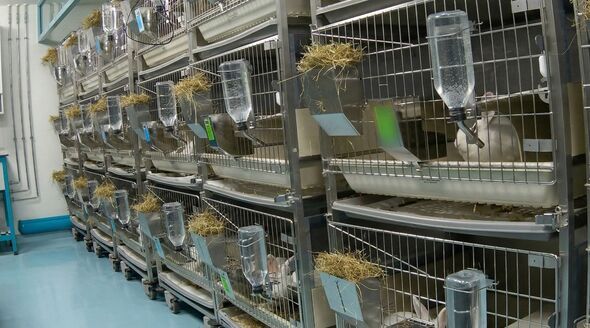
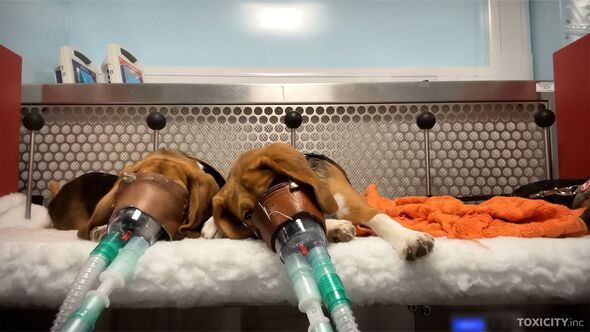
Last week, unprecedented footage taken by a traumatised former laboratory worker was released by charities Animal Aid and Animals International. It showed dogs wearing inhalation masks and being forced to breathe in substances to see how toxic they are. It also included pigs squealing in pain as they had substances dropped onto wounds cut into their backs, rabbits squeezed into cylindrical tubes for IV testing, and terrified monkeys struggling in restraints with tubes forced down their throats.
While some medications are potential treatments for serious diseases, others were products for non-life threatening conditions from headache pills to antibiotics. Some of the distressing footage featured restrained long-tailed maca ques being fed anti-obesity medication.
Iain, who has been campaigning to end animal testing for more than forty years, says: "It was the most harrowing and extensive footage of animal research that I had ever seen.
"By the end of watching it, I was in floods of tears and had to go outside and just take a walk in nature to try and process what I had just seen. But my upset was nothing compared to the suffering that these animals are going through in the laboratories, sometimes for months on end."
The footage and photographs show the suffering which these animals go through on a daily basis. "Anyone who sees it will be in no doubt that this is not right," Iain says.
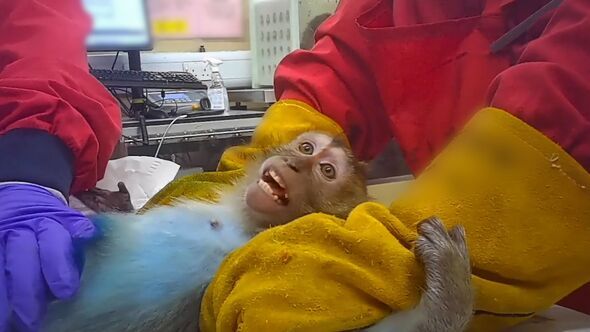
While animal testing for cosmetics was prohibited in the UK and across Europe more than a decade ago, tests for drugs, chemicals, food additives and other products occur across the country every day, harming tens of thousands of animals.
"The use of animals for toxicity testing and in experiments is highly secret, and I think there is very little public awareness of what these tests look like and how the animals suffer," Iain continues. "Most people are shocked that animal testing still continues. I hope that this footage will raise awareness and outrage in the public and inform politicians."
Iain, who wrote the first ever guide to cruelty-free cosmetics in 1986, branded the practice of using animals in testing as "torture dressed up as science". He attended a debate in parliament yesterday to help push an urgent end to the use of dogs and other animals in testing and move forward with modern human relevant non-animal methods.
"No more delays, no more excuses - we must act now to stop animals suffering in laboratories," he says. "The government must immediately suspend all new tests, conduct a full review of all current licences, and finally deliver on its promise to replace animals in science."
A government spokesperson said: "The UK has some of the world's toughest rules to ensure animal testing happens only when it is genuinely needed and always under strict, licensed conditions.
"Furthermore, our Alternatives Strategy, backed by £75 million in funding and developed in collaboration with animal welfare organisations, will phase out animal testing wherever possible and use safe, proven alternatives instead."
To find out more about Animal Aid's work to end animal testing, visit animalaid.org.uk
-
NDA Hat-Trick In Assam? Matrize Predicts Comfortable Victory For BJP-Led Alliance

-
Exit Polls: Vijay's Debut A Flop Show? Jana Nayagan Superstar Fails To Perform In Tamil Nadu

-
Congress-Led UDF Ahead In Kerala, Three Exit Polls Suggest Close Contest

-
MI VS SRH, IPL 2026: Will Rohit Sharma Play Against SRH At Wankhede?

-
IPL 2026: James Hopes Remains Positive As Punjab Kings Stay Top Despite First Defeat Against Rajasthan Royals