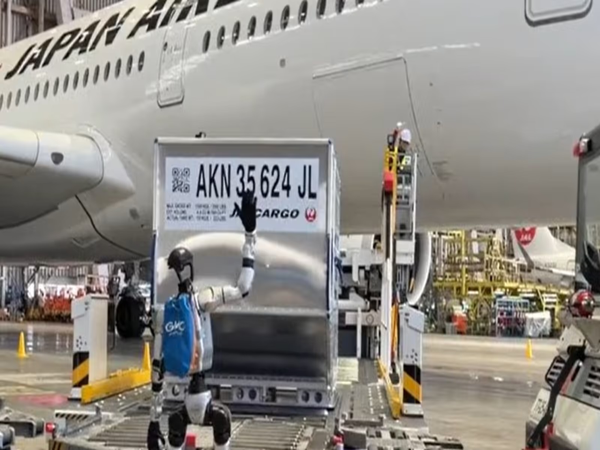
Japan has long been renowned for its hardworking workforce; however, at Tokyo's bustling Haneda Airport, the burden on these employees is now set to be alleviated somewhat. Starting in early May, Japan Airlines (JAL) is launching a trial run involving "humanoid robots." These Chinese-manufactured robots will be deployed to assist with the lifting and handling of passenger luggage and cargo. Haneda Airport serves over 60 million passengers annually. Consequently, JAL and its partner, the GMO Internet Group, anticipate that this pilot program—scheduled to run until 2028—will significantly reduce the physical strain on human employees.
**How Will These Specialized Robots Function?**
Recently, a demonstration was held for the media featuring a 130-centimeter-tall robot developed by Unitree, a tech firm based in Hangzhou, China. During the demonstration, the robot was observed pushing cargo onto a conveyor belt near an aircraft and signaling to a human colleague by waving its arm. Once fully charged, these robots can operate continuously for two to three hours. There are plans to assign them additional tasks in the future, such as cleaning aircraft cabins. However, airport authorities have clarified that highly sensitive and critical responsibilities—such as security management—will continue to be handled exclusively by human personnel.
**Japan's Declining Population Sparks Concern**
Japan is currently grappling with a major dual challenge. On one hand, the country's population is rapidly shrinking and aging; on the other, it is experiencing a massive influx of foreign tourists. Despite a decline in the number of Chinese tourists—attributed to diplomatic tensions between Tokyo and Beijing—Japan welcomed a record-breaking 42.7 million visitors last year. Furthermore, in just the first two months of 2026, over 7 million people have already visited the country. Also Read: A Sharp Satire on Tech Billionaires—'Robot Dogs' with the Heads of Musk and Zuckerberg Spotted Roaming a Berlin Museum
Humans Will Not Be Completely Replaced
According to one estimate, Japan will require 6.5 million foreign workers by 2040 to achieve its economic goals. However, the government also faces immense political pressure to control immigration. Clarifying the situation, Tomohiro Uchida, President of GMO AI & Robotics, noted that no matter how modern airports may appear from the outside, their back-end operations still rely heavily on human labor.
Disclaimer: This content has been sourced and edited from Amar Ujala. While we have made modifications for clarity and presentation, the original content belongs to its respective authors and website. We do not claim ownership of the content.
-
Ecuador starts fracking in Amazon rainforest
-
This book describes the 18-day festival in Tamil Nadu which sees thousands of transgender women

-
Trasi: Fatal accident occurs during educational tour, MLA joins rescue efforts

-
How the nasal 'na' insists on Marathi's caste hierarchy

-
Hulikal Ghat landslide: Slow progress of works, Minister Madhu Bangarappa conducts inspection