
Listen to this article in summarized format
Loading...
××
Subscribe to

Unlock AI Briefing and Premium Content
New Year Offer 24 Hours Left
Subscribe NowAlready a member? Sign In
What's Included
- Exclusive Stories
- Daily ePaper Access
- Smart Market Tools
- Curated Investment Ideas
- Ad-lite Experience
Subscription

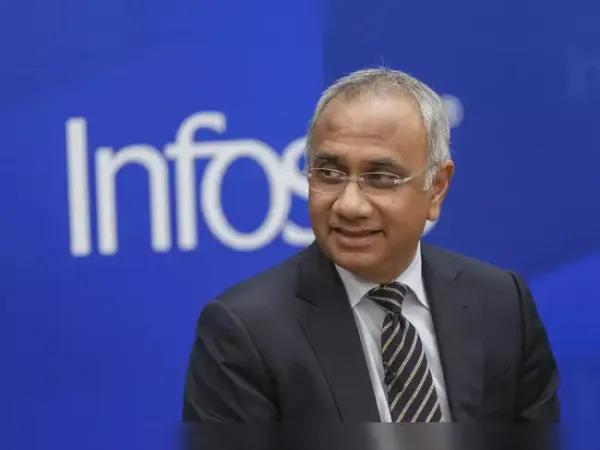
Infosys CEO Salil Parekh expects AI to bring changes to the Indian IT pyramid model that has underpinned the industry for four decades. Parekh, who declined to comment on Infosys' upcoming management change, told Jochelle Mendonca that the IT company had already begun making changes to how it hires, though large-scale structural changes would take time. Edited Excerpts:
Q) How is Infosys looking at dealing with the deflationary aspects of AI. Even when the deal wins are strong, the overall growth guidance is more muted.
Our AI services strategy is working well. We laid out these six areas where we see a huge opportunity. We see something like a $300 billion addressable market, and this is new work. We are making sure that we are driving growth in this area. Then we've applied AI to the rest of the activities that we are driving what we call AI augmented services. We're gaining in some cases from consolidation, in some cases from expanding the scope as clients are being more selective. Our guidance for next year is growth. The main difference was that the macro was somewhat different. At the start of Q4, with the situation in the Middle East… that is now getting resolved. And we are seeing increasingly that the macroeconomic environment will be better as the year progresses. So that's how we see the environment in terms of AI strategy and services.
Q) How will AI affect Indian IT’s pyramid talent model? Analysts are talking about diamond structure.
My own sense is AI is going to create a lot more opportunity as we go into the future. Last financial year, we recruited 20,000 college graduates…this financial year will also have quite a similar type of number. What we are doing in training is making sure that people coming in are fully trained on building software in the way they should be building themselves, and then also getting trained by using foundation model tools. We’re also recruiting specialists at different levels already from colleges. Some of that variation will come into the pyramid. As AI services become a larger part of our business and overall growth starts to scale, there will be a need for people, in addition to agents that we are deploying. And the (pyramid) shape will change. I don’t think it will change that quickly. We’re looking at the horizon of change where more specialized skills will become more important.
Q) Other IT companies are combining units to sell clients AI-driven outcomes rather than separate services. Is Infosys looking at such structural changes as well?
We put in One Infosys very early, which is to take everything within Infosys and do what is best or right for the client. With the outcomes, there's even more need to have all the internal pieces working together. The scale also has changed from when I started to today. We're almost twice, just under twice the size in terms of the company. So, it's even more important that we become fully integrated. We are not planning any change in structure today, though we are making sure that it’s tighter in the way that they collaborate our teams; collaborate and making sure that the incentives are even better aligned
Q) We are seeing companies such as Meta create scoreboards for token usage to drive. How does Infosys track similar measures?
As with any of these things, these are all what are essentially intermediate measures. So, any intermediate measure, token usage is one example, is important but the real impact measure is what is the change that comes for a company or a client. Are they able to get a little bit more in their growth with revenue with different markets? Are they able to get more efficient? And so, those will remain the impact measures. I don't think the intermediate measures are always interesting and obviously to be tracked but with some sort of carefulness. So, you can't use it as a full-scale measure in that sense.
Q) Does Infosys have a limit or target for token usage?
Our token usage is growing extremely fast. We are encouraging our employees to use tokens. We want to see if the applications they're building, the code they're developing becomes useful either with clients or within the company. We don't have a target. I have an internal number of what we use in Q4. We will start to share it. I'm not able to share it with you now, but it's more indicative. I think as we go through it, the token usage will become more. But it's an intermediate measure. I think it might create some excitement, but in the end, it's an intermediate measure.
Q) How is Infosys looking at dealing with the deflationary aspects of AI. Even when the deal wins are strong, the overall growth guidance is more muted.
Our AI services strategy is working well. We laid out these six areas where we see a huge opportunity. We see something like a $300 billion addressable market, and this is new work. We are making sure that we are driving growth in this area. Then we've applied AI to the rest of the activities that we are driving what we call AI augmented services. We're gaining in some cases from consolidation, in some cases from expanding the scope as clients are being more selective. Our guidance for next year is growth. The main difference was that the macro was somewhat different. At the start of Q4, with the situation in the Middle East… that is now getting resolved. And we are seeing increasingly that the macroeconomic environment will be better as the year progresses. So that's how we see the environment in terms of AI strategy and services.
Q) How will AI affect Indian IT’s pyramid talent model? Analysts are talking about diamond structure.
My own sense is AI is going to create a lot more opportunity as we go into the future. Last financial year, we recruited 20,000 college graduates…this financial year will also have quite a similar type of number. What we are doing in training is making sure that people coming in are fully trained on building software in the way they should be building themselves, and then also getting trained by using foundation model tools. We’re also recruiting specialists at different levels already from colleges. Some of that variation will come into the pyramid. As AI services become a larger part of our business and overall growth starts to scale, there will be a need for people, in addition to agents that we are deploying. And the (pyramid) shape will change. I don’t think it will change that quickly. We’re looking at the horizon of change where more specialized skills will become more important.
Q) Other IT companies are combining units to sell clients AI-driven outcomes rather than separate services. Is Infosys looking at such structural changes as well?
We put in One Infosys very early, which is to take everything within Infosys and do what is best or right for the client. With the outcomes, there's even more need to have all the internal pieces working together. The scale also has changed from when I started to today. We're almost twice, just under twice the size in terms of the company. So, it's even more important that we become fully integrated. We are not planning any change in structure today, though we are making sure that it’s tighter in the way that they collaborate our teams; collaborate and making sure that the incentives are even better aligned
Q) We are seeing companies such as Meta create scoreboards for token usage to drive. How does Infosys track similar measures?
As with any of these things, these are all what are essentially intermediate measures. So, any intermediate measure, token usage is one example, is important but the real impact measure is what is the change that comes for a company or a client. Are they able to get a little bit more in their growth with revenue with different markets? Are they able to get more efficient? And so, those will remain the impact measures. I don't think the intermediate measures are always interesting and obviously to be tracked but with some sort of carefulness. So, you can't use it as a full-scale measure in that sense.
Q) Does Infosys have a limit or target for token usage?
Our token usage is growing extremely fast. We are encouraging our employees to use tokens. We want to see if the applications they're building, the code they're developing becomes useful either with clients or within the company. We don't have a target. I have an internal number of what we use in Q4. We will start to share it. I'm not able to share it with you now, but it's more indicative. I think as we go through it, the token usage will become more. But it's an intermediate measure. I think it might create some excitement, but in the end, it's an intermediate measure.