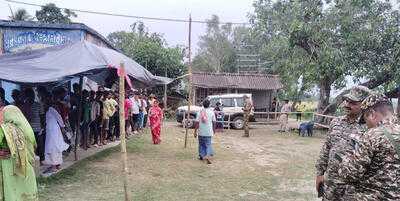
(Photo: @CrpfWest)
Kolkata, Apr 30: The assembly elections in West Bengal concluded on Wednesday, achieving an impressive voter turnout of 91.66% during the second and final phase. This election cycle has been marked by intense competition, setting the stage for a significant decision on whether Chief Minister Mamata Banerjee will maintain her influence or if the BJP will disrupt the TMC's stronghold in the state.
The second phase, covering 142 constituencies in South Bengal, is on track to rival the first phase's turnout of 93.19%. Kolkata itself saw around 87% participation, while Purba Bardhaman district led with a turnout of 92.46%.
According to the Election Commission, the turnout of 91.66% was recorded until 7:45 PM, bringing the overall participation rate across both phases to 92.47%. The first phase took place on April 23, with vote counting scheduled for May 4.
"This marks the highest voter participation since Independence in West Bengal," the commission noted.
The substantial turnout sends a clear political message: voters are engaged and ready to challenge narratives and claims of momentum.
While the first phase tested the BJP's hold in North Bengal, the second phase was crucial for the party's attempt to penetrate the TMC's southern strongholds, including Kolkata, Howrah, Hooghly, Nadia, North and South 24 Parganas, and Purba Bardhaman.
At the heart of this political contest is Bhabanipur, a constituency that has become synonymous with Banerjee's political identity and a battleground for the BJP.
Banerjee, 71, is vying for a fourth consecutive term after 15 years in office, facing off against Opposition Leader Suvendu Adhikari in a contest viewed as a rematch of their previous encounter in Nandigram, where Adhikari emerged victorious in 2021 after leaving the TMC for the BJP.
Five years later, the focus has shifted to Banerjee's stronghold. For the TMC, holding onto Bhabanipur is crucial for maintaining the chief minister's authority, while for the BJP, winning here would challenge the perception of Banerjee's political invincibility. The constituency saw nearly 87% voter turnout, a significant increase from 61% in the 2021 assembly elections and 57% in the bypoll that reinstated Banerjee.
Breaking from her usual routine of voting later in the day, Banerjee took to the streets early, visiting areas like Chetla, Padmapukur, and Chakraberia in response to reports of intimidation against local TMC leaders.
In the politically charged atmosphere of Bengal, the interplay between anti-incumbency sentiments and the adjustment of electoral rolls will likely shape the power dynamics at Nabanna, the state's administrative hub.
Out of the 142 seats contested on Wednesday, the TMC had secured 123 in 2021, leaving 18 for the BJP and one for the ISF.
The regions of North and South 24 Parganas, Kolkata, and Howrah represent 91 of Bengal's 294 assembly seats, nearly one-third of the total. Without making inroads into this southern region, the BJP's path to Nabanna remains challenging.
-
Child dies after cobra bite in Kerala

-
Karnataka orders inspection of hospital buildings after deadly Bengaluru wall collapse
-
Lucknow Student Achieves Top Marks in ICSE Class 10 Results

-
Akhilesh Yadav Criticizes BJP Government's Alleged Misuse of Power
-
AMU Nigerian Student's '3 Idiots'-Style Hindi Speech Goes Viral - WATCH