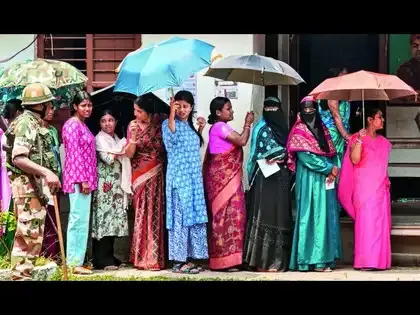
While the political outcome of elections in four states and a Union territory must wait till May 4, there's one instant takeaway: the staggering voter turnout. 92.47% in West Bengal, 85.10% Tamil Nadu, 85.38% Assam, 89.83% Puducherry, and 78% Kerala. The first four are records. Oh, and in all 5 polls, women have outnumbered men at polling stations.
This surge was partly anticipated when Bihar - with a weak turnout history, and the first state to come under SIR - had a record 67% assembly election turnout last year. With removal of those absent, shifted, dead and duplicates from electoral rolls, a significant upward correction in turnout was expected. SIR also forced sensitisation about the value of being a voter.
During the first 10 Lok Sabha elections since 1951 (45.67% turnout), the level remained below 60%. In the next five, it was marginally above. 2014 was a watershed election year yielding 66.44% turnout, above 65% for the first time. Polling in assembly elections witnessed a similar increase in the last 15 yrs.
EC deserves credit for placing the voter at the centre of the exercise. 'Greater participation for a stronger democracy' became the buzzword from 2010 onwards, when EC began its Systematic Voters' Education and Electoral Participation (Sveep) programme. A kind of 'special intensive' mobilisation was visible, to get everyone eligible on the electoral roll, and those on the register to vote.
The commission worked on scientific identification of non-voting groups and geographies from polling stations upwards and made suitable demand and supply interventions. Gaps in female and youth participation, along with urban apathy, were specially followed up.
This momentum has been unabated, despite the push from last year to remove 'ineligible' people from electoral rolls. Steps to make voting more friendly continue, the latest being limiting 1,200 electors per polling station, home voting, mobile deposit facility at polling booths, transport for people with disabilities, and more readable voter information slips.
Indian election laws don't overtly prescribe electoral participation measures. Electoral managers believe that their job is to set the playground right. People walking in or not to vote is their call.
The latest round of assembly polls has seen combative campaigns, both online and offline, many of them falling on the wrong side of the model code. But these did set effective narratives to draw people out. Polarisation has meant large numbers coming out 'to defend' and an equal number 'to dislodge'. In a mature setting, voting can be an endorsement of governance or of an alternate agenda. But in much of the Indian context, it can also be pushed by resentment or frustration. Votes are still cast along identity, community and clan lines where nothing else is judged.
In West Bengal's bumper show this time, a sizeable number of voters were migrants returning to cast their votes. This is a positive development, since there has always been concerns about people being unable to travel to make their choice. EC attempted several interventions in the past, including an all-party consultation on remote voting. But this has yielded limited results so far.
But it's another matter whether workers on modest wages working in NCR or Mumbai travelled to polling booths in Bengal - where SIR, immigration and the threat of losing their citizenship were electoral issues - out of their own volition to exercise their democratic rights, or for self-preservation. Many migrant voters had to make a second trip to their constituency to cast their vote, the first being for enumeration, hearings or submission of documents to secure themselves as electors.
All post-SIR elections, whether in Bihar in 2025, or the five conducted over last month, cement an elevated path of popular participation. India, after recovering from an earlier average of 55% turnout, had already moved to the 'middle range' of countries with turnouts higher than 60%. Now, abetted by SIR, the country is poised to break into the top league with a steady turnout level of above 75%. In a world of dwindling democratic practices, rising distrust in electoral functions and election workers, and decline in voter interest, this is no mean achievement.
But euphoria over new turnout records will do well to be tempered by sobriety on at least two grounds:
SIR-pushed: There is need for circumspection over the promise of voting rights of all. Ambedkar's principle of 'one man, one vote and one vote, one value' needs to be experienced by marginalised Indians at the state's cost. Any exclusion of electors based on technicalities, staff inefficiency, poor documentation or tight timelines can diminish the glow of a great turnout. 'Greater participation' and 'pure electoral roll' are two sides of the same coin. No space should be allowed for collateral damage in search of 'purity'.
When it comes to shove: Voting driven by provocation, coercion and bribes can have far-reaching unpleasant consequences for India's society beyond polling day. Instead, voting conducted and exercised under calm and informed persuasion, or civic sense can augment sociopolitical capital. Turnout as vengeance or out of fear, and turnout as nation-building are different servings from the same poll kitchen.
This surge was partly anticipated when Bihar - with a weak turnout history, and the first state to come under SIR - had a record 67% assembly election turnout last year. With removal of those absent, shifted, dead and duplicates from electoral rolls, a significant upward correction in turnout was expected. SIR also forced sensitisation about the value of being a voter.
During the first 10 Lok Sabha elections since 1951 (45.67% turnout), the level remained below 60%. In the next five, it was marginally above. 2014 was a watershed election year yielding 66.44% turnout, above 65% for the first time. Polling in assembly elections witnessed a similar increase in the last 15 yrs.
EC deserves credit for placing the voter at the centre of the exercise. 'Greater participation for a stronger democracy' became the buzzword from 2010 onwards, when EC began its Systematic Voters' Education and Electoral Participation (Sveep) programme. A kind of 'special intensive' mobilisation was visible, to get everyone eligible on the electoral roll, and those on the register to vote.
The commission worked on scientific identification of non-voting groups and geographies from polling stations upwards and made suitable demand and supply interventions. Gaps in female and youth participation, along with urban apathy, were specially followed up.
This momentum has been unabated, despite the push from last year to remove 'ineligible' people from electoral rolls. Steps to make voting more friendly continue, the latest being limiting 1,200 electors per polling station, home voting, mobile deposit facility at polling booths, transport for people with disabilities, and more readable voter information slips.
Indian election laws don't overtly prescribe electoral participation measures. Electoral managers believe that their job is to set the playground right. People walking in or not to vote is their call.
The latest round of assembly polls has seen combative campaigns, both online and offline, many of them falling on the wrong side of the model code. But these did set effective narratives to draw people out. Polarisation has meant large numbers coming out 'to defend' and an equal number 'to dislodge'. In a mature setting, voting can be an endorsement of governance or of an alternate agenda. But in much of the Indian context, it can also be pushed by resentment or frustration. Votes are still cast along identity, community and clan lines where nothing else is judged.
In West Bengal's bumper show this time, a sizeable number of voters were migrants returning to cast their votes. This is a positive development, since there has always been concerns about people being unable to travel to make their choice. EC attempted several interventions in the past, including an all-party consultation on remote voting. But this has yielded limited results so far.
But it's another matter whether workers on modest wages working in NCR or Mumbai travelled to polling booths in Bengal - where SIR, immigration and the threat of losing their citizenship were electoral issues - out of their own volition to exercise their democratic rights, or for self-preservation. Many migrant voters had to make a second trip to their constituency to cast their vote, the first being for enumeration, hearings or submission of documents to secure themselves as electors.
All post-SIR elections, whether in Bihar in 2025, or the five conducted over last month, cement an elevated path of popular participation. India, after recovering from an earlier average of 55% turnout, had already moved to the 'middle range' of countries with turnouts higher than 60%. Now, abetted by SIR, the country is poised to break into the top league with a steady turnout level of above 75%. In a world of dwindling democratic practices, rising distrust in electoral functions and election workers, and decline in voter interest, this is no mean achievement.
But euphoria over new turnout records will do well to be tempered by sobriety on at least two grounds:
SIR-pushed: There is need for circumspection over the promise of voting rights of all. Ambedkar's principle of 'one man, one vote and one vote, one value' needs to be experienced by marginalised Indians at the state's cost. Any exclusion of electors based on technicalities, staff inefficiency, poor documentation or tight timelines can diminish the glow of a great turnout. 'Greater participation' and 'pure electoral roll' are two sides of the same coin. No space should be allowed for collateral damage in search of 'purity'.
When it comes to shove: Voting driven by provocation, coercion and bribes can have far-reaching unpleasant consequences for India's society beyond polling day. Instead, voting conducted and exercised under calm and informed persuasion, or civic sense can augment sociopolitical capital. Turnout as vengeance or out of fear, and turnout as nation-building are different servings from the same poll kitchen.
(Disclaimer: The opinions expressed in this column are that of the writer. The facts and opinions expressed here do not reflect the views of www.economictimes.com.)




Akshay Rout
The writer is former director general, Election Commission of India