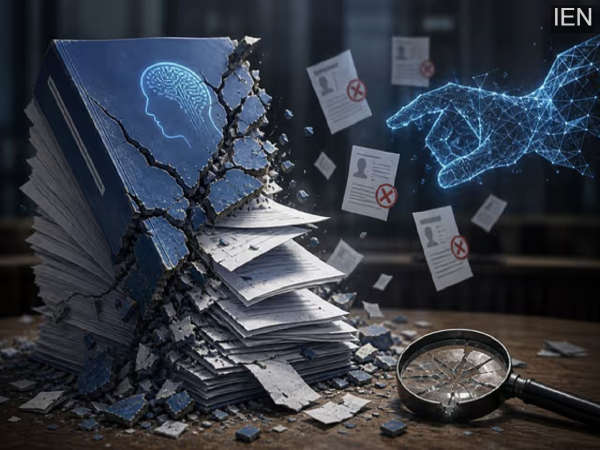
South Africa AI Policy: Technology evolves in every era. In this age of high-tech science, it feels as though something new emerges every single month. One such new technological advancement is AI—that is, Artificial Intelligence. Every nation is striving to secure its place in this field. The United States, China, Europe, and India are all pushing forward with full force. South Africa, too, made an attempt. However, it has withdrawn its first draft National Artificial Intelligence (AI) Policy just 16 days after its publication. Why? Because an investigation revealed that certain sections of the document contained fake and AI-generated academic references. In other words, the country's AI policy itself was generated by AI.
South Africa's Department of Communications and Digital Technologies released the "Draft South Africa National Artificial Intelligence Policy" for public comment on April 10. The document positioned the country as an emerging leader in AI innovation. Yet, just 16 days later, the document was withdrawn.
What Did the Policy Contain?
The objective of this draft policy was to establish a comprehensive AI governance framework, including proposals for the formation of a National AI Commission, an Ethics Board, and a regulatory authority. It also outlined tax incentives, grants, and subsidies to encourage private-sector investment in AI infrastructure, while simultaneously addressing the ethical, social, and economic challenges associated with the technology.
The AI "Hallucinated"
The country's Minister of Communications, Mondli Gungubele (Solly Mlatisi), confirmed that out of the 67 references cited in the policy, at least six were "hallucinated." This meant they either pointed to academic journals that do not exist or referred to articles that were never published in any legitimate publication. This revelation raised serious concerns regarding credibility and governance.
How Did the Case Come to Light?
This matter surfaced when an investigation by a South African broadcaster exposed discrepancies in the references cited. According to a report by the British newspaper *The Independent*, editors of prestigious journals—such as the *South African Journal of Philosophy*, *AI & Society*, and the *Journal of Ethics and Social Philosophy*—confirmed that the articles cited simply did not exist.
What Did the AI Do?
The fabricated references were likely generated using tools such as ChatGPT or Google Gemini. These AI-generated references not only invented sources but also created an illusion of false credibility by falsely attributing research to the names of reputable journals and researchers. This incident has demonstrated that generative AI poses widespread risks, including the dissemination of misinformation, deepfakes, and the misuse of digital identities.
A Blow to South Africa's Credibility
Malatsi stated, "The most probable explanation is that AI-generated references were included without proper verification. This should not have happened." He further noted that this oversight has damaged South Africa's reputation and credibility. The incident has dealt a setback to South Africa's plans regarding its AI policy.
The Minister acknowledged that this issue represents not merely a technical error, but also a failure of human oversight. He remarked, "This unacceptable oversight proves just how essential vigilant human supervision is regarding the use of artificial intelligence." He also indicated that accountability for this lapse would be established. The government is now preparing to revise this draft policy and release it once again for public consultation.
-
Gender investment gap — Are women catching up with men?

-
GT vs RCB, IPL 2026 Match Highlights: Gujarat Titans Beat Royal Challengers Bengaluru by 4 Wickets as Arshad, Rashid Shine; Jason Holder's Catch Turns the Game

-
Shah Rukh Khan & Deepika Padukone's Pics From King's Shoot In Cape Town Leaked; Fans Say 'Great Styling'

-
Sensex, Nifty end week lower as global tensions and oil surge weigh on markets

-
Ettinahole works to resume in a week, says D K Shivakumar