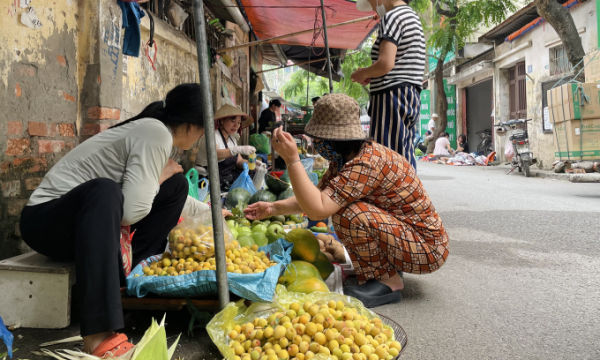
When the loudspeaker blares from a ward patrol car, dozens of street vendors along both sides of the railroad tracks in Co Nhue in Dong Ngac Ward quickly pack up.
Itinerant hawkers grab their stuff and rush into nearby alleys, while those with fixed spots fold umbrellas and pull tables back behind the painted restricted markings. Minutes after the patrol passes, the goods come back out along the roadside.
This cycle of retreating from patrols and returning afterward is playing out at many of the 231 makeshift markets Hanoi plans to clear. Under the plan, 75 sites were scheduled for removal in the first phase before Jan. 31, another 118 by June 30, and the rest by next year.
|
Stalls encroaching on the roadway at a wet market in alley 199 Ho Tung Mau, Hanoi, on March 4. Photo by Quynh Duong |
According to city authorities, 170 of these locations have been surveyed, affecting around 7,200 vendors. The remaining 61 sites are estimated to involve nearly 3,000 more.
After authorities began clearance campaigns, the number of vendors has dropped noticeably in wards such as Ngoc Ha, Nghia Do, Cau Giay, Tu Liem, Tay Tuu, Ha Dong, and Kien Hung. Some vendors have moved into shops, reducing sidewalk encroachment.
On Tran Quoc Vuong Street in Cau Giay Ward, to have been cleared in the first phase, nearly half the 70 sellers remain.
Van, 58, displays bananas but keeps most of her goods hidden in a nearby alley. “I sell what I grow at home,” she says. “Some days I sell, some days I rest, and so I do not want to rent a stall in the market.”
But at other places the hawkers reappear after patrols leave. Around Van La Market in Kien Hung Ward on April 3, dozens of vendors continue to sell vegetables on the street and sidewalks outside.
In alley 199 Ho Tung Mau in Phu Dien Ward, some 20 vendors continue to sell on the road. Confiscation of their goods by authorities does not deter many.
At noon on April 7 Le Thi Hong, 60, set up again in alley 189 Hoang Hoa Tham just an hour after her basket of fruits had been seized. “I am old and I go to the market just to earn enough to get by,” she says.
 |
|
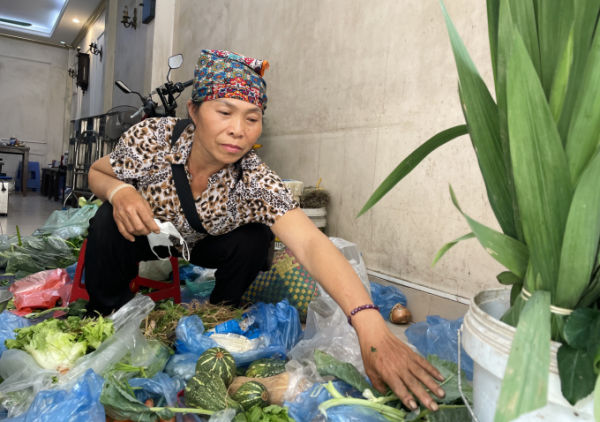
Nguyen Giang, 59, has been renting business space at a private residence in Alley 189 Hoang Hoa Tham, Hanoi, since mid-March 2026. Photo by Quynh Duong. |
But renting space and moving inside means both lower sales and higher costs for the vendors.
In March Thanh Thuy, 43, and Nguyen Giang, 59, moved into a rented place in Alley 189 Hoang Hoa Tham for VND2 million a month. Since moving inside, Thuy’s pork sales have fallen from 30 kg to 20 kg a day as customers hesitate to stop.
Giang’s vegetable stall also gets fewer customers. On good days she earns VND200,000-300,000, but now must pay rent. “At least I am not chased away, but it is too quiet inside,” she says.
To implement Plan 373, many localities follow a three-step approach: public outreach, peak enforcement and maintaining monitoring posts.
But authorities admit the effort is stuck in a loop of chasing away and returning. Lieutenant Colonel Do Quoc Minh, deputy police chief of Ngoc Ha Ward, says clearing wet markets is difficult. “Vendors tend to return as soon as enforcement officials leave.”
Lieutenant Colonel Le Xuan Tho, deputy police chief of Gia Lam Commune, says the responsibility does not lie with sellers alone and is sustained by people’s convenience-driven habit of stopping by the roadside to shop.
 |
|
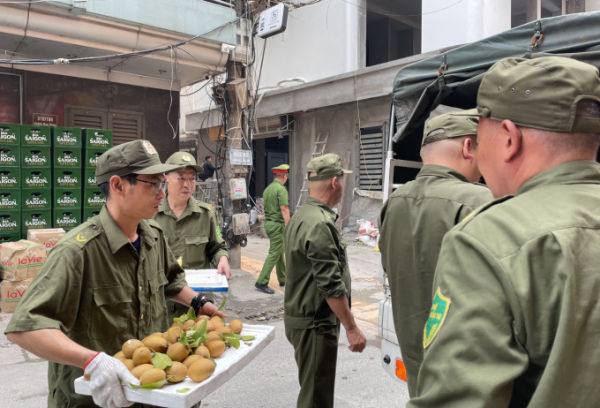
Security forces in Ngoc Ha Ward confiscate vendors’ goods after repeated warnings and outreach, on March 4. Photo by Quynh Duong |
Many vendors with stalls inside formal markets struggle to attract customers as a result and spill back onto the streets, he says.
To support livelihoods, Ngoc Ha Ward has arranged stalls for about 10 low-income vendors at Cong Vi Market. In Gia Lam commune, authorities have managed to clear smaller wet markets with fewer than 50 vendors.
However, larger places such as Sui and DX8, with hundreds of vendors, are being dismantled more gradually to avoid disrupting livelihoods. Authorities have also helped hundreds of vendors from the temporary DX8 site relocate to the newly built Kim Au Market.
In Khuong Dinh Ward, officials arranged 100 spots in the main market for vendors from the wet market at 129 Nguyen Trai at just 8,000-10,000 dong a day.
However, according to Pham Thanh Nam, deputy head of the ward’s infrastructure and investment project management, only a few have registered to move.
The challenge of clearing these markets remains. Besides the site at 129 Nguyen Trai, the hotspot at alley 66 Kim Giang with some 200 households must also be cleared before year end. “Clearing the streets can be done quickly, but eliminating sidewalk trading is a long-term problem. It also requires addressing the habits of buyers,” Tho said.
-
Vernon Kay 'knocked off my feet' as Strictly star makes tearful confession to him

-
Jyeshtha Month 2026: This time, the month of Jyeshtha will span 59 days instead of the usual 30—which deity will be worshipped?
-
RAK emerges as UAE's industrial powerhouse, driving exports and growth

-
Familiar vs Future: How Buyers Choose Between ICE SUVs and EVs

-
Buddha Purnima 2026 Remedies: Perform this simple remedy right at home tonight on Buddha Purnima..