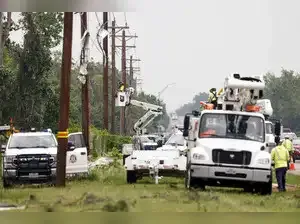
Flash flood warning has been issued for parts of the U.S. tonight. A storm tracking across the Southern U.S. will continue heavy rainfall across Texas and Louisiana, before shifting east along the Gulf Coast on Friday.
The Southeast U.S. will see heavier rain Saturday, with cooler conditions spreading west to east in the storm's wake through the weekend. While much of this rainfall will be beneficial to the ongoing drought, however pockets of excessive rainfall may bring localized areas of flash and urban flooding, National Weather Service stated in its advisory for Friday, Saturday.
Major storms continue to sweep across southern portions of the Midwest. An elevated risk of tornadoes was predicted Monday night. Glass shards flew everywhere as Eric Gockel waited out one of the worst hailstorms to hit Missouri.
One of the softball-size hunks of ice that hit the Springfield area on Tuesday measured 4.75 inches (12 centimeters). The hail killed an emu at the zoo, injured some drivers, knocked out power to thousands and damaged hundreds of vehicles and even some aircraft.
Severe spring weather is plaguing the South and Midwest, and emergency management officials said the hailstorm was Springfield’s worst in history, although it falls short of a state record. Mark Burchfield, a meteorologist with the National Weather Service in Springfield, said that distinction goes to the 6-inch (15.2-centimeter) hail recorded in 2004 near the town of Maryville.
At the Dickerson Park Zoo in Springfield, staff tried to move animals inside, including Adam, a 21-year-old female emu. But an emu’s natural behavior is to lie down and take cover, spokesperson Joey Powell said in an email to The Associated Press.
Adam died from head trauma. And Oscar, a 17-year-old type of flightless bird called a rhea, was injured by the hail but was receiving pain medication and doing well Wednesday morning, as the zoo remained closed.
Some of the worst damage was recorded at the Springfield-Branson National Airport, about 5 miles (8 kilometers) northwest of the city center.
Dozens of flights were delayed or canceled, and hundreds of vehicles had windshields or sunroofs busted out, said Ren Luebbering, the airport public information officer.
The Southeast U.S. will see heavier rain Saturday, with cooler conditions spreading west to east in the storm's wake through the weekend. While much of this rainfall will be beneficial to the ongoing drought, however pockets of excessive rainfall may bring localized areas of flash and urban flooding, National Weather Service stated in its advisory for Friday, Saturday.
Major storms continue to sweep across southern portions of the Midwest. An elevated risk of tornadoes was predicted Monday night. Glass shards flew everywhere as Eric Gockel waited out one of the worst hailstorms to hit Missouri.
One of the softball-size hunks of ice that hit the Springfield area on Tuesday measured 4.75 inches (12 centimeters). The hail killed an emu at the zoo, injured some drivers, knocked out power to thousands and damaged hundreds of vehicles and even some aircraft.
Severe spring weather is plaguing the South and Midwest, and emergency management officials said the hailstorm was Springfield’s worst in history, although it falls short of a state record. Mark Burchfield, a meteorologist with the National Weather Service in Springfield, said that distinction goes to the 6-inch (15.2-centimeter) hail recorded in 2004 near the town of Maryville.
At the Dickerson Park Zoo in Springfield, staff tried to move animals inside, including Adam, a 21-year-old female emu. But an emu’s natural behavior is to lie down and take cover, spokesperson Joey Powell said in an email to The Associated Press.
Adam died from head trauma. And Oscar, a 17-year-old type of flightless bird called a rhea, was injured by the hail but was receiving pain medication and doing well Wednesday morning, as the zoo remained closed.
Some of the worst damage was recorded at the Springfield-Branson National Airport, about 5 miles (8 kilometers) northwest of the city center.
Dozens of flights were delayed or canceled, and hundreds of vehicles had windshields or sunroofs busted out, said Ren Luebbering, the airport public information officer.