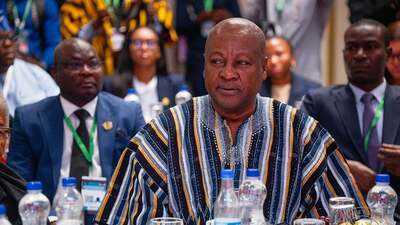
Ghana has turned down a proposed health agreement with the United States over data privacy concerns and is now seeking revised terms, an official said on Friday, 1 May. It is the latest African country to reject the deal on similar grounds.
The proposal would have allowed US entities access to Ghana’s sensitive health data without adequate safeguards, according to Arnold Kavaarpuo, executive director of Ghana’s Data Protection Commission.
The extent of the requested access “went far beyond what would typically be required,” Kavaarpuo told the Associated Press.
A US State Department spokesperson said the department does not disclose details of bilateral negotiations. “We continue to look for ways to strengthen the bilateral partnership between our two countries,” the spokesperson added, speaking on condition of anonymity.
Under the 'America First' global health funding approach of President Donald Trump, the US has signed similar agreements with more than 30 countries, most of them in Africa. The policy, introduced late last year, replaces earlier arrangements under the now-dismantled United States Agency for International Development.
These agreements offer hundreds of millions of dollars in US funding to African countries hit hardest by aid cuts, aimed at supporting public health systems and tackling disease outbreaks.
However, they have drawn scrutiny over data privacy. In February, authorities in Zimbabwe said they rejected a similar proposal citing concerns over health data, fairness and sovereignty. Zambia is also reported to have raised objections to parts of its draft agreement, though no final decision has been taken.
Activists across Africa say the deals often lack sufficient safeguards on data use and can be restrictive in scope. In Nigeria, for instance, US support has been reported to focus largely on Christian faith-based healthcare providers.
Jean Kaseya, head of the Africa Centres for Disease Control and Prevention, has also flagged “huge concerns” about data-sharing provisions in remarks to reporters.
Ghana says no prior approval for data use
Under the proposed agreement, valued at about USD 300 million, Ghana would have received roughly USD 109 million in US funding over five years, with additional contributions from its own government, Kavaarpuo said.
He noted a provision allowing individuals to be identified where deemed necessary in handling sensitive health data. “That, in effect, was outsourcing the health data architecture of the country to a foreign body,” he said. “The proposed data sharing agreement looked at access not only to health data sets, but also to metadata, dashboards, reporting tools, data models and data dictionaries.”
The proposal would have granted up to 10 US entities access to such data without requiring prior approval from Ghana, he added. “We did not get a sense that Ghana had any real governance oversight when it came to how the data was going to be utilised. It was more or less that if they undertook an exercise, they would notify the country. So it was not a prior approval arrangement,” he said.
Kavaarpuo said Ghana has informed the US of its decision to reject the proposal and has requested improved terms for a revised agreement.
With AP/PTI inputs
-
What workers should know about gratuity calculation in the UAE
-
mahahsscboard.in Maharashtra HSC Result 2026 Alternative Websites: How to download scores from DigiLocker, UMANG app? Here are the details
-
Spirit Airlines cancels all flights with immediate effect as fuel price surge hits operations

-
Quote of the Day by Lisa Kleypas: ‘I no longer believed in the idea of soul mates, or love at first sight, but…’ - How imperfect romance creates the strongest emotional impetus

-
Fintech funding holds at $513 million in Q1 2026, even as deal count collapses 54%: Report