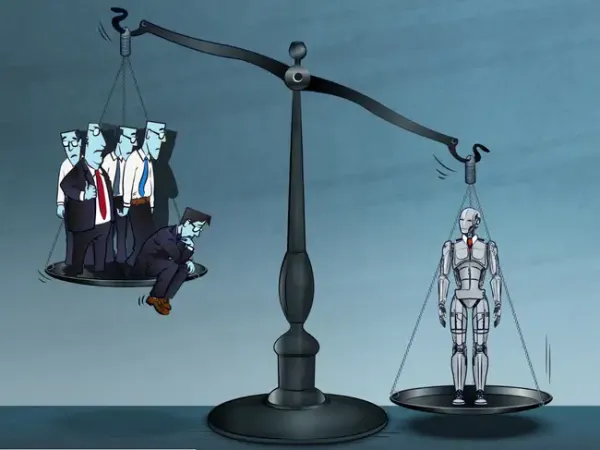
The recent ruling by a court in Hangzhou in China has given a new legal twist to the global debate over AI-driven job losses, setting out limits on how far companies can go in treating automation as justification for firing workers. At a time when businesses across the world are rapidly deploying AI models to replace or reshape human roles, the decision indicates that courts may not accept AI efficiency as a blanket defence for layoffs. Instead, it places the focus back on contract law, fairness and employer responsibility during technological transition. The case can become a possible early template for how legal systems might respond as AI job losses gather pace.
A legal line in the sand on AI jobs replacement
The Hangzhou Intermediate People’s Court case dissects the mechanics of AI-driven job replacement. According to a report by Chinese news agency Xinhua, the employee, a senior quality assurance supervisor earning about 25,000 yuan a month, had a role that sat directly at the human-AI interface. His work involved aligning user queries with large language models and filtering outputs for illegal or privacy-violating content, a function central to safe AI deployment. Over time, those same large language models were upgraded to perform much of this work autonomously, effectively finishing the human role.
Rather than eliminating the position outright, the company attempted to reassign the employee to a lower-ranking job with a sharply reduced salary of 15,000 yuan per month. When he refused, the firm terminated his contract and offered compensation of just over 311,000 yuan, arguing that organisational restructuring driven by AI adoption justified the move. The employee challenged both the dismissal and the compensation, first through arbitration and then through the courts.
Both the arbitration panel and the lower court sided with the employee, and the Hangzhou Intermediate People’s Court upheld those findings on appeal. Crucially, the court examined whether AI replacement could qualify as a “major change in objective circumstances” under China’s Labor Contract Law, a legal threshold that allows contract termination. It concluded that this standard is reserved for external, structural disruptions such as relocation, mergers, or events that make contract performance impossible. The company’s decision to deploy AI, by contrast, was deemed an internal, voluntary business adjustment.
The court also found that the employer failed to prove that the original role had become impossible to perform. Even if some tasks were automated, the broader function of supervising and ensuring AI output quality still existed. This distinction is significant, as it rejects the idea that partial automation can justify full displacement.
Equally important was the court’s assessment of the reassignment offer. By proposing a role with a 40 percent pay cut and lower status, the company did not meet the standard of a “reasonable adjustment.” The court effectively set a benchmark that reassignment must preserve not just employment, but dignity and economic standing to a meaningful degree.
This ruling establishes a layered legal test. AI adoption does not automatically constitute a fundamental change in circumstances, and employers must show genuine impossibility of continuing the original role. Any reassignment must be substantively fair, not merely procedural. And if these conditions are not met, termination may be ruled unlawful.
This level of judicial scrutiny adds a new dimension to global debates. Much of the discussion around AI job loss has focused on scale and speed, often framed through projections which estimate that hundreds of millions of jobs could be affected worldwide. The Chinese ruling shifts attention from macro forecasts to micro accountability. Effectively, it asks who will bear the cost when these forecasts materialise.
The decision also implicitly challenges a narrative common in tech circles that AI displacement is an unavoidable external force. By contrast, the court treats it as a strategic choice that carries legal consequences.
Western policy debates
Across the United States and Europe, policymakers have been grappling with similar tensions, though mostly at a regulatory and advisory level rather than through court rulings. The White House’s several executive actions on AI have emphasised worker protection, including commitments from major tech firms to study labour impacts and avoid harmful deployment. Yet these measures remain largely voluntary.
In the European Union, the AI Act came into force in stages starting in 2024. While the law focuses primarily on risk classification and safety, European officials have increasingly tied it to labour concerns. The European Trade Union Confederation has pushed for stronger provisions to protect workers from algorithmic management and automated dismissal, arguing that current safeguards are insufficient.
The Hangzhou ruling goes further than these frameworks by directly addressing termination practices. It effectively creates a judicial test -- if AI adoption is voluntary and does not make a job impossible to perform, dismissal may be unlawful. That clarity is still largely absent in Western legal systems.
Courts versus regulators
One striking aspect of the Chinese case is that it emerges from the judiciary rather than from legislation. In many Western economies, the regulatory response has been proactive but focusing on principles rather than specific disputes. The US courts are only beginning to confront AI-related employment cases, often in areas like hiring discrimination rather than displacement. Similarly, UK regulators have taken a light-touch approach, relying on existing employment law frameworks rather than crafting AI-specific rules.
The Chinese ruling suggests that courts may become a frontline arena for defining AI labour norms. By setting precedents case by case, they can move faster than legislatures. This could create a patchwork of legal interpretations across jurisdictions, especially if similar disputes begin to surface in Europe and North America.
The economics of responsibility
A key implication of the ruling is economic. It reinforces the idea that productivity gains from AI should not come at zero cost to employers. Instead, companies may need to absorb transition costs through higher severance, retraining programmes or meaningful reassignment. This aligns with arguments made by many analysts who warn that unchecked automation could widen inequality if firms capture most of the gains while workers bear the risks. The Hangzhou court effectively translates that concern into a legal principle.
Recently, there have been waves of layoffs in sectors like tech and customer service where AI tools are rapidly being deployed. In many cases, companies have framed these cuts as efficiency improvements rather than necessity. The Chinese ruling challenges that argument.
A possible template for global policy
For regulators worldwide, the ruling offers a potential template. It does not block AI adoption, nor does it impose rigid constraints on innovation. Instead, it sets conditions under which technological change must occur. These include good-faith reassignment, proportional compensation and a clear demonstration that job functions cannot reasonably continue.
This approach could influence future policymaking. Several governments in the West are already reviewing labour laws to address AI-related disruption. The Chinese case provides a concrete example of how such laws might be interpreted in practice. It also reinforces a broader principle gaining traction in international policy circles that technological progress must be governed and not just encouraged. The challenge is not stopping AI but distributing its benefits and costs more equitably.
The Hangzhou ruling does not stop the advance of AI but redefines the terms of that advance. By asserting that companies cannot simply cite AI as justification for layoffs, it places human role and legal responsibility back at the centre of the issue which has so far been largely about the inevitability of job losses due to AI.
The Chinese court ruling suggests the future of work will not be shaped by just technological advances but also by the rules governments, courts and regulators enforce. It indicates that those rules may arrive sooner and with sharp teeth than many in the tech industry may expect.
A legal line in the sand on AI jobs replacement
The Hangzhou Intermediate People’s Court case dissects the mechanics of AI-driven job replacement. According to a report by Chinese news agency Xinhua, the employee, a senior quality assurance supervisor earning about 25,000 yuan a month, had a role that sat directly at the human-AI interface. His work involved aligning user queries with large language models and filtering outputs for illegal or privacy-violating content, a function central to safe AI deployment. Over time, those same large language models were upgraded to perform much of this work autonomously, effectively finishing the human role.
Rather than eliminating the position outright, the company attempted to reassign the employee to a lower-ranking job with a sharply reduced salary of 15,000 yuan per month. When he refused, the firm terminated his contract and offered compensation of just over 311,000 yuan, arguing that organisational restructuring driven by AI adoption justified the move. The employee challenged both the dismissal and the compensation, first through arbitration and then through the courts.
Both the arbitration panel and the lower court sided with the employee, and the Hangzhou Intermediate People’s Court upheld those findings on appeal. Crucially, the court examined whether AI replacement could qualify as a “major change in objective circumstances” under China’s Labor Contract Law, a legal threshold that allows contract termination. It concluded that this standard is reserved for external, structural disruptions such as relocation, mergers, or events that make contract performance impossible. The company’s decision to deploy AI, by contrast, was deemed an internal, voluntary business adjustment.
The court also found that the employer failed to prove that the original role had become impossible to perform. Even if some tasks were automated, the broader function of supervising and ensuring AI output quality still existed. This distinction is significant, as it rejects the idea that partial automation can justify full displacement.
Equally important was the court’s assessment of the reassignment offer. By proposing a role with a 40 percent pay cut and lower status, the company did not meet the standard of a “reasonable adjustment.” The court effectively set a benchmark that reassignment must preserve not just employment, but dignity and economic standing to a meaningful degree.
This ruling establishes a layered legal test. AI adoption does not automatically constitute a fundamental change in circumstances, and employers must show genuine impossibility of continuing the original role. Any reassignment must be substantively fair, not merely procedural. And if these conditions are not met, termination may be ruled unlawful.
This level of judicial scrutiny adds a new dimension to global debates. Much of the discussion around AI job loss has focused on scale and speed, often framed through projections which estimate that hundreds of millions of jobs could be affected worldwide. The Chinese ruling shifts attention from macro forecasts to micro accountability. Effectively, it asks who will bear the cost when these forecasts materialise.
The decision also implicitly challenges a narrative common in tech circles that AI displacement is an unavoidable external force. By contrast, the court treats it as a strategic choice that carries legal consequences.
Western policy debates
Across the United States and Europe, policymakers have been grappling with similar tensions, though mostly at a regulatory and advisory level rather than through court rulings. The White House’s several executive actions on AI have emphasised worker protection, including commitments from major tech firms to study labour impacts and avoid harmful deployment. Yet these measures remain largely voluntary.
In the European Union, the AI Act came into force in stages starting in 2024. While the law focuses primarily on risk classification and safety, European officials have increasingly tied it to labour concerns. The European Trade Union Confederation has pushed for stronger provisions to protect workers from algorithmic management and automated dismissal, arguing that current safeguards are insufficient.
The Hangzhou ruling goes further than these frameworks by directly addressing termination practices. It effectively creates a judicial test -- if AI adoption is voluntary and does not make a job impossible to perform, dismissal may be unlawful. That clarity is still largely absent in Western legal systems.
Courts versus regulators
One striking aspect of the Chinese case is that it emerges from the judiciary rather than from legislation. In many Western economies, the regulatory response has been proactive but focusing on principles rather than specific disputes. The US courts are only beginning to confront AI-related employment cases, often in areas like hiring discrimination rather than displacement. Similarly, UK regulators have taken a light-touch approach, relying on existing employment law frameworks rather than crafting AI-specific rules.
The Chinese ruling suggests that courts may become a frontline arena for defining AI labour norms. By setting precedents case by case, they can move faster than legislatures. This could create a patchwork of legal interpretations across jurisdictions, especially if similar disputes begin to surface in Europe and North America.
The economics of responsibility
A key implication of the ruling is economic. It reinforces the idea that productivity gains from AI should not come at zero cost to employers. Instead, companies may need to absorb transition costs through higher severance, retraining programmes or meaningful reassignment. This aligns with arguments made by many analysts who warn that unchecked automation could widen inequality if firms capture most of the gains while workers bear the risks. The Hangzhou court effectively translates that concern into a legal principle.
Recently, there have been waves of layoffs in sectors like tech and customer service where AI tools are rapidly being deployed. In many cases, companies have framed these cuts as efficiency improvements rather than necessity. The Chinese ruling challenges that argument.
A possible template for global policy
For regulators worldwide, the ruling offers a potential template. It does not block AI adoption, nor does it impose rigid constraints on innovation. Instead, it sets conditions under which technological change must occur. These include good-faith reassignment, proportional compensation and a clear demonstration that job functions cannot reasonably continue.
This approach could influence future policymaking. Several governments in the West are already reviewing labour laws to address AI-related disruption. The Chinese case provides a concrete example of how such laws might be interpreted in practice. It also reinforces a broader principle gaining traction in international policy circles that technological progress must be governed and not just encouraged. The challenge is not stopping AI but distributing its benefits and costs more equitably.
The Hangzhou ruling does not stop the advance of AI but redefines the terms of that advance. By asserting that companies cannot simply cite AI as justification for layoffs, it places human role and legal responsibility back at the centre of the issue which has so far been largely about the inevitability of job losses due to AI.
The Chinese court ruling suggests the future of work will not be shaped by just technological advances but also by the rules governments, courts and regulators enforce. It indicates that those rules may arrive sooner and with sharp teeth than many in the tech industry may expect.