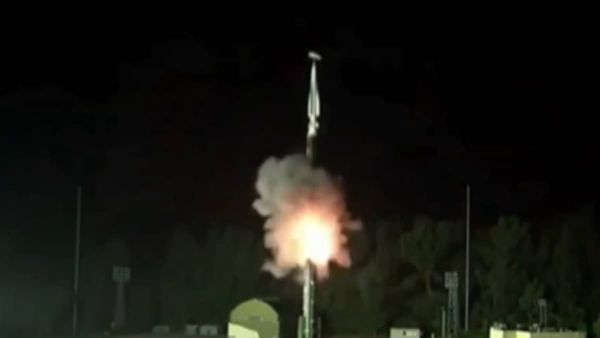
India has once again demonstrated its defense prowess by successfully conducting a flight test of its Long-Range Anti-Ship Missile (LR-AShM) system from a testing facility off the Odisha coast. Developed by the Defence Research and Development Organisation (DRDO), the Phase-II testing focused on a 2-stage hypersonic glide vehicle design. This represents a crucial advancement in India’s next-generation striking capabilities.
Reports confirm that the missile achieved an impressive striking range of 1,500 km, significantly extending India’s maritime defensive reach into the deep ocean.
Purpose and Operational Flexibility
The LR-AShM was developed to meet the Indian Navy’s coastal defense requirements, specifically the ability to engage both stationary and moving maritime targets. Designed to carry multiple payload configurations, the missile offers enhanced operational flexibility across diverse combat scenarios.
Trial and Performance Validation
The recent test flight successfully demonstrated the missile's exceptional terminal guidance accuracy, resulting in a direct kinetic impact after a high-speed flight path. The system met every technical benchmark established for the mission—covering the initial launch sequence, mid-flight course adjustments, and final impact. These results effectively confirm the structural integrity of the airframe and the dependable performance of the propulsion unit.
?????’? ?????????? ???? ???? ??? ???????. ?
DRDO’s LR-AShM Phase-II test off the Odisha coast signals a new era.
Reflecting the vision of PM Modi for a self-reliant, future-ready India, it marks a powerful leap in indigenous defence… pic.twitter.com/8ubvYE3FQ8— BJP (@BJP4India) May 2, 2026
Technological Integration and Precision
Equipped with locally developed avionics and advanced sensor suites, the missile offers enhanced precision and operational consistency. These indigenous subsystems are specifically designed to maintain targeting lock-on and reliability, even when navigating sophisticated or contested combat environments.
Hypersonic Flight Profile
The LR-AShM operates as a hypersonic glide vehicle (HGV), following a quasi-ballistic trajectory. In its initial powered phase, the missile achieves speeds of up to Mach 10 before transitioning into a controlled glide at an average velocity of approximately Mach 5.
This flight profile, combined with low-altitude maneuvers, makes detection and interception by enemy radar systems extremely difficult. The missile’s ability to execute evasive maneuvers during its terminal phase further strengthens its survivability and effectiveness.
Two-Stage Propulsion System
The propulsion system consists of a two-stage solid rocket motor:
- First Stage: Provides the initial boost before separation.
- Second Stage: Accelerates the vehicle to hypersonic speeds.
Once the powered phase is complete, the missile enters an unpowered glide while maintaining high maneuverability. Indigenous sensors guide the vehicle during this glide phase to ensure a precision strike on the target.
Strategic Positioning in the Indian Navy
The LR-AShM serves as a vital bridge in India's naval strategy, occupying the operational space between the BrahMos supersonic cruise missile and heavy-duty strategic ballistic weapons. Key benefits include:
- Maritime Dominance: Provides a powerful, non-nuclear deterrent designed to neutralize high-value naval targets.
- Tactical Versatility: Offers a flexible strike option that balances speed and range beyond current supersonic limits.
Domestic Innovation and Global Standing
This successful test marks a pivotal milestone in India’s mastery of hypersonic technology. It underscores the DRDO’s growing proficiency in creating home-grown defense solutions, further reducing dependence on foreign military hardware.
As India moves into the testing phase for hypersonic glide vehicles, it joins an elite tier of global powers. The transition from theoretical design to live trials confirms India's status as a leader in deploying next-generation, high-velocity strike platforms.
-
Humpback whale Timmy released in North Sea but risk remains
-
India and Ecuador Move Towards Preferential Trade Agreement

-
India's Remittance Flow Remains Stable Amid West Asia Tensions

-
KL Rahul Shines in IPL 2026, Secures 17th Player of the Match Award

-
Controversy Surrounds Arrest of BJP Leader in Double Murder Case