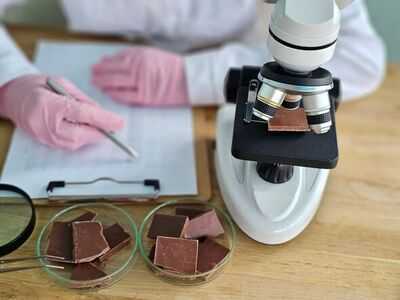
Laboratory-grown chocolate bars are set to hit the shelves by next year to secure supplies of the world's favourite treat from weather extremes.
In recent years the supply of cocoa beans has been hit by droughts and floods, particularly in West Africa, prompting Cadbury and Toblerone owner Mondelz International to make nearly a dozen chocolate bars from the cocoa butter supplied by Celleste Bio.
Celleste, backed by Mondelz, said the milestone paves the way to scale up production and have its cell cultured cocoa butter market-ready by 2027.
The process involves taking cells from a cocoa bean that are grown before being put in vats and fermented with water, sugar and vitamins to produce a biomass, which is then harvested.
The coca butter has the same fats and flavour compounds found in the natural product provided from around six million smallholders across Africa, Latin America and Asia.
Celleste said the alternative source will help chocolate manufacturers continue to provide the world's favourite treat as ageing trees, disease and climate change threaten cocoa growers.
Hanne Volpin, the firm's chief technical and scientific officer, said: "Building a resilient supply chain means being able to produce at commercial volumes while offsetting disruptions caused by climate change, deforestation and resource scarcity.
"We are on track to produce one ton of cocoa butter annually in a 1,000 litre bioreactor from a single bean - which would otherwise require about a hectare of cocoa trees.
"To that end, we've curated a very robust bank of multiple cocoa bean varietals we can use to grow, test and scale material without ever having to cut down a single tree in the rainforest."
But Kerry Daroci, from the Rainforest Alliance, said cocoa growers in developing countries must not be forgotten as technoligcal advancements are brought in.
She said: "While cocoa butter substitutes may help manufacturers during cocoa price crises, they present real risks for smallholder farmers.
"If alternatives capture significant market share without deliberate intervention, we could see demand erosion that devastates already vulnerable communities - particularly in West Africa, where cocoa represents up to 40% of export earnings in some countries.
"The chocolate industry stands at a crossroads. One path leads to technological substitution that leaves farmers behind. The other integrates innovation with investment in people and landscapes.
"At the Rainforest Alliance, we're working to ensure the industry chooses the latter - because sustainability that abandons communities isn't sustainable at all."

Marina El-Hasni, from the Fairtrade Foundation, welcomed "scientific innovation that aims to reduce environmental harm and strengthen the future of global food systems".
She added: "However, Fairtrade Foundation believes any new technology in relation to cocoa production must be assessed through a simple lens: does it protect and advance the rights, livelihoods and resilience of the millions of smallscale farmers who grow the world's cocoa?
"Labgrown cocoa is often marketed as a sustainability solution to reduce pressure on forests or supply volatility.
"Its use must not undermine farming communities who rely on cocoa production for their livelihoods.
"Any shift toward labgrown alternatives must not make the people who grow our cocoa more vulnerable."
-
Not the season, admits MI skipper Hardik Pandya after another defeat

-
Political atmosphere intensifies in UP as SP chief, Deputy CMs exchange words on social media

-
Odisha Class 10 Result 2026 OUT At bseodisha.ac.in; Direct Link Here To Be Activate At 6 PM

-
'Most Memorable Moments': Kannada Actor Rishab Shetty Meets Union Home Minister, Amit Shah; Discusses Kantara Legacy, Art & Upcoming Projects

-
Mexican governor indicted by US steps down