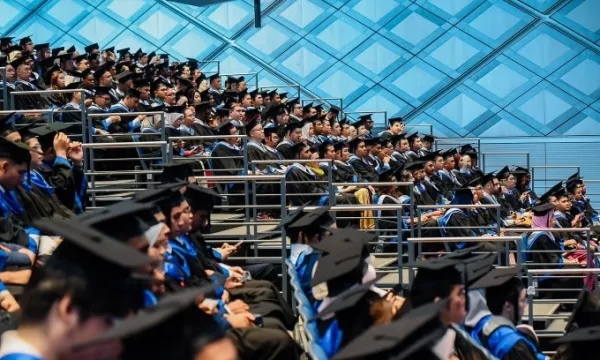
The Universiti Teknologi Petronas climbed eight places to secure the joint 35th position in the 2026 ranking, becoming the first Malaysian university to breach the top 40 in this regional table.
The ranking evaluates a record 929 universities across 36 countries and territories across 18 performance indicators grouped into five key pillars — the teaching and learning environment, the research environment (spanning volume, income, and reputation), research quality (citation impact) and research influence, international outlook, and industry income and patents.
Malaysia stood out as a strong performer, with a sharp increase in top-tier placements. Six Malaysian universities rank within Asia’s top 100, doubling the number recorded in the previous year.
The three new additions are Sunway University, Universiti Kebangsaan Malaysia and Universiti Sains Malaysia.
Universiti Malaya remains the country’s second-highest-ranked institution, despite experiencing a slight drop to the 65th spot.
|
Graduating students at the Universiti Teknologi Petronas, Malaysia. Photo from the university’s Facebook page |
The Asia list continues to see dominance by China, which secured five of the top 10 spots, led by Tsinghua University and Peking University. Singapore, Japan, and Hong Kong also maintained a strong presence at the top of the table.
The National University of Singapore and Nanyang Technological University took third and fourth places.
Analysts suggest Malaysia’s upward trend reflects sustained investment in higher education, stronger research performance, and expanding global partnerships.
Gerard A. Postiglione, chair professor of education at the University of Hong Kong, noted that Malaysia’s progress reflects a highly calculated approach to regional positioning.
“Malaysia has become more strategic in learning from its tiny neighbor, Singapore, and using its larger population to become China’s largest ASEAN partner in cross-border university ventures,” he told Times Higher Education.
James Chin, professor of Asian studies at the University of Tasmania, pointed out that Malaysia’s recent gains reflect long-term efforts to position itself as a regional education hub. This strong performance is driven in part by private universities that are distinctly focused on improving their global standing.
“The key strength of the system is that the private universities are doing very well, in the sense that they take the rankings game seriously,” he told THE. “So this is a long process and what you’re seeing now is Malaysia in a mature place for higher education.”
-
IPL 2026: Will BCCI listen to Virat-Rohit? Big news regarding impact player

-
The cycle of 13 recharges in 1 year is over! Jio Airtel and Vi introduced magical plans, you will get a whole month’s leave in one recharge – News Himachali News Himachali

-
IDBI Bank Sale: Why did Kotak Bank withdraw its steps? CEO reveals the biggest secret of deal getting stuck

-
Salute to the courage… Army officer’s wife sacrificed her life, 14 year old boy got a new life

-
Nautapa 2026: Nautapa will scorch for 9 days, know when the hottest days of summer will start