0
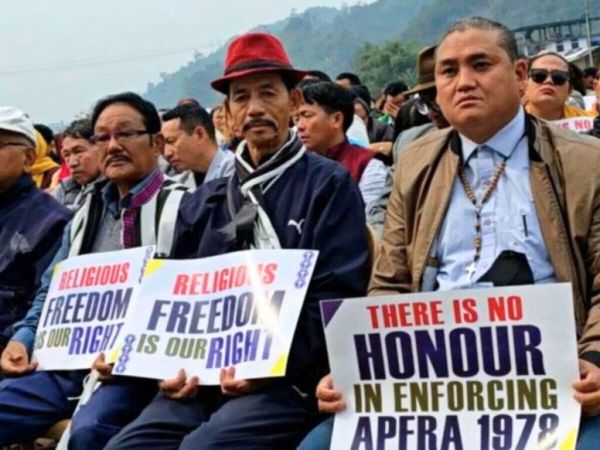
Arunachal Pradesh is witnessing widespread protests as thousands of Christians across the state demand the repeal of the Arunachal Pradesh Freedom of Religion Act (APFRA), 1978. The demonstrations, led mainly by the Arunachal Christian Forum (ACF) and allied groups, have spread across several districts, including Itanagar, Pasighat, Lower Dibang Valley, West Siang, East Kameng, Kamle and Changlang. The protests have brought renewed attention to the long-standing debate over religious freedom, indigenous identity, and cultural preservation in the eastern Himalayan state.
At the centre of the controversy is a law passed nearly five decades ago but largely inactive for years. The issue resurfaced after a 2024 directive by the Gauhati High Court asked the Arunachal Pradesh government to frame rules for implementing the Act. Christian groups see this move as a direct threat to their religious freedom.
Christianity has grown sharply in Arunachal Pradesh over the decades. Census figures show that Christians made up less than one percent of the population in 1971. The number rose to 4.32 percent in 1981 and reached 30.26 percent by the 2011 Census. Many believe the figure is even higher today.
You Might Be Interested In
The APFRA was passed in 1978 during the Janata Party government led by then Chief Minister P.K. Thungon. The law prohibits religious conversion through “force or inducement or by fraudulent means.” It also requires prior intimation to the Deputy Commissioner before any religious conversion takes place. Violations can lead to up to two years in prison and fines.
The law was introduced during a period when concerns were growing over rapid missionary activities in the region, then known as the North-East Frontier Agency (NEFA), which was moving toward statehood. Indigenous leaders feared that tribal customs, traditional beliefs, and social structures could weaken due to increasing conversions.
Supporters of the law, including the Indigenous Faith and Cultural Society of Arunachal Pradesh (IFCSAP), argue that the Act protects vulnerable tribal communities and preserves indigenous traditions. Organisations linked to Donyi-Polo, the traditional Sun-Moon faith followed by many Tani tribes such as the Nyishi, Adi, Galo, and Apatani, have long demanded strict implementation of the law.
The Donyi-Polo movement itself saw a revival from the late 1960s under leaders like Talom Rukbo. Traditional practices gradually became more organised through prayer halls known as ganggings, written prayers, and community groups such as the Donyi-Polo Yelam Kebang. The revival was partly seen as a response to the spread of Christianity.
Christian groups, however, strongly oppose the law. ACF leaders say the Act is outdated, vague, and unfairly targets Christians. “It infringes upon the freedom to practice any religion in a democratic country. We feel that this law is specifically targeted at Christians,” ACF President James Techi Tara said during protest rallies. Protesters say that informing authorities before conversion creates unnecessary government interference and could lead to harassment. They say the law violates Articles 25 and 26 of the Constitution, which guarantee freedom of religion. The current protests follow earlier demonstrations, including a large gathering in March 2025 where nearly 200,000 Christians reportedly participated.
Protest meetings and dharnas have focused on constitutional rights, peaceful coexistence, and secularism. In Pasighat, protest events included prayers, solidarity meetings, and calls to continue agitation until the law is repealed.
On the other side, indigenous faith groups argue that large-scale conversions have affected traditional beliefs and weakened community structures. They point to the decline in followers of Donyi-Polo and other indigenous faiths, which accounted for around 26 percent of the population in 2011.
The government led by Chief Minister Pema Khandu has said it will hold consultations with stakeholders. The BJP-led government has maintained that implementation rules would prevent misuse while protecting the original purpose of the law.
The issue has placed the government under pressure from both Christian groups and indigenous faith organisations in a state where tribal identity and cultural protection remain highly sensitive issues.
-
What Is 'Shrekking'? Inside Gen Z's Dating Trend Turning Beauty Standards Upside Down

-
Indian LPG Tanker 'Sarv Shakti' Crosses Strait Of Hormuz Amid US Blockade

-
Manish Malhotra Brings Drama To MET Gala 2026 Pre-Party In Tulle Blazer & Floral Brooch
-
CSIS Report Flags Khalistani Extremist Threat In Canada, Alleges Foreign Interference By India, China, Russia
-
Israel approves plan to buy F-35 and F-15I fighter jets from US amid Iran war