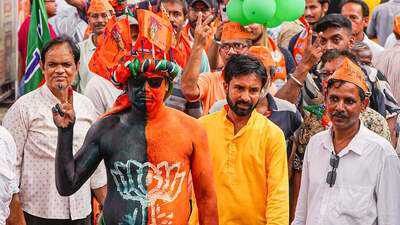
If you are a normal voter, you have any number of parties you can support and vote for. There is the DMK, AIADMK, TDP, NCP, PDP, TMC, INC, JD(S) and JD(U), the NCP again, TRS, the new TVK, CPM, CPI and so on. There is no shortage of parties with different platforms.
But if your primary interest lies in the bullying and harassment of Indian minorities, particularly Muslims, there is only one party for you — and that is the BJP. Fortunately, it is on offer nationally and in most states. It unites prejudiced Indians in much the same way as cricket and the English language do, cutting across regions.
In a recent media interaction, an analyst put the same point differently. He said of the BJP’s appeal: “Anybody who has a right-wing ideology has one party. On the other side, there is so much competition and that vote gets split.”
Let us try to understand why this is the case, because it is true: the BJP has no competition when it comes to what it does. The term ‘right-wing’ is often a euphemism for hate-based politics — and we shall see why in a moment. First, after accepting that there is no rival to the BJP, we must also accept that it offers a simple, easy-to-understand formula.
‘I hate Muslims’ does not require further elaboration. It is clear, direct and effective. The voter does not need to examine a manifesto to understand what the party represents. The distilled essence of the BJP’s ideology is anti-minority.
If you are in the market for a party that does this, you have one at hand — with a national presence and decades of proven delivery on this issue. So why look for another? There is no need.
The careful art of sounding inclusiveA question arises: can the BJP not face competition from another party whose position is: 'But I hate Muslims more'?
It could, and it might — but that position can also be taken within the BJP itself, as we will likely see if and when succession struggles begin. The acceptable spectrum of the BJP’s ideology ranges from disliking minorities to detesting them, and all sentiments within this spectrum are acceptable.
This is the first and most important reason why the BJP has no rival in what it does: it is consistently anti-minority. The second reason is that other parties either choose not to do what the BJP focuses on, or do it episodically and come across as inauthentic. Many parties in India have dabbled in communalism, as we know. But communalism is not at the centre of their politics or identity. The BJP is not the only party to have profited from division and hate, but it is the only one to have made this its central platform.
The list of issues that made the BJP what it is — India’s largest party — remained unchanged for years. First, Muslims must give up their mosque in Ayodhya; second, Muslims must give up their constitutional autonomy in Kashmir; third, Muslims must give up their personal law. Note that there is nothing for Hindus in this framework — for instance, reservations for Dalits and Adivasis remain untouched. The focus is on minorities, which underpins conclusions about what the party stands for.
Shifting goalposts: The many strands of the Sangh Parivar narrativeHaving achieved most of what it set out to do, the party has remained on the same path, as we have seen: Muslims must give up their diet; give up agency over whom to love and marry; give up agency over where to live and pray; whether they can vote; whether they can seek asylum — and so on. There is no end to this, and there will be no end, because harassment is the intent and bullying the ultimate objective.
This bigotry is often described as ‘right-wing’ ideology — a characterisation that does a disservice to the term. Conservatism, as generally understood in politics, has a long and respectable tradition. It seeks continuity and values stability.
Abolishing currency, for instance, is a radical idea, not a conservative one. None of the arbitrary tinkering, renaming, institutional weakening or disruption we have witnessed fits within classical conservatism. What is presented as ‘right-wing’ here is, in fact, intense prejudice cloaked in a more acceptable label.
It is for this reason that BJP manifestos over the decades have experimented with, adopted and then abandoned many positions. In the 1960s and 1970s, they leaned socialist. Under Vajpayee, the party proposed capping incomes and home sizes — later abandoned. It argued against mechanisation replacing labour in factories — also dropped. It even advocated the use of bullocks instead of tractors — again, discarded. None of these positions were taken up or abandoned with much explanation, because none was needed.
The primary product that the BJP and its predecessor, the Jana Sangh, have consistently offered has always been visible: an unchanging hostility towards minorities. The rest has been secondary. As long as that core promise was delivered upon — and it has been, one must concede — the rest was largely irrelevant.
That is why there is only one BJP — and why it is unlikely to face a challenger on its chosen terrain.
Views are personal. More of Aakar Patel’s writing here
-
'IPL In Safest Of Hands': Lalit Modi Reacts As Mittal Family & Adar Poonawalla Set To Acquire Rajasthan Royals In Whopping ₹15,660 Crore Deal
-
SRH vs KKR, IPL 2026, Match 45: Pat Cummins Won Toss & Elected To Bat First In Hyderabad

-
IPL 2026: Mittal Family & Adar Poonawalla Set To Acquire Rajasthan Royals In Whopping ₹15,660 Crore Deal
-
Kiara Advani Requests Yash & Toxic Makers To Trim Down Her Intimate Portions Amid 'Obscene Scenes' Backlash: Report

-
Boat capsize in MP's Jabalpur: Toll rises to 13, body of last missing person recovered