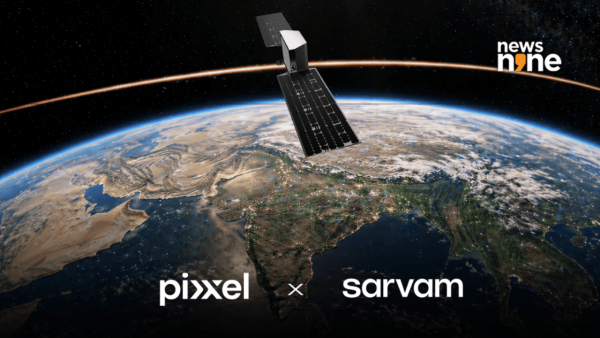
New Delhi: Pixxel and Sarvam have announced a partnership to build India’s first orbital data centre satellite, bringing Indian satellite engineering and India-built AI models into one space mission. The satellite, called Pathfinder, is scheduled to reach orbit as early as Q4 2026.
Under the partnership, Pixxel will design, build, launch and operate the 200 kg-class satellite. Sarvam will provide the AI backbone, with its models running directly on the satellite for training and inference. The companies say this will allow data to be processed in orbit, without depending on foreign cloud or ground infrastructure.
We are excited to announce that Sarvam is partnering with @PixxelSpace to power the AI backbone of India’s first orbital data centre satellite.
This is a first for the country, with India-built AI models running on an India-built satellite and both training and inference… pic.twitter.com/KOGezDX2xQ
— Sarvam (@SarvamAI) May 4, 2026
India’s AI stack heads to orbit
The Pathfinder satellite will carry datacentre-class GPUs and Pixxel’s hyperspectral imaging camera. The plan is to let the satellite capture high-detail Earth imagery and analyse it on board in real time.
This is different from the usual satellite model, where data is captured in space, sent back to Earth, and then processed by ground systems. That process can take time. Pixxel and Sarvam want to reduce that delay by moving compute closer to the source of the data.
The satellite could help detect a wildfire, monitor crop stress, track environmental changes or flag a pipeline leak faster than a system that waits for raw data to reach Earth first.
Why the project matters
The partnership comes at a time when AI infrastructure is becoming a business, policy and sovereignty issue. AI models need compute. Satellites produce huge amounts of data. Processing that data in orbit could become useful for governments, enterprises, climate monitoring teams and companies working with critical infrastructure.
Pixxel CEO Awais Ahmed said, “Ground-based data centres are facing increasing constraints around energy, land, regulation, and scale, and the current model is becoming harder to sustain environmentally.” He added that orbital data centres open a new frontier where compute can use solar energy, work closer to space-based data and move past some limits faced on Earth.
Sarvam CEO Pratyush Kumar said, “AI infrastructure is not just a software question – it is a sovereignty question.” He said the partnership allows Sarvam to extend its sovereign AI stack into space, with India-built models running on an India-built satellite.
What comes next
The Pathfinder mission will test AI inference, data processing, power use, heat control and real-time workflows in space. Pixxel said the satellite will be developed at Gigapixxel, its upcoming facility meant to scale satellite production to up to 100 units.
For India’s AI and space sectors, this is a notable test case. If the mission works as planned, it could show how future satellites may do more than collect data. They may process it, analyse it and send back insights much faster.
-
IndiGo Flight Experiences Power Bank Explosion During Taxiing in Chandigarh

-
Cabinet Approves Major Rail Multi-Tracking Projects to Enhance Connectivity

-
Historic Victory in West Bengal Elections 2026: A New Era Begins

-
Ambati Rayudu Takes Charge as Head of Cricket Operations in Hyderabad

-
Understanding Kalbaisakhi: The Weather Phenomenon Impacting India and Bangladesh