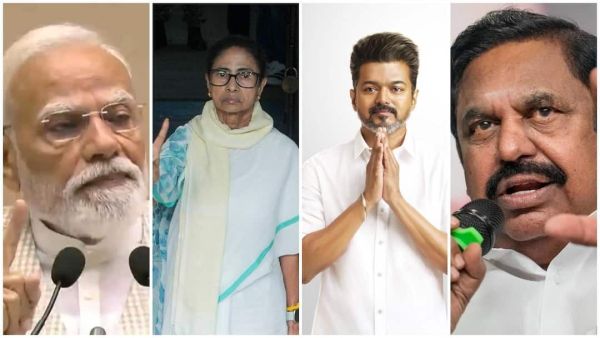
May 4, 2026, is shaping up to be a landmark day in Indian politics. Vote counting is underway in West Bengal, Tamil Nadu, Kerala, Assam, and Puducherry, and early trends point to major upsets, shaking established players while boosting both new and old parties. The BJP, Congress, and TVK are gaining ground, while TMC and AIADMK appear to be slipping. Here’s a clear breakdown of the situation:
What Do The Early Trends Show?
According to the Election Commission of India (ECI), the situation as of 1 PM is as follows:
West Bengal (294 seats): BJP is leading in around 193 seats, while TMC is near 92 and both had won 1 seats each. BJP has crossed the majority mark of 148, indicating a strong possibility of ending Mamata Banerjee’s 15-year rule.
Tamil Nadu (234 seats): Actor Vijay’s new party TVK is ahead in 100–110 seats. AIADMK is leading in 70–80 seats, while the ruling DMK trails in third with 50–60 seats. Majority mark: 118.
Kerala (140 seats): Congress-led UDF is leading in over 90 seats, while the LDF is limited to around 40. Majority mark: 71.
Assam (126 seats): NDA is leading strongly in 80–95 seats, on track to retain power. Majority mark: 64.
Puducherry (30 seats): NDA (BJP + AINRC) is ahead in over 20 seats, well above the majority mark of 16.
These are early trends and may change, but they already signal significant political shifts. Clearer results are expected by evening.
Which Parties Are Gaining Strength?
BJP: The party has made a historic breakthrough in TMC’s stronghold of West Bengal and strengthened its position in Assam. It has capitalized on anti-incumbency, consolidation of Hindu votes, women’s safety concerns, and central government schemes.
Congress: The party is seeing a resurgence in Kerala, where the UDF is close to a decisive win over the LDF, driven by a wave for change and economic issues.
TVK: Vijay’s new party has emerged as the biggest surprise in Tamil Nadu, disrupting traditional politics and attracting strong youth support.
AIADMK: Despite the TVK surge, AIADMK has maintained a solid presence and improved its standing with a significant number of seats.
Which Parties Are Losing Ground?
TMC: After 15 years in power, the party is facing strong anti-incumbency in West Bengal. Issues like corruption, law and order, alleged syndicate culture, and women’s safety have hurt its prospects.
DMK: In Tamil Nadu, allegations of nepotism, corruption, and unemployment have pushed the party to third place.
LDF: In Kerala, governance fatigue, economic challenges, and policy setbacks have weakened the Left front against the Congress-led UDF.
Why Did These Political Swings Happen?
The primary driver appears to be anti-incumbency against long-ruling parties.
In West Bengal, anger against the TMC government, along with issues like the school recruitment scam, RG Kar case, and Sandeshkhali controversy, played a major role. Concerns over women’s safety and BJP’s targeted narratives also helped the party.
In Tamil Nadu, Vijay’s star power and TVK’s fresh appeal resonated with young voters, breaking the traditional DMK-AIADMK dominance.
In Kerala, fatigue with LDF rule and economic concerns created an opening for Congress.
In Assam and Puducherry, BJP benefited from development work, stability, and strong alliances.
Overall, voters appear to have prioritized issues like corruption, employment, safety, and development, signaling a desire for change.
What Lies Ahead for These Parties?
BJP: A potential victory in West Bengal will significantly strengthen its position in eastern India and boost preparations for the 2029 Lok Sabha elections.
Congress: A strong performance in Kerala could provide Rahul Gandhi a platform for political resurgence, though coordination within the opposition bloc may become challenging.
TVK: The party could emerge as a kingmaker in Tamil Nadu and aim to become the principal opposition in upcoming local elections.
TMC: If voted out in West Bengal, Mamata Banerjee may struggle to maintain her national influence and could attempt to build a third front.
DMK: Losing power in Tamil Nadu could trigger internal challenges and reduce its role in national politics.
AIADMK: A return to power may revive the party, though it will face pressure from TVK’s rise.
Left: Heavy losses in Kerala and West Bengal could push the Left further toward political irrelevance at the national level.
The Bigger Picture
Early counting trends suggest new opportunities for the BJP in southern and northeastern India, while regional parties face a clear message: voters are seeking change. Congress has found breathing space, and TVK has emerged as a new force. The road to the 2029 Lok Sabha elections is already beginning to take shape.
-
CPI(M) Takes Swipe At Congress Over Kerala CM Deadlock, Says UDF Unity ‘Exposed’
-
EU Clears New Sanctions Against Israeli Settlers In West Bank

-
SportVot X FPJ: Kurlai Saphale And Ankur Clinch Titles At Balyogi Sadanand Baba Chashak Kabaddi Tournament In Mumbai

-
Sunil Pal Says He Felt Targeted On Kapil Sharma Show: 'People Were Giving Extreme Reactions To Samay Raina's Smallest Joke'

-
How to read the classics in an age of distraction (and three short books to get you going)