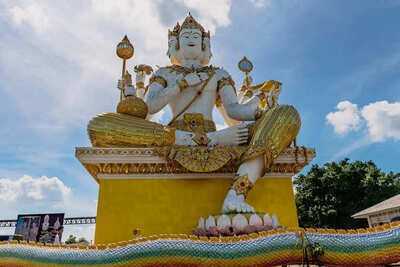
Among the most enduring philosophical questions in Hindu mythology is the comparison between the three principal deities of the Trimurti: Lord Shiva, Lord Vishnu, and Lord Brahma, each representing a fundamental force in the cosmic cycle of existence. The question of who is truly the most powerful is not only popular in modern discussions but also deeply rooted in ancient symbolic interpretations of creation, preservation, and dissolution.
In traditional Hindu philosophy, this question is not meant to establish rivalry, but to explore how different aspects of divine function operate within a unified cosmic system, where each deity plays a role that is essential rather than hierarchical.
Lord Brahma: The Creator and the Origin of Knowledge
Lord Brahma is traditionally regarded as the creator within the Trimurti, responsible for the formation of the universe and the manifestation of living beings. However, his role is often interpreted symbolically rather than as absolute supremacy, because creation in Hindu thought is not a one-time event but an ongoing process within cosmic cycles. Scriptural traditions describe Brahma as emerging from the cosmic reality itself, emphasizing that creation is not independent but arises from a higher unified existence. This philosophical framing suggests that Brahma represents the beginning of knowledge, structure, and cosmic design, rather than ultimate authority over existence.
Lord Vishnu: The Preserver of Cosmic Balance

Lord Vishnu represents the principle of preservation, ensuring that the universe functions in harmony after creation. Through his many avatars, Vishnu intervenes in moments of cosmic imbalance, restoring order and protecting dharma, or universal righteousness. In epics such as the Ramayana and Mahabharata, Vishnu’s incarnations as Rama and Krishna demonstrate his active role in guiding human civilisation through moral and spiritual crises. Rather than being a distant force, Vishnu is often portrayed as deeply engaged with worldly affairs, maintaining balance whenever disruption threatens cosmic stability.
Lord Shiva: The Force of Transformation and Dissolution
Lord Shiva is associated with transformation and dissolution, representing the necessary ending of cycles so that renewal can occur. In Shaiva philosophy, destruction is not negative but essential, as it removes stagnation and prepares existence for rebirth and regeneration. Shiva’s role is often described as the most paradoxical, as he embodies both intense stillness and immense cosmic power. His function is not to oppose creation or preservation, but to ensure that no form of existence becomes permanent or stagnant, maintaining the dynamic flow of the universe.
So Who Is the Most Powerful? The Philosophical Answer
In theological interpretation, Hindu philosophy does not position the Trimurti in a competitive hierarchy. Instead, it presents all three deities as interconnected aspects of a single ultimate reality known as Brahman, where creation, preservation, and destruction are continuous processes rather than separate powers. Many philosophical schools emphasise that power in this context is not about dominance but about function within cosmic order. Brahma creates, Vishnu preserves, and Shiva transforms, and without any one of these functions, the universe as understood in Hindu cosmology would not be complete.
This integrated view suggests that asking “who is most powerful” is less meaningful than understanding how each divine force contributes uniquely to the balance of existence.
The Deeper Meaning Behind the Debate
The enduring fascination with this question reflects a broader human curiosity about origin, continuity, and transformation. Rather than providing a literal answer, Hindu mythology encourages reflection on the interconnectedness of all forces in existence. The Trimurti concept ultimately teaches that power is not singular or competitive but cyclical and cooperative, where each divine role is necessary for the universe to function as a whole. In this sense, the question itself becomes a pathway to philosophical understanding rather than a search for a definitive winner.
Conclusion: Unity Beyond Comparison
While modern interpretations often frame Shiva, Vishnu, and Brahma in comparative terms, traditional theology emphasises unity over separation. Each deity represents a fundamental principle of cosmic reality, and their combined function sustains the universe across time and cycles. Thus, the question of who is truly the most powerful does not lead to a single answer, but instead reveals a deeper truth that in Hindu philosophy, power exists not in isolation, but in balance, continuity, and transformation.
Unlock insightful tips and inspiration on personal growth, productivity, and well-being. Stay motivated and updated with the latest at My Life XP.
-
Major UK pizza chain closing down 16 restaurants - full list

-
Ageless star Cher, 79, turns heads in lace at Met Gala after iconic 'naked dress'

-
Understanding Male Sexual Desire: Age and Beyond

-
Girlfriend's Hilarious Love Letter Goes Viral
-
The incredible £2.2 bn railway project that will transform major African country