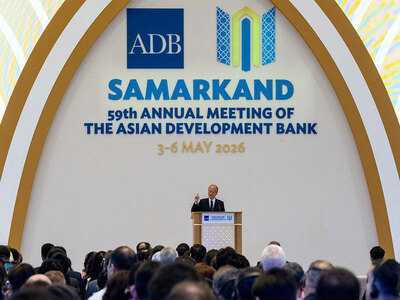
New Delhi [India], May 5 (ANI): Asian Development Bank (ADB) President Masato Kanda called for deeper regional cooperation and cross-border connectivity across Asia and the Pacific, stressing that collective action is key to ensuring resilience and inclusive growth in an increasingly fragmented global landscape.
Addressing the opening session of ADB's 59th Annual Meeting in Samarkand, Kanda said the region stands at a critical juncture where traditional and isolated approaches to development are no longer effective.
"The decisions we make at this new crossroads will secure the future for the next generation," he said, urging countries to "act together to develop together" by building integrated and resilient systems.
The four-day meeting, being held from May 3 to 6 under the theme "Crossroads of Progress: Advancing the Region's Connected Future," has brought together policymakers, private sector leaders, development partners, and innovators to discuss solutions in regional connectivity, digital innovation, and development finance.
Kanda highlighted that economic and geopolitical shocks are increasingly spreading rapidly across borders through energy markets, supply chains, and digital networks, disproportionately impacting vulnerable communities. He emphasised that such challenges require coordinated regional responses beyond national frameworks.
Outlining ADB's response, Kanda said the bank is scaling up investments and accelerating reforms to help integrate infrastructure, markets, and institutions across the region. He noted that ADB extended financial support of USD 29.3 billion last year while enhancing its capacity to deliver assistance more efficiently.
The bank has also launched a USD 70 billion programme aimed at strengthening regional resilience. This includes a USD 50 billion initiative to develop a Pan-Asia Power Grid to support renewable energy integration and improve energy security, along with a USD 20 billion plan to expand cross-border digital connectivity and bridge the digital divide.
Kanda further said ADB has taken early steps to support member countries affected by the ongoing West Asia conflict, warning that prolonged disruptions could increase energy prices, tighten financial conditions, and dampen economic activity across Asia and the Pacific.
According to ADB projections, growth in developing Asia and the Pacific is expected to slow to 4.7 per cent this year from 5.4 per cent last year, while inflation may rise to 5.2 per cent from 3.0 per cent. In a more severe scenario involving further escalation of conflict and rising oil prices, growth could slow further to 4.2 per cent, with inflation climbing to 7.4 per cent in 2026.
Describing ADB as an "anchor of stability," Kanda said the institution will continue to play a key role in addressing challenges such as mobilising private sector investment and tackling environmental degradation.
"The work ahead is immense, but our purpose is clear. We have the strategy. We have the resources. We have the collective will to execute," he added. (ANI)
-
'Specific Reasons Not Communicated': KSCA Alleges No Clarity From BCCI On Chinnaswamy Rejection As IPL 2026 Final Moves To Narendra Modi Stadium

-
'It's Going To Be An Exciting Contest': Sanjay Bangar Reflects His Thoughts Ahead Of SRH vs PBKS IPL 2026 Clash

-
Coinbase To Lay Off 14% Of Workforce As AI Transforms Operations: CEO Brian Armstrong

-
Inspector Avinash Season 2 OTT Release Date: Everything You Need To Know About Randeep Hooda Crime Thriller Series

-
Ektaa Kapoor Says Akshay Kumar Reminds Her Of Father Jeetendra, Pens Heartfelt Note For Him After Bhooth Bangla Success