
A monthly salary that looks strong on paper can still leave people feeling stuck, confused, and constantly short on money. It’s a frustration many young professionals quietly deal with, especially when expenses seem to swallow income before the month even ends. But sometimes, the issue isn’t how much you earn or even how much you spend. It’s how you interpret your finances. A recent breakdown by a Bengaluru-based chartered accountant is now changing how people look at their money.
Meenal Goel recently took to social media to analyse the finances of a 29-year-old professional earning Rs 1.55 lakh per month. Despite this income, the individual shared that only Rs 5,000 to Rs 9,000 remained in his account by the end of each month, leaving him feeling financially strained. He laid out a detailed picture of his expenses, including monthly costs, investments, and liabilities, while also sharing his total income and expenses from the previous year.
His monthly expenses
His monthly structure showed a wide range of outflows. Around ₹78,700 went into routine expenses such as household bills, food, travel, childcare, medical needs, and personal spending. On top of that, he was committing Rs 20,000 every month towards SIP investments and Rs 70,000 towards loan repayments, bringing his total monthly outflow to nearly Rs 1.48 lakh. His yearly numbers reflected a similar pattern, with earnings of Rs 19.64 lakh and expenses of Rs 18.62 lakh.
He also explained that medical costs had been unusually high due to specific treatments and recovery-related expenses in the family. With a household of three, including his wife and child, the financial pressure felt very real.
CA breaks down the math
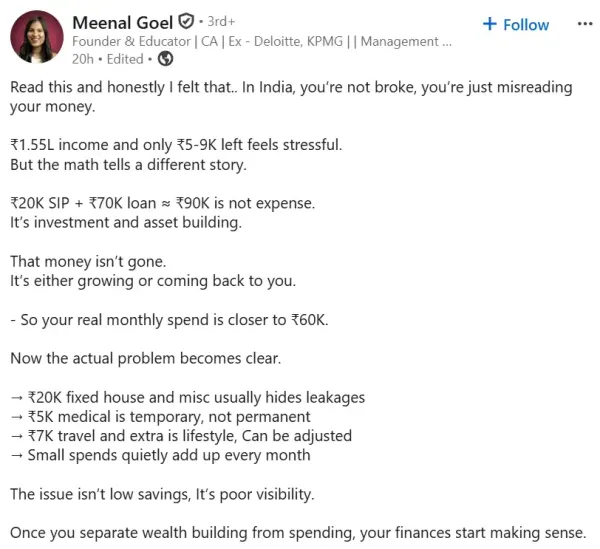
However, Meenal Goel approached the situation from a different angle. Instead of seeing the low end-of-month balance as a sign of financial struggle, she pointed out that the numbers told a more stable story. A large portion of what appeared to be expenses was actually going towards wealth creation and asset building. The Rs 20,000 SIP was being invested for future growth, while the Rs 70,000 loan repayment was contributing towards an asset that would eventually belong to him.
When these two components were separated from regular spending, the picture shifted significantly. The actual monthly expense, according to her breakdown, came closer to Rs 60,000 rather than the full Rs 1.48 lakh. This reframing highlighted that the individual was not overspending in the way he believed, but rather lacked clarity on how his money was being allocated.
She further pointed out areas where inefficiencies might exist. A Rs 20,000 allocation under fixed house and miscellaneous expenses could be masking smaller, unnoticed leakages. The Rs 5,000 medical expense, while significant, was likely temporary and not a recurring burden. Lifestyle-driven spending, such as Rs 7,000 on travel and extra expenses, could be adjusted if needed. Even small, everyday costs, often ignored, can quietly add up over time and impact the overall financial picture.
Her key takeaway focused on visibility. The issue, she explained, was not low savings but the way the finances were being viewed. By clearly separating wealth-building components like investments and loan repayments from actual consumption, the situation becomes easier to understand and manage.
Assembly Elections 2026
Election Results 2026 Live Updates: Who's ahead in which state
West Bengal Election Results 2026 Live Updates
TN Election Result 2026 Live Updates
His monthly expenses
His monthly structure showed a wide range of outflows. Around ₹78,700 went into routine expenses such as household bills, food, travel, childcare, medical needs, and personal spending. On top of that, he was committing Rs 20,000 every month towards SIP investments and Rs 70,000 towards loan repayments, bringing his total monthly outflow to nearly Rs 1.48 lakh. His yearly numbers reflected a similar pattern, with earnings of Rs 19.64 lakh and expenses of Rs 18.62 lakh.He also explained that medical costs had been unusually high due to specific treatments and recovery-related expenses in the family. With a household of three, including his wife and child, the financial pressure felt very real.
Screenshot of CA's post
CA breaks down the math
However, Meenal Goel approached the situation from a different angle. Instead of seeing the low end-of-month balance as a sign of financial struggle, she pointed out that the numbers told a more stable story. A large portion of what appeared to be expenses was actually going towards wealth creation and asset building. The Rs 20,000 SIP was being invested for future growth, while the Rs 70,000 loan repayment was contributing towards an asset that would eventually belong to him.When these two components were separated from regular spending, the picture shifted significantly. The actual monthly expense, according to her breakdown, came closer to Rs 60,000 rather than the full Rs 1.48 lakh. This reframing highlighted that the individual was not overspending in the way he believed, but rather lacked clarity on how his money was being allocated.
She further pointed out areas where inefficiencies might exist. A Rs 20,000 allocation under fixed house and miscellaneous expenses could be masking smaller, unnoticed leakages. The Rs 5,000 medical expense, while significant, was likely temporary and not a recurring burden. Lifestyle-driven spending, such as Rs 7,000 on travel and extra expenses, could be adjusted if needed. Even small, everyday costs, often ignored, can quietly add up over time and impact the overall financial picture.
Her key takeaway focused on visibility. The issue, she explained, was not low savings but the way the finances were being viewed. By clearly separating wealth-building components like investments and loan repayments from actual consumption, the situation becomes easier to understand and manage.