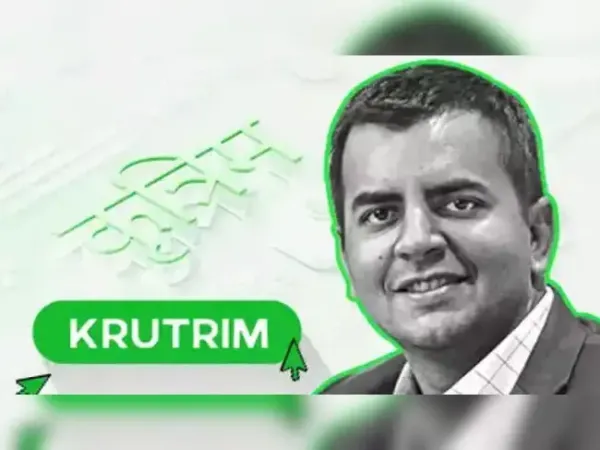
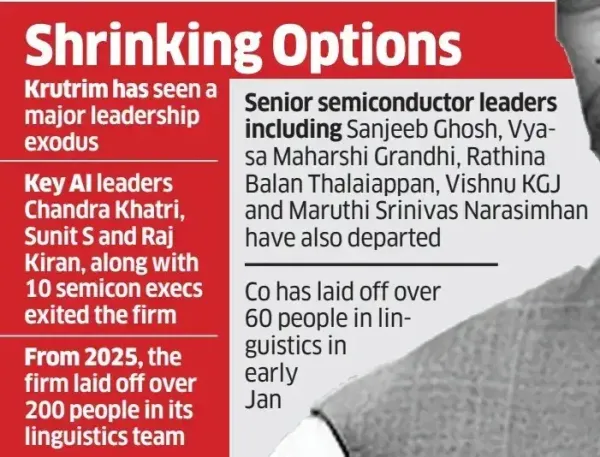
Ola Krutrim’s AI bulwark crumbled as the three key leaders, Chandra Khatri, Sunit S, and Raj Kiran, leaders of Krutrim’s AI initiatives, and close to 10 executives in its semiconductor arm quit the company.
Khatri was the founding head of AI and based in Silicon Valley in the US, Sunit was heading design and Raj Kiran led the AI research group, exited the firm in the past quarter. Senior leaders of the semiconductor efforts include Sanjeeb Ghosh, Vyasa Maharshi Grandhi, Rathina Balan Thalaiappan, Vishnu KGJ and Maruthi Srinivas Narasimhan who have also left the company in the last six months, ET has learnt.
The company also laid off over 60 people in linguistics in early January, the last of the company’s data annotation team for its AI models. From 2025, the firm laid off over 200 people in its linguistics team, ET had earlier reported.
The company had to pause the work on AI models and semiconductors as funding dried up and leadership haemorrhaged, sources aware of the development told ET. The company has also discontinued its AI agentic platform Kruti, which was removed across the app stores of Google and Apple, and was not accessible on the web.
Krutrim has not responded to ET’s specific queries about its operations. However, after ET sent its queries, Krutrim issued a press statement, where it said it is pivoting to AI cloud services. “This repositioning follows a business realignment undertaken in late 2025, which involved a deliberate reallocation of capital and talent, including a pause on chip design initiatives to concentrate the company's resources on building and scaling its core AI cloud services stack,” the statement read.
Krutrim, founded by Bhavish Aggarwal, was launched in 2023 with an ambition of building AI models from India rivalling global platforms such as OpenAI. The firm raised $50 million in 2024 becoming India’s first AI unicorn. Aggarwal also made a Rs 10,000 crore commitment to develop Krutrim in February 2025. The plan was to have a full stack AI platform including large language models for language, speech and vision, semiconductors and cloud platform.
Also Read: Ola's AI smart assistant 'Kruti' goes dark across app platforms
Most of this has now unravelled.
“To build models and semiconductors, you need funding, which the company was unable to get. So, over the past year, the company has been reducing the workforce,” said a former executive of Krutrim.
Over the last year, multiple people from Ola Electric and other teams were moved to Krutrim. “These members are now being pulled back into other teams now,” the executive added.
The Bodhi 1 chip, which was expected to be released in 2026, now stands scrapped. “Currently, the chips the company procured for training models are being used to run simulations for Ola Electric scooters,” another industry source told ET.
Krutrim Cloud and maps are the only surviving products. A former employee, aware of the developments, said that Krutrim Cloud’s largest user has been Ola, and it has been courting external clients. ET had earlier reported that the division currently employs 100 people.
The company did not respond to ET’s specific questions about its GPU and cloud operations. However, in the press statement, it said its cloud is seeing increased adoption with over 25 enterprise customers including leading telecom service providers, financial institutions, and consumer internet platforms. It also added that Krutrim’s GPU compute capacity is witnessing strong external demand, with most of the capacity already committed to external enterprise workloads.
Assembly Elections 2026
Election Results 2026 Live Updates: Who's ahead in which state
West Bengal Election Results 2026 Live Updates
TN Election Result 2026 Live Updates
The company also laid off over 60 people in linguistics in early January, the last of the company’s data annotation team for its AI models. From 2025, the firm laid off over 200 people in its linguistics team, ET had earlier reported.
The company had to pause the work on AI models and semiconductors as funding dried up and leadership haemorrhaged, sources aware of the development told ET. The company has also discontinued its AI agentic platform Kruti, which was removed across the app stores of Google and Apple, and was not accessible on the web.
Krutrim has not responded to ET’s specific queries about its operations. However, after ET sent its queries, Krutrim issued a press statement, where it said it is pivoting to AI cloud services. “This repositioning follows a business realignment undertaken in late 2025, which involved a deliberate reallocation of capital and talent, including a pause on chip design initiatives to concentrate the company's resources on building and scaling its core AI cloud services stack,” the statement read.
Krutrim, founded by Bhavish Aggarwal, was launched in 2023 with an ambition of building AI models from India rivalling global platforms such as OpenAI. The firm raised $50 million in 2024 becoming India’s first AI unicorn. Aggarwal also made a Rs 10,000 crore commitment to develop Krutrim in February 2025. The plan was to have a full stack AI platform including large language models for language, speech and vision, semiconductors and cloud platform.
Also Read: Ola's AI smart assistant 'Kruti' goes dark across app platforms
Most of this has now unravelled.
“To build models and semiconductors, you need funding, which the company was unable to get. So, over the past year, the company has been reducing the workforce,” said a former executive of Krutrim.
Over the last year, multiple people from Ola Electric and other teams were moved to Krutrim. “These members are now being pulled back into other teams now,” the executive added.
The Bodhi 1 chip, which was expected to be released in 2026, now stands scrapped. “Currently, the chips the company procured for training models are being used to run simulations for Ola Electric scooters,” another industry source told ET.
Krutrim Cloud and maps are the only surviving products. A former employee, aware of the developments, said that Krutrim Cloud’s largest user has been Ola, and it has been courting external clients. ET had earlier reported that the division currently employs 100 people.
The company did not respond to ET’s specific questions about its GPU and cloud operations. However, in the press statement, it said its cloud is seeing increased adoption with over 25 enterprise customers including leading telecom service providers, financial institutions, and consumer internet platforms. It also added that Krutrim’s GPU compute capacity is witnessing strong external demand, with most of the capacity already committed to external enterprise workloads.