
Listen to this article in summarized format
Loading...
××
Subscribe to

Unlock AI Briefing and Premium Content
New Year Offer 24 Hours Left
Subscribe NowAlready a member? Sign In
What's Included
- Exclusive Stories
- Daily ePaper Access
- Smart Market Tools
- Curated Investment Ideas
- Ad-lite Experience
Subscription


Every wrong Mutual Fund delays your freedom.
Free Mutual Funds Workshop
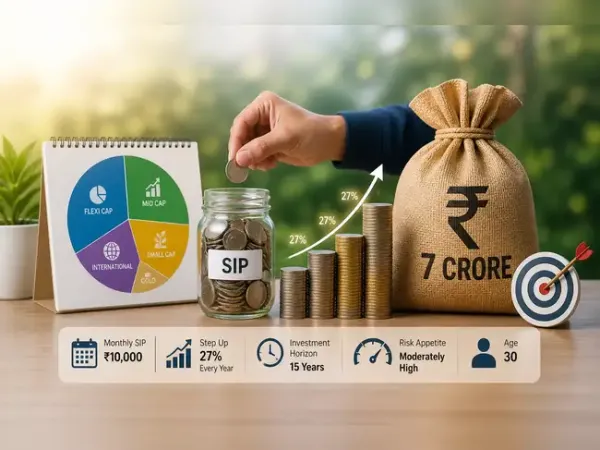
Building a large corpus through mutual fund SIPs requires the right mix of discipline, asset allocation, and realistic return expectations. While a long investment horizon and a high step-up strategy can significantly boost outcomes, portfolio structure and contribution levels play a critical role in achieving ambitious financial goals.
A 30-year-old investor with a 15-year horizon and a moderately high risk appetite who is currently investing Rs 10,000 per month in funds such as Parag Parikh Flexi Cap Fund, HDFC Mid-Cap Opportunities Fund, Kotak Midcap Fund (Earlier known as Kotak Emerging Equity Fund), Nippon India Small Cap Fund, Tata Small Cap Fund, and SBI Gold Fund.
Also Read | Defence mutual funds surge up to 25% in a month. Should you invest now or wait for a correction?
His existing portfolio of Rs 2.5 lakh is spread across these funds and he also has plan to step-up his SIP by 27%.
He reached out to ETMutualFunds for an analysis of his portfolio and expert Vishal Dhawan, Founder & CEO, Plan Ahead Wealth Advisors analysed the portfolio and told ETMutualFunds that at first glance, the portfolio appears diversified across market caps and asset classes. However, a closer look reveals some degree of over-diversification within equities.
Holding two mid-cap funds and two small-cap funds leads to overlap in stock holdings, which may not add meaningful diversification but can dilute portfolio efficiency, Dhawan said.
When it comes to the target of building a Rs 7 crore corpus over 15 years, the numbers suggest a gap. Assuming a 12% annual return, a Rs 10,000 SIP with a 27% yearly step-up is likely to grow to around Rs 4.5 – Rs 4.8 crore which indicates a shortfall of roughly Rs 2.2 – Rs 2.5 crore from the intended goal.
Dhawan said that to bridge this gap, the investor may need to either increase the starting SIP, further enhance the step-up rate, or recalibrate corpus expectations. Among these, increasing contributions over time tends to have the most meaningful impact on long-term wealth creation.
From a portfolio perspective, consolidation can improve efficiency. The flexi-cap allocation through Parag Parikh Flexi Cap Fund can be retained as the core holding due to its diversified approach across market caps and geographies. In the mid-cap segment, retaining one fund such as HDFC Mid-Cap Opportunities Fund while exiting the duplicate exposure from Kotak Midcap Fund (Earlier Kotak Emerging Equity Fund) can help reduce overlap.
Also Read | Bandhan Small Cap & ICICI Pru Midcap among 7 equity mutual funds that have delivered over 25% CAGR over 3 years
Similarly, in the small-cap space, continuing with Nippon India Small Cap Fund while exiting Tata Small Cap Fund can streamline the portfolio by keeping exit loads and short term taxes in mind.
The expert said, “Retain Parag Parikh Flexi Cap Fund as the core holding for stability and diversification - retain one mid-cap fund—preferably HDFC Mid-Cap Opportunities Fund—and exit Kotak Emerging Equity Fund to reduce duplication. Be mindful of exit loads and short term taxes whilst doing so. Retain one small-cap fund—preferably Nippon India Small Cap Fund—and exit Tata Small Cap Fund. Be mindful of exit loads and short term taxes whilst doing so.”
To further strengthen diversification, adding global exposure through a fund like Axis Global Equity Alpha FoF can provide access to international markets. Meanwhile, gold exposure through SBI Gold Fund can be maintained at around 5–10% as a hedge against volatility, the expert further said.
Dhawan further said that based on this restructuring, a more efficient allocation within the existing Rs 10,000 SIP could be increasing the allocation like - Rs 3,000 in Parag Parikh Flexi Cap Fund, Rs 2,000 in HDFC Mid-Cap Opportunities Fund, Rs 2,000 in Nippon India Small Cap Fund, Rs 2,000 in Axis Global Equity Alpha FoF, and Rs 1,000 in SBI Gold Fund.
The expert also said that rather than adding more schemes, the focus should remain on optimizing the current portfolio and increasing overall investment contributions over time.
Also Read | Targeting 14% CAGR with mutual funds? Here’s how to fix your portfolio & boost outcomes
The key priorities should be optimisation of the portfolio structure and enhancement of the savings rate, as these will have a far greater impact on long-term wealth creation than additional diversification besides geographical diversification at this stage.
(Disclaimer: Recommendations, suggestions, views and opinions given by the experts are their own. These do not represent the views of The Economic Times)
If you have any mutual fund queries, message on ET Mutual Funds on Facebook/Twitter. We will get it answered by our panel of experts. Do share your questions on ETMFqueries@timesinternet.in alongwith your age, risk profile, and Twitter handle.
A 30-year-old investor with a 15-year horizon and a moderately high risk appetite who is currently investing Rs 10,000 per month in funds such as Parag Parikh Flexi Cap Fund, HDFC Mid-Cap Opportunities Fund, Kotak Midcap Fund (Earlier known as Kotak Emerging Equity Fund), Nippon India Small Cap Fund, Tata Small Cap Fund, and SBI Gold Fund.
Also Read | Defence mutual funds surge up to 25% in a month. Should you invest now or wait for a correction?
Best MF to invest
Looking for the best mutual funds to invest? Here are our recommendations.
His existing portfolio of Rs 2.5 lakh is spread across these funds and he also has plan to step-up his SIP by 27%.
He reached out to ETMutualFunds for an analysis of his portfolio and expert Vishal Dhawan, Founder & CEO, Plan Ahead Wealth Advisors analysed the portfolio and told ETMutualFunds that at first glance, the portfolio appears diversified across market caps and asset classes. However, a closer look reveals some degree of over-diversification within equities.
Holding two mid-cap funds and two small-cap funds leads to overlap in stock holdings, which may not add meaningful diversification but can dilute portfolio efficiency, Dhawan said.
When it comes to the target of building a Rs 7 crore corpus over 15 years, the numbers suggest a gap. Assuming a 12% annual return, a Rs 10,000 SIP with a 27% yearly step-up is likely to grow to around Rs 4.5 – Rs 4.8 crore which indicates a shortfall of roughly Rs 2.2 – Rs 2.5 crore from the intended goal.
Dhawan said that to bridge this gap, the investor may need to either increase the starting SIP, further enhance the step-up rate, or recalibrate corpus expectations. Among these, increasing contributions over time tends to have the most meaningful impact on long-term wealth creation.
From a portfolio perspective, consolidation can improve efficiency. The flexi-cap allocation through Parag Parikh Flexi Cap Fund can be retained as the core holding due to its diversified approach across market caps and geographies. In the mid-cap segment, retaining one fund such as HDFC Mid-Cap Opportunities Fund while exiting the duplicate exposure from Kotak Midcap Fund (Earlier Kotak Emerging Equity Fund) can help reduce overlap.
Also Read | Bandhan Small Cap & ICICI Pru Midcap among 7 equity mutual funds that have delivered over 25% CAGR over 3 years
Similarly, in the small-cap space, continuing with Nippon India Small Cap Fund while exiting Tata Small Cap Fund can streamline the portfolio by keeping exit loads and short term taxes in mind.
The expert said, “Retain Parag Parikh Flexi Cap Fund as the core holding for stability and diversification - retain one mid-cap fund—preferably HDFC Mid-Cap Opportunities Fund—and exit Kotak Emerging Equity Fund to reduce duplication. Be mindful of exit loads and short term taxes whilst doing so. Retain one small-cap fund—preferably Nippon India Small Cap Fund—and exit Tata Small Cap Fund. Be mindful of exit loads and short term taxes whilst doing so.”
To further strengthen diversification, adding global exposure through a fund like Axis Global Equity Alpha FoF can provide access to international markets. Meanwhile, gold exposure through SBI Gold Fund can be maintained at around 5–10% as a hedge against volatility, the expert further said.
Dhawan further said that based on this restructuring, a more efficient allocation within the existing Rs 10,000 SIP could be increasing the allocation like - Rs 3,000 in Parag Parikh Flexi Cap Fund, Rs 2,000 in HDFC Mid-Cap Opportunities Fund, Rs 2,000 in Nippon India Small Cap Fund, Rs 2,000 in Axis Global Equity Alpha FoF, and Rs 1,000 in SBI Gold Fund.
The expert also said that rather than adding more schemes, the focus should remain on optimizing the current portfolio and increasing overall investment contributions over time.
Also Read | Targeting 14% CAGR with mutual funds? Here’s how to fix your portfolio & boost outcomes
The key priorities should be optimisation of the portfolio structure and enhancement of the savings rate, as these will have a far greater impact on long-term wealth creation than additional diversification besides geographical diversification at this stage.
(Disclaimer: Recommendations, suggestions, views and opinions given by the experts are their own. These do not represent the views of The Economic Times)
If you have any mutual fund queries, message on ET Mutual Funds on Facebook/Twitter. We will get it answered by our panel of experts. Do share your questions on ETMFqueries@timesinternet.in alongwith your age, risk profile, and Twitter handle.