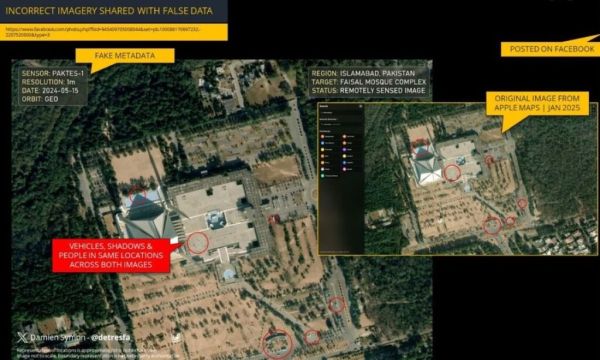
Claim: Pakistani social media accounts, in the days following the EO-3 satellite launch in April, circulated an aerial photograph of Karachi Port as the satellite’s first-ever captured image — proof, the claim suggested, that the new satellite was already operational and transmitting data.
Verdict: False. The image had been published on SUPARCO’s own official website months before the satellite launched. It could not have been captured by EO-3.
The EO-3 satellite itself is real. Launched on 25 April 2026 from the Taiyuan Satellite Launch Center in China aboard a Long March 6 rocket, EO-3 is a Pakistani Earth observation satellite developed by SUPARCO, intended to enhance remote sensing capabilities including high-resolution imaging for civilian and strategic applications.
It is the third and final unit in Pakistan’s PRSC-EO constellation, with two predecessors already operational. Its applications include agriculture monitoring, disaster response, urban planning, and security.
The launch was verified. The satellite is in orbit. SUPARCO has not released confirmed technical specifications for EO-3’s resolution, though independent analysts estimate it performs in approximately the one-metre class.

What was not verified — and what does not withstand verification — is the photograph. Independent analysts identified the discrepancy by checking SUPARCO’s own public web archive, where the same image appeared with a date that predated the satellite’s launch by months. No correction was issued by SUPARCO.
The image was eventually labeled “unconfirmed” in some online discussions, with no formal acknowledgment from the agency of what had happened.
This fact-check sits within a much larger context of documented disinformation from Pakistani official and state-adjacent sources, particularly around military and security events.
Operation Sindoor — India’s military operation against terrorist infrastructure in May 2025 — generated the most extensive recent case. Pakistani officials and media accounts circulated large quantities of imagery claiming to show the destruction of Indian military assets: air defense systems, weapons storage sites, and airfields. India’s PIB fact-checked the material in detail, refuting viral claims including fake videos, fabricated images, and false government advisories.
Western OSINT analysts conducted independent reviews. The material was found to consist of repurposed footage from un conflicts, old clips recycled from previous years, and in at least one high-profile instance, footage taken directly from an army simulation video game.
The documentation of this disinformation campaign by both Indian government sources and independent Western analysts makes it one of the better-evidenced examples of coordinated fabrication in the recent South Asia context.
Pakistan’s space program has its own documented history of overclaiming. Paksat-1 was acquired in 2002 — the satellite itself had been in orbit since 1996, when it was launched as Palapa-C1 for Indonesia.
When Musharraf presented it as evidence of Pakistani leadership in Asian space technology, the indigenous development claim was false. Paksat-1 was a third-hand satellite — originally bought by Indonesia, later sold to Turkey, and then hurriedly purchased by Pakistan to occupy its only remaining orbital slot. The satellite had suffered a battery problem that rendered it partially inoperable, was sold on, and Pakistan eventually acquired it for around five million dollars.
SUPARCO’s forfeiture of geostationary orbital slots in the early 1990s is a matter of international space record. The ITU allotted five slots to Pakistan in 1984; Pakistan failed to launch any satellite until 1995, was granted an extension, failed again, and lost four of those five positions permanently. The one slot Pakistan managed to retain — 38°E — was saved only by the last-minute acquisition of Paksat-1 itself.
Badr-B, launched in December 2001, is also more complicated than it is usually presented. Its design life was two years — not five — and the mission lasted approximately two years, meaning it performed broadly as specified before eventual decommissioning.
The real failure was the decade of institutional delays, funding freezes, and political interference that kept the satellite in storage through most of the 1990s, squandering the window it was meant to exploit.
SUPARCO was founded in 1961 and has real engineering capability. That capability deserves to stand on its own record — and it cannot, as long as real achievements continue to be padded with unverifiable and ultimately discredited imagery. The damage to credibility from each episode compounds the damage from the last.
-
‘Dhurandhar 2’ OTT Release Date Out? Court Hearing Drops Major Streaming Hint

-
Mother's Day 2026: 7 Thoughtful Gifting Ideas To Make Your Mom Feel Extra Special

-
Why Does Vijay Use ‘0277’ On Every Vehicle? The Story Behind TVK Chief’s Number Plates

-
After 'Waka Waka', Shakira Joins Hands With Burna Boy For FIFA World Cup 2026 Anthem 'Dai Dai'

-
Tamil Nadu 12th Result 2026 To Be LIVE Today At 9:30 AM; Direct Link At tnresults.nic.in