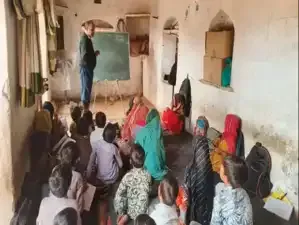
At a time when India is making strides in every field, including education, multiple government primary schools in Haryana's Nuh do not even have their own buildings, reports TOI's Anjali Singh. In these dilapidated structures, teachers hold classes in cattle sheds, open fields and village chaupals across the Ferozepur Jhirka block. Children in Nuh's Ferozepur Jhirka block have a will to learn, and they are doing so, in dire conditions.
ALSO READ: 409 gold coins buried for 100 years found beneath the remains of a destroyed home; mystery owner still unknown
ALSO READ: TMC worker with fake bandage on head exposed on LIVE TV
An eight-year-old boy Aryan told TOI that all the classes are conducted by the teachers at the same time in the same space. He worries the roof may collapse during the monsoon. Six-year-old Rukhsana says she “loves coming to school”, but the presence of animals nearby troubles her.
He adds that rainwater leaks from all sides during the monsoon, while in summer the shed becomes too hot to hold even two classes together. “I am forced to make them sit outside in the sun,” he was quoted as saying. “There should be more teachers here. One NGO worker helps, but it is not enough for 62 children of different learning levels.”
Even though the authorities have identified the panchayat land for a school building, Abhay Singh says children cannot walk 3.5 km daily. Nearby land falls within the Aravalis and comes under the forest department, where construction cannot begin until the land is transferred to the education department. Locals say they have raised the issue several times with the district education officer and the deputy commissioner, but no progress has been made so far.
Despite facing financial constraints, parents continue to send their children to the school that lacks even the basic infrastructure. A woman said her family cannot afford private school fees. “Our children will have to stop studying altogether,” she says.
Salman says classes often stop when villagers gather. A Balvatika student says “she likes coming to school but feels very thirsty”.
Head teacher Rohtash Kumar says managing the school in such conditions is difficult. “There is no washroom for children or teachers, no water and no space to hold separate classes. All this affects learning,” he says. Assistant teachers Rekha and Priyanka, who travel nearly 30 km daily, say the lack of toilets affects girls the most. “There is no midday meal either because there is no kitchen, no storage space and no place to cook,” Rohtash told TOI.
Villagers say enrolment has dropped due to the lack of facilities. “Earlier, there were around 50 children studying here. Now, some parents are sending their children to other schools,” a resident says.
The school even came close to shutting down, but parents have intervened to keep it running. Among those who continue to attend, attendance remains above 90%. Authorities are now considering merging the school with a high school in Doha, located about 1 km away.
For nearly three years, the entire primary section, with around 350 students, was managed by a single teacher after a guest teacher retired. The same teacher was also assigned booth level officer duties during this period.
A parent says he wants his children to continue their education but feels discouraged by the conditions. “There is no proper building and too few teachers. Children need a decent place to learn,” he says.
In July 2020, the Haryana government approved 68 new schools in Nuh. However, beyond enrolment records and UDISE (Unified District Information System for Education) codes, several schools did not get basic infrastructure. In some cases, authorities allotted land far from the areas they were meant to serve.
(With TOI inputs)
ALSO READ: 409 gold coins buried for 100 years found beneath the remains of a destroyed home; mystery owner still unknown
19 schools operate without building
What is surprising is that Kubdabass is not an isolated example. It is among at least 19 schools in Nuh near Gurugram that operate without proper infrastructure and building. 45 boys and 50 girls attend classes here in an open field with cows and goats gazing around them. With limited or no access to facilities in these schools, teachers tie blackboards to tree trunks and conduct lessons there. The situation becomes tough in the monsoon as the field turns muddy and in winter, cold winds make it difficult for students to sit through classes.ALSO READ: TMC worker with fake bandage on head exposed on LIVE TV
Children love coming to school
According to villagers, the Kubdabass school continues only because a local family that owns the shed allows children to study on its private land.An eight-year-old boy Aryan told TOI that all the classes are conducted by the teachers at the same time in the same space. He worries the roof may collapse during the monsoon. Six-year-old Rukhsana says she “loves coming to school”, but the presence of animals nearby troubles her.
All classes at the same time
The school has only one government teacher, Abhay Singh, posted here on a temporary basis. Terming the situation painful and unfair for students, he said, “I teach them in a room that is unsafe."He adds that rainwater leaks from all sides during the monsoon, while in summer the shed becomes too hot to hold even two classes together. “I am forced to make them sit outside in the sun,” he was quoted as saying. “There should be more teachers here. One NGO worker helps, but it is not enough for 62 children of different learning levels.”
Even though the authorities have identified the panchayat land for a school building, Abhay Singh says children cannot walk 3.5 km daily. Nearby land falls within the Aravalis and comes under the forest department, where construction cannot begin until the land is transferred to the education department. Locals say they have raised the issue several times with the district education officer and the deputy commissioner, but no progress has been made so far.
Land available but not allocated
Lone teacher Barkat Ali posted at a government primary school Kalu Bas in Nuh said that the land is available for school but yet to be allocated. “There are 10 acres of panchayat land nearby and nearly 80 acres vacant in the village. But the school has not been given even a small portion,” he says. “Education is suffering because of village politics,” he adds.Despite facing financial constraints, parents continue to send their children to the school that lacks even the basic infrastructure. A woman said her family cannot afford private school fees. “Our children will have to stop studying altogether,” she says.
No toilets, no drinking water
A primary school in Mali Bas, a small settlement of Doha village, has been running from a village chaupal for the past five years. As many as 29 students, from Balvatika to Class V, sit together on the floor in a single room. The space has no boundary wall, no toilets and no drinking water. As the chaupal is used for community meetings, people walk in and out during school hours.Salman says classes often stop when villagers gather. A Balvatika student says “she likes coming to school but feels very thirsty”.
Head teacher Rohtash Kumar says managing the school in such conditions is difficult. “There is no washroom for children or teachers, no water and no space to hold separate classes. All this affects learning,” he says. Assistant teachers Rekha and Priyanka, who travel nearly 30 km daily, say the lack of toilets affects girls the most. “There is no midday meal either because there is no kitchen, no storage space and no place to cook,” Rohtash told TOI.
Distance too far
“That distance is too far for children. We even tried to exchange it, but no one agreed,” a resident says.Villagers say enrolment has dropped due to the lack of facilities. “Earlier, there were around 50 children studying here. Now, some parents are sending their children to other schools,” a resident says.
The school even came close to shutting down, but parents have intervened to keep it running. Among those who continue to attend, attendance remains above 90%. Authorities are now considering merging the school with a high school in Doha, located about 1 km away.
One teacher for 350 students
In Ghatwas village of Nuh, the government primary school operates from a dilapidated and abandoned room and toen mosquito nets hang from the walls to shield children from insects. A student says the room feels crowded and uncomfortable, making it difficult to focus. “It does not feel like school as there is no place to play,” another student says.For nearly three years, the entire primary section, with around 350 students, was managed by a single teacher after a guest teacher retired. The same teacher was also assigned booth level officer duties during this period.
A parent says he wants his children to continue their education but feels discouraged by the conditions. “There is no proper building and too few teachers. Children need a decent place to learn,” he says.
No infra in many schools
Recently, two Shiksha Sahayaks and three trained graduate teachers (TGTs) joined the middle school section, offering some relief. School officials say land for a new building has been identified, but construction has not started.In July 2020, the Haryana government approved 68 new schools in Nuh. However, beyond enrolment records and UDISE (Unified District Information System for Education) codes, several schools did not get basic infrastructure. In some cases, authorities allotted land far from the areas they were meant to serve.
(With TOI inputs)