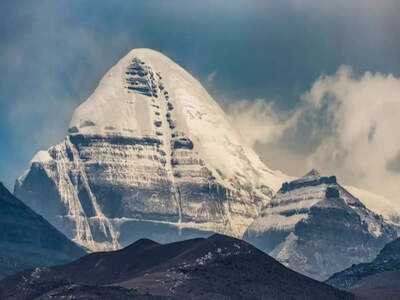
Mount Kailash, honored as the sacred home of Lord Shiva, stands not only as a spiritual landmark but also as one of the most intriguing mysteries on Earth. It raises an intriguing question: why do climbers, who have conquered towering peaks like Mount Everest, shy away from Mount Kailash, which is 2,000 meters shorter?
This 6,638-meter-high mountain remains unconquered, and the reasons extend beyond mere religious beliefs; various geographical elements continue to perplex scientists. Let's delve into the factors that have prevented anyone from scaling Mount Kailash.
Spiritual Importance and Religious Beliefs
Mount Kailash holds immense spiritual significance across Hinduism, Buddhism, Jainism, and the Bon religion. In Hindu tradition, it is seen as the residence of Lord Shiva. Jainism regards it as the site where the first Tirthankara, Rishabhanatha, achieved Nirvana. For Buddhists, it symbolizes tranquility, while in Bon, it is viewed as the world's spiritual epicenter.
Followers of these faiths believe that attempting to climb the mountain is an affront to the divine. Consequently, the Chinese authorities have enforced a strict prohibition against climbing it.
Challenging Geography and Terrain
The structure of Mount Kailash resembles a pyramid, with its four faces oriented towards the cardinal directions. Scientists are puzzled by how a mountain can exhibit such perfect symmetry naturally. It is thought that tectonic activity and wind erosion contribute to this unique formation.
Additionally, the mountain's steep and rocky slopes hinder snow accumulation. The harsh, icy winds and the extreme altitude create a daunting challenge for climbers attempting to ascend Mount Kailash.
The Curious Flow of Time
Various legends surround Mount Kailash, including tales of time behaving unusually in this region. It is said that time seems to speed up, with people's hair and nails growing in mere hours as they would typically over weeks. Many climbers report losing their way, feeling as if they are climbing higher, only to find themselves back at the base.
The Lakes of Manasarovar and Rakshas Tal
At the base of Mount Kailash lie two lakes, each representing different energies:
Manasarovar—A freshwater lake symbolizing purity and positivity.
Rakshas Tal—A saltwater lake devoid of life, associated with negativity.
Interestingly, despite their close proximity, these lakes exhibit contrasting characteristics.
The Sacred Circumambulation of Kailash
As climbing the peak is prohibited, devotees engage in a *Kora*, a circumambulation around the mountain. This challenging 52-kilometer trek is believed to cleanse one of all sins accumulated throughout a lifetime.
Conclusion
PC Social Media
-
Summer Vacation Announcements for Schools in Delhi and Other States
-
Coal India CIL Management Trainee Recruitment 2026: Apply for 276 Positions

-
Understanding Endometrial Cancer: Risks and Prevention

-
Lucknow's Safety Project Targeted by Thieves During IPL

-
Impact of Middle East Conflict on India's Economy: Challenges and Resilience