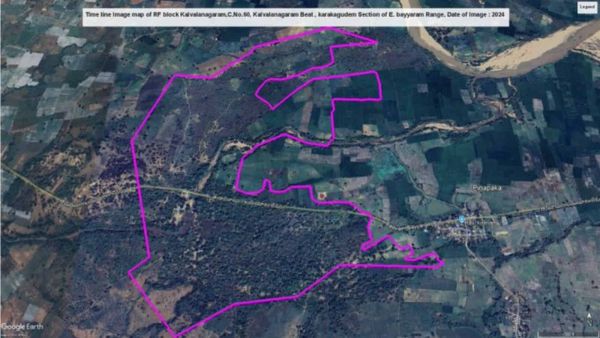
Hyderabad: In a landmark judgement in a case spanning more than 75 years, the Supreme Court of India has dismissed an appeal by two individuals, who were staking claim to ownership of 600 acres of forest land in Survey No 81 of Kalvalanagaram village in Karakagudem mandal of Bhadradri Kothagudem district.
The judgement was delivered by a bench comprising Justice SVN Bhatti and Justice Pankaj Mittal on Wednesday, May 6, in a civil appeal filed by Vadiyala Prabhakar Rao and others, against the Government of Andhra Pradesh.
What was the case about
The appellants had been claiming that in 1931-32, the Seventh Nizam of Hyderabad Mir Osman Ali Khan had granted pattas in their favour, or in favour of their predecessors. They had been claiming that in 1920 (1330 Fasli), rights were created in favour of Sivai jamandars, and the same were mutated in favour of persons in possession in or about 1931, when pattas, i.e., a grant or allotment, were made in their favour.

On February 6, 1950, a proposal was initiated for notifying an extent of 787 acre in Survey No 81, which included the land presently in question, as forest land.
The claimants had been contending that the state government/forest department’s action to treat the 600 acre land out of the total 785 acre land as forest land, was illegal.
The legal process that ensued
Their first proprietary claim was rejected by the Joint Collector of the erstwhile Khammam district in AP on May 19, 2003, had held that the claimants had failed to produce original documentary evidence, such as patta certificates, to support their claim of assignment, noting that mere entries in the revenue records were insufficient to confer title.
It was also established that the claimants were never in physical possession of the land for 70 years, as the property remained uncultivated and was covered by forest growth. Additionally, the claimants had failed to provide evidence explaining how the land’s mutation transitioned from the twelve original persons down to only two claimants.
Ultimately, the Joint Collector concluded that he was not the appropriate forum to adjudicate matters of land title.
The document of title, i.e., the patta certificate, was never produced in support of the claimants’ case.
The revenue record for the year 1954-55, i.e., the Khasra Pahani, had recorded the land in question as UFTADA and covered in thick forest growth, and the claimants were never in possession of that land.
AP High Court’s single bench order given in favour of claimants
A single-bench of the AP High Court in Hyderabad, on March 27, 2012, had allowed the writ petition filed by the claimants, had established that they had been given pattas in 1933 AD (1343 Fasli).
The single-bench had also cited the Mandal Revenue Officer’s (MRO) report showed the original 12
pattadars were granted the land after paying forest growth valuation and consulting forest authorities.
The single bench had supported the claimants’ stance that although records for the mutation of the full 600 acre land to the two primary claimants was unavailable; it was “admittedly destroyed” during the Police Action (Operation Polo) launched by the Indian Union against the Nizam’s Government in 1948.
The single judge had also found that the 1950 notification, and the Joint Collector’s order was ultra vires and non est in the eyes of the law, because it was issued under the repealed 1326 Fasli Act rather than the 1355 Fasli Act.
The High Court’s division bench impugned single bench’s order
The division bench had held that a notification was not invalidated merely because it was issued
under the wrong enactment, provided it was not inconsistent with the provisions of the new Act.
Impugning the single bench’s order, the division bench held that revenue entries needed to be based on documents presented to the authorities for mutation. In the absence of such documents, the division bench deemed the entries non-compliant with procedure and lacking in sanctity. Hence, in the failure to produce the documents of title, the case could not be countenanced.
Appeal in the Supreme Court
The appellants claimed in the Suprme Court that the said land was fortified and established through Revenue Records: (a) Faisal Patti for the 1342 Fasli, (b) Pahanies for the years 1347 Fasli and 1356 Fasli dated December 7, 1990, (c) 1348 Fasli, 1353 Fasli and 1355 Fasli dated December 7,1990, (d) 1354 Fasli dated December 7, 1990, and an extract of Vasool Baqi of 1352 Fasli.
“The Revenue Records, namely, Faisal Patti and Vasool Baqi, by themselves do not create a title in favour of the Appellants. The genesis of the Claim is a Patta, allegedly issued in favour of the Appellants or their predecessors-in-interest, which the Appellants have not exhibited. The mere Revenue entries cannot be treated as axiomatic proof of title in favour of the Claimants,” the Supreme Court’s order stated.
The Supreme Court’s bench had also found that the claimants were trying to buy time by invoking certain provisions at a time when their purpose had already become untenable, and found fault with their attempts to buy time, when it wasn’t needed anymore.
“A Revenue Record is not a document of title and does not confer any ownership or title upon the person whose name appears in it. The mere acceptance of municipal or agricultural taxes, or the granting of a bank loan based on these records, does not stop the State from challenging the ownership of the land. Maintenance and custody of Revenue Records is the exclusive domain of the Patwari, and it is not uncommon that Revenue Records are often tinkered with by him to suit the exigencies,” the supreme Court noted.
“The creation of fabricated records in collusion acts as a camouflage to defeat the legal rights of the actual tiller, and the Government is not bound by them,” the Supreme Court’s order emphasized.
Observing that the Pahani copy of the village for the Faslis 1346-1356, shown in Column No 3, records Survey No 81 of Kalvalanagaram as a Jungle/Forest, the Supreme Court had dismissed the civil appeal by the claimants/appellants in the case.
-
Summer Vacation Announcements for Schools in Delhi and Other States
-
Coal India CIL Management Trainee Recruitment 2026: Apply for 276 Positions

-
Understanding Endometrial Cancer: Risks and Prevention

-
Lucknow's Safety Project Targeted by Thieves During IPL
-
Impact of Middle East Conflict on India's Economy: Challenges and Resilience