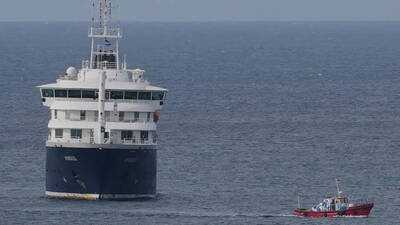
On Wednesday, the UN health agency reported that three individuals suspected of having hantavirus infections were evacuated from a cruise ship to the Netherlands. This ship, currently anchored off Cape Verde, has nearly 150 passengers awaiting transport to Spain's Canary Islands. Footage from the Associated Press depicted health personnel in protective gear boarding the vessel for the evacuation, which included the ship's British doctor, who was previously in serious condition but has since shown improvement. An air ambulance was dispatched for the transfer.
According to the World Health Organization (WHO), three fatalities have been confirmed, with one body still aboard the ship. A total of eight cases have been identified, three of which have been confirmed through laboratory tests. Hantavirus is typically transmitted through inhalation of contaminated rodent droppings and can occasionally spread between humans, although this is rare. Contact tracing efforts are underway across Europe and Africa to identify individuals who may have been infected after leaving the ship, which set sail over a month ago from South America, making stops in Antarctica and various remote Atlantic islands.
Investigation into Outbreak Origins
Two Argentine officials investigating the outbreak's origins suggest that a Dutch couple may have contracted the virus while bird-watching in Ushuaia before boarding the ship. They noted that the couple visited a landfill during their tour, potentially exposing them to rodents. These officials requested anonymity due to the ongoing investigation. Notably, Ushuaia and the surrounding Tierra del Fuego province have not previously reported any hantavirus cases.
Current Health Status of Passengers Health Updates on Evacuated Individuals
The Dutch foreign ministry confirmed that the evacuated individuals include a 41-year-old Dutch national, a 56-year-old British national, and a 65-year-old German national, all of whom will be transferred to specialized hospitals in Europe. A Dutch hospital has confirmed its readiness to receive one of the patients, while German authorities are preparing for another. Two of the evacuated individuals are reported to be in serious condition, while the third, who is symptom-free, had close contact with a German passenger who died on the MV Hondius ship on May 2.
Health officials have stated that the remaining passengers and crew aboard the ship are currently asymptomatic. The WHO has indicated that the passengers represent 23 different nationalities. The journey to the Canary Islands is expected to take three to four days, with Spain's health ministry assuring that their arrival poses no public health risk.
Testing and Public Health Concerns
Testing conducted in Switzerland, South Africa, and Senegal has confirmed the presence of the Andes strain of hantavirus. The WHO notes that this strain is primarily found in South America, particularly in Argentina and Chile, and while it can spread between individuals, such occurrences are rare and typically require close contact.
Expert Insights on the Situation
Maria Van Kerkhove, the WHO's leading epidemic expert, emphasized that the public risk remains low, clarifying that while hantavirus is a serious infectious disease, it is not comparable to COVID-19. She noted that most individuals will likely never encounter this virus. For those on the ship, timely access to medical care is crucial, as infected individuals can develop severe respiratory distress requiring oxygen or mechanical ventilation. The incubation period for hantavirus can range from one to six weeks or longer.
Cruise Ship's Journey and Current Location Details of the Ship's Itinerary
The cruise ship departed from Argentina on April 1, with its itinerary including stops across the South Atlantic, such as Antarctica and several remote islands like South Georgia and Tristan da Cunha. Currently, the ship is located in the Atlantic near Cape Verde, where passengers are isolating in their cabins. Two Dutch infectious disease specialists are set to join the ship to assist with the situation.
Spain's health ministry has stated that the ship will be received in the Canary Islands following a request from the WHO and the European Center for Disease Prevention and Control. The regional president of the Canary Islands, Fernando Clavijo, expressed concerns about the potential risk to the local population and has called for a meeting with Prime Minister Pedro Sánchez.
Tracing Contacts and Ongoing Investigations Efforts to Trace Potential Contacts
In Switzerland, a former passenger is receiving treatment at a Zurich hospital after testing positive for the Andes strain. South African authorities have reported that two passengers transferred there also tested positive, with one in intensive care and another having collapsed and died. The Swiss health office confirmed that the patient had disembarked during the ship's stop at St. Helena, although the details of his travel to Switzerland remain unclear. His wife is self-isolating as a precaution despite showing no symptoms.
Meanwhile, South African health officials are actively tracing individuals who may have had contact with the two infected passengers. Out of 62 individuals believed to have been in contact, 42 have been located and tested negative for hantavirus, while 20 individuals, including flight crew members, are still unaccounted for and may have traveled internationally.
-
What Would Chris Gayle Change if He Started His Career Today?

-
Chris Gayle's Indian Premier League (IPL) Memories Across KKR, RCB and Punjab Still Feel Like They Belong in the Present

-
Recognizing Early Signs of Cancer: Don't Ignore These Symptoms

-
Railway ALP Vacancy: Recruitment announced for over 11,000 Assistant Loco Pilot posts in the Railways; applications to begin on May 15..

-
CSL Jobs 2026: Jobs at Cochin Shipyard for 8th Pass Candidates—Recruitment Underway for Rigger Trainee Apprentices..