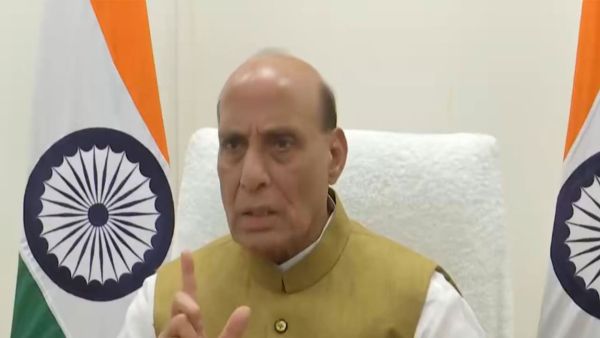
Defence Minister Rajnath Singh salutes the valour of the armed forces on the anniversary of Operation Sindoor, a response to the Pahalgam terror attack. The op successfully destroyed terror launchpads in Pakistan and PoJK, killing over 100 terrorists.
Defence Minister Rajnath Singh on Thursday paid tribute to the valour and sacrifices of the Indian armed forces on the anniversary of Operation Sindoor. He described the operation as a "powerful symbol of national resolve and preparedness," saying it reflected the armed forces' unmatched precision, seamless jointness and readiness to act decisively in safeguarding the nation.

In a post on X, the Defence Minister wrote, "On the anniversary of Operation Sindoor, we salute the valour and sacrifices of our armed forces, whose courage and dedication continue to safeguard the nation. Their actions during the operation reflected unmatched precision, seamless jointness and deep synergy across services, setting a benchmark for modern military operations." On the anniversary of Operation Sindoor, we salute the valour and sacrifices of our armed forces, whose courage and dedication continue to safeguard the nation. Their actions during the operation reflected unmatched precision, seamless jointness and deep synergy across services,… pic.twitter.com/r8pVDnEoYV — Rajnath Singh (@rajnathsingh) May 7, 2026 "Operation Sindoor stands as a powerful symbol of national resolve and preparedness, showing that our armed forces are always ready to act decisively when it matters most. It also stands testament to India's steady advance towards achieving Atmanirbharta, enhancing capability while reinforcing resilience," the post read.
Background of the Operation
Operation Sindoor was launched in the aftermath of the Pahalgam terror attack that claimed 26 lives, prompting a strong military response from India. Indian armed forces struck terror bases in Pakistan and Pakistan-occupied Jammu and Kashmir (PoJK).
Military Action and Ceasefire
In Operation Sindoor, launched on May 7, 2025, India successfully destroyed nine major terror launchpads in Pakistan and Pakistan-occupied Jammu and Kashmir (PoJK), targeting Lashkar-e-Taiba, Jaish-e-Mohammed, and Hizbul Mujahideen facilities. Indian armed forces killed over 100 terrorists in action.
Pakistan responded with drone attacks and shelling, which led to a four-day conflict between the two neighbouring countries. India showed formidable defence and conducted retaliatory strikes, destroying Radar installations in Lahore and Radar facilities near Gurjanwala. Following significant damage, Pakistan's Director General of Military Operations (DGMO) reached out to the Indian DGMO, and a ceasefire was agreed on May 10, bringing an end to the hostilities.
(Except for the headline, this story has not been edited by Asianet Newsable English staff and is published from a syndicated feed.)-
Dhurandhar 2 Slips 5.45% On Wednesday, Bhooth Bangla Becomes Akshay Kumar’s Third Biggest Post-COVID Hit

-
Why Is Apple Spending Rs 100 Crore In India? Hint: It's Not Just About iPhones

-
Vijay's Oath Ceremony Not Today? TVK Yet To Stake Claim As Governor Not Convinced: Report

-
Tamil Nadu Govt Formation: AIADMK Moves Section Of MLAs To Puducherry Resort Amid Numbers Game

-
Shikhar Dhawan Officially Registers Marriage With Sophie Shine In Gurugram