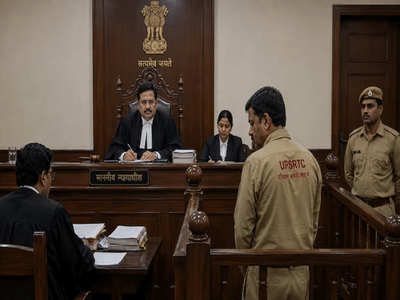
A government bus conductor in Uttar Pradesh lost his job and spent more than two decades fighting in court after 59 passengers were allegedly found travelling without tickets in a state transport bus. In a major ruling, the Allahabad High Court refused to overturn the dismissal, observing that allowing passengers to travel without tickets amounted to serious misconduct and caused financial loss to the government.
The case has once again highlighted how negligence in government service can lead to severe consequences, especially in departments handling public money and revenue collection.
High Court Upholds Dismissal of UPSRTC ConductorThe case involved a conductor employed with the Uttar Pradesh State Road Transport Corporation (UPSRTC). The conductor was dismissed from service after officials discovered dozens of passengers travelling without valid tickets during a surprise inspection.
The Allahabad High Court ruled that such conduct could not be treated as a minor mistake. According to the court, carrying passengers without issuing tickets reflects dishonesty, negligence, and misconduct that directly impacts government revenue.
As a result, the court upheld the termination order and dismissed the conductor’s plea seeking relief.
Incident Dates Back to 2004The matter originated on June 23, 2004, when the conductor was on duty aboard a UPSRTC bus travelling from Faizabad to Akbarpur in Uttar Pradesh.
According to official records presented before the court, the bus was subjected to a surprise inspection roughly 12 kilometres after the journey began. During the checking process, authorities allegedly found 59 passengers travelling without tickets.
Investigators noted that although the conductor had filled in pay-bills related to the journey, tickets had not been issued to the passengers onboard.
Following the inspection, disciplinary proceedings were initiated against the conductor.
Departmental Inquiry Led to DismissalAfter the incident, the transport corporation issued a chargesheet and launched a departmental inquiry into the matter.
The inquiry report was submitted on September 19, 2004. Based on the findings, the Assistant Regional Manager in Akbarpur issued a show-cause notice to the conductor.
Subsequently, the UPSRTC terminated his services.
Challenging the dismissal, the conductor approached the Allahabad High Court and continued fighting the case for nearly 22 years.
Conductor Claimed He Was UnwellDuring court proceedings, the conductor’s legal team argued that he was suffering from severe stomach pain on the day of the inspection, which allegedly prevented him from issuing tickets to passengers.
His lawyer also claimed that the bus had been checked only about two kilometres after the journey started, leaving insufficient time to distribute tickets properly.
The defence further argued that the conductor had already collected fares from passengers and filled the required pay-bills. Therefore, according to the argument, the transport corporation had not suffered any actual financial loss.
Another point raised by the conductor’s side was that the officer who prepared the inquiry report had passed away during the course of the legal proceedings. The defence claimed that because of this, the report could not be fully verified in court.
It was also argued that statements from passengers had not been formally recorded during the inquiry process.
UPSRTC Rejected the DefenceThe transport corporation strongly opposed the conductor’s arguments.
UPSRTC informed the court that the inspection had not taken place after just two kilometres, as claimed by the conductor, but after nearly 12 kilometres of travel.
According to the corporation, this provided more than enough time for tickets to be issued to passengers.
The corporation also argued that the conductor had been given adequate opportunity to explain his actions during departmental proceedings, but his response was found unsatisfactory.
UPSRTC maintained that the incident reflected serious misconduct and justified strict disciplinary action.
Court Calls Ticketless Travel a Serious OffenceWhile delivering its judgment on April 16, 2026, the Allahabad High Court referred to earlier judicial precedents related to transport misconduct cases.
The court observed that allowing passengers to travel without tickets, or issuing fewer tickets than required, amounts to serious negligence and dishonesty in public service.
The bench noted that the conductor had sufficient time to issue tickets but failed to do so despite carrying a large number of passengers.
The court further stated that such acts can lead to substantial financial losses for the government and therefore cannot be treated lightly.
Based on these observations, the High Court rejected the petition and upheld the dismissal order passed by UPSRTC.
Case Sends Strong Message to Government EmployeesThe ruling has drawn significant attention because it underlines the strict standards expected from government employees, especially those handling public funds and administrative responsibilities.
Legal experts say courts generally avoid interfering in disciplinary matters when clear procedural steps have been followed and misconduct is considered serious.
The judgment also serves as a reminder that even a single act of negligence in government service can have long-term consequences for an employee’s career and future.
For the conductor involved, what began as a routine bus journey in 2004 eventually turned into a 22-year legal battle that ended without relief.
-
Woman, 24, dies after being left in hospital corridor with 'unconnected' oxygen mask

-
Paytm Bets On AI Makeover To Drive FY27 Momentum
-
Border official and ex-Hong Kong chief guilty of spying for China

-
Understanding Women's Intentions Through Chanakya's Wisdom

-
Partial road closure announced of street in key Abu Dhabi area